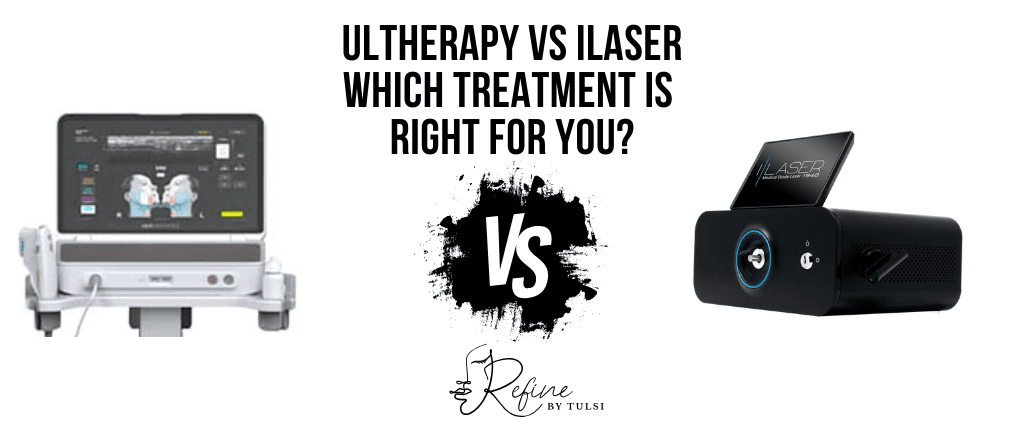
If you’re researching nonsurgical skin tightening options in Chicago, two technologies consistently appear: Ultherapy and I-Laser. Both promise to tighten skin and lift sagging areas without surgery. Both use energy-based technology to stimulate collagen. Both cost thousands of dollars.
But they work through entirely different mechanisms, produce different types of results, and are suited for different patients. More importantly: after evaluating both technologies extensively, Refine by Tulsi made the strategic decision to offer I-Laser at our Lincoln Park and Logan Square locations—and not Ultherapy.
This article will explain exactly why. Not as a sales pitch, but as a physician’s transparent analysis of two competing technologies, what each delivers, and why I believe I-Laser offers superior results for most Chicago patients seeking nonsurgical skin tightening.
Understanding the Core Technologies
Before comparing outcomes, you need to understand the fundamental science behind each approach. Both stimulate collagen, but through completely different mechanisms.
Ultherapy: Focused Ultrasound
Micro-Focused Ultrasound | FDA-Cleared for LiftingThe Technology: Ultherapy delivers focused ultrasound energy to create thermal coagulation points at specific depths (1.5mm, 3.0mm, and 4.5mm) beneath the skin. The deepest setting (4.5mm) targets the SMAS layer—the muscular fascia layer that plastic surgeons address during surgical facelifts.
How It Works: The ultrasound energy heats small, focused areas of tissue to 60-70°C, creating controlled micro-injuries. This thermal damage triggers your body’s wound-healing cascade, producing new collagen over the following 2-3 months. As that collagen matures and contracts, it theoretically creates a lifting effect.
What Makes It Unique: Ultherapy is the only device FDA-cleared with a specific “lifting” indication. It includes ultrasound imaging (the same technology used in prenatal ultrasounds) allowing providers to visualize tissue layers before treatment.
The Reality: Lifting results are modest and highly variable. Success depends on individual healing response, degree of existing laxity, and tissue quality. Many patients see minimal change despite significant cost and discomfort.
I-Laser: 1940nm Diode Laser
1940nm Wavelength | Collagen Tightening & Skin QualityThe Technology: I-Laser uses a 1940nm diode laser wavelength that is specifically absorbed by water in the skin’s collagen matrix. This selective absorption allows precise heating of the dermis to stimulate collagen remodeling while protecting the skin’s surface.
How It Works: The 1940nm wavelength penetrates to the dermal-subcutaneous junction (approximately 2-4mm depth) where it heats water molecules embedded in the collagen structure. This controlled thermal energy causes:
- Immediate collagen contraction (you see some tightening right away)
- Sustained collagen remodeling over the following 3-6 months as your body produces new, organized collagen
- Improved skin texture and quality due to dermal remodeling
- Enhanced dermal thickness which creates a tightening effect
What Makes It Unique: The 1940nm wavelength is highly selective for water, making it extremely safe and effective for collagen remodeling. The technology treats both superficial and deeper layers simultaneously, producing results that affect both skin quality and structural tightness.
The Reality: I-Laser delivers visible, predictable results across a broader range of patients. The tightening effect is gradual but consistent, and the additional benefits to skin texture and quality create comprehensive improvement that Ultherapy cannot match.
The Key Difference
Ultherapy: Creates deep, focused thermal injury at the SMAS layer (4.5mm), relying entirely on your body’s healing response to produce new collagen. Results depend heavily on individual healing capacity. No surface-level benefits.
I-Laser: Uses water-selective wavelength to heat the dermal collagen matrix throughout multiple layers (2-4mm), creating immediate contraction PLUS sustained remodeling. Produces both tightening and skin quality improvement.
Think of Ultherapy as a deep, narrow intervention targeting one specific layer. I-Laser is a broader intervention affecting the entire dermal structure—producing more comprehensive, visible transformation.
Why Refine by Tulsi Chose I-Laser Over Ultherapy
After extensive evaluation, training on both systems, and analyzing patient outcomes from other practices, I made a deliberate choice to invest in I-Laser for our Chicago locations. Here’s my honest reasoning as a physician:
1. More Predictable, Consistent Results
Ultherapy results are wildly variable. Some patients see noticeable improvement; many see minimal to no change. The unpredictability creates patient dissatisfaction despite significant investment.
I-Laser produces consistent results across diverse patients. While individual results vary based on skin quality and aging degree, I can reliably predict noticeable tightening and skin quality improvement for appropriate candidates.
2. Dual Benefits: Tightening + Skin Quality
Ultherapy addresses only one aspect of facial aging: tissue laxity/sagging. It does nothing for texture, tone, pores, or skin quality. Patients are left with (maybe) tighter skin that still looks aged.
I-Laser simultaneously addresses tightening AND skin quality—producing smoother, more refined, younger-looking skin alongside the tightening effect. This comprehensive improvement is what patients actually want when they seek “nonsurgical facelift.”
3. Better Patient Experience
Ultherapy is notoriously painful. Despite numbing cream, most patients rate it 6-8 out of 10 on pain scale. The discomfort is significant enough that some patients refuse repeat treatments even when results are good.
I-Laser, with proper numbing, is much more tolerable (3-4 out of 10). The improved comfort means patients are willing to maintain results with repeat treatments when needed.
4. Superior Cost-to-Value Ratio
At similar price points ($4,000-$5,500), I-Laser delivers substantially more visible transformation. Patients consistently report higher satisfaction with I-Laser results compared to Ultherapy.
The cost-to-benefit analysis clearly favors I-Laser for most patients seeking nonsurgical tightening.
5. Honest Assessment of What Patients Need
Most patients seeking “nonsurgical facelift” don’t have severe enough laxity to benefit dramatically from SMAS-layer targeting (Ultherapy’s selling point). They have mild-to-moderate skin laxity that responds beautifully to dermal remodeling (I-Laser’s strength).
I-Laser treats the degree of aging most Chicago professionals actually have. Ultherapy is overkill that under-delivers for this population.
I initially wanted Ultherapy because I’d seen ads claiming it was the “gold standard.” When I consulted with Dr. Kotecha, she explained that my degree of laxity didn’t warrant SMAS-level treatment, and that I’d see better comprehensive results with I-Laser. She was absolutely right. My skin is noticeably tighter, but also smoother and more refined. Friends say I look 5-7 years younger. I’m so glad I trusted her recommendation instead of just going with the most-marketed option.
The Comprehensive Comparison
| Factor | Ultherapy | I-Laser (1940nm Diode) |
|---|---|---|
| Technology | Focused ultrasound | 1940nm diode laser |
| Primary Mechanism | Deep thermal injury (SMAS layer) | Water-selective dermal heating |
| Depth of Treatment | 4.5mm (SMAS layer) | 2-4mm (dermal-subcutaneous) |
| Skin Tightening | Variable (depends on healing) | Consistent and predictable |
| Skin Quality/Texture | No improvement | Significant improvement |
| Immediate Results | None | Some immediate tightening |
| Final Results Timeline | 2-3 months | 3-6 months (progressive) |
| Discomfort Level | High (6-8/10) | Moderate (3-4/10) |
| Treatment Time | 60-90 minutes | 30-60 minutes |
| Downtime | Minimal (possible swelling) | Minimal (possible redness 1-2 days) |
| Results Predictability | Highly variable | Consistent |
| Areas Treated | Face, neck, brow | Face, neck, body areas |
| Results Duration | 12-18 months | 18-24+ months |
| Patient Satisfaction | Mixed (many underwhelmed) | Consistently high |
| Cost (Chicago) | $3,500-$5,500 | $4,000-$5,500 |
| Value Per Dollar | Fair | Excellent |
Who I-Laser Is Perfect For
Based on hundreds of I-Laser treatments at our Chicago locations, here are the patients who achieve exceptional results:
You’re an Ideal I-Laser Candidate If:
- You have mild-to-moderate skin laxity (early jowls, neck looseness, general loss of firmness)
- You’re age 35-65 with realistic expectations for nonsurgical tightening
- You want improved skin quality (texture, tone) alongside tightening
- You’re seeking predictable, reliable results rather than gambling on variable outcomes
- You prefer treatments with minimal downtime (1-2 days mild redness at most)
- You have sun damage or texture concerns you’d like addressed simultaneously
- You want longer-lasting results (18-24+ months)
When Ultherapy Might Be Considered
I’ll be completely honest: there are narrow scenarios where Ultherapy could be appropriate:
- You have isolated, severe jowls with otherwise excellent skin quality and no texture concerns
- You’re younger (late 30s-early 40s) with very early laxity and perfect skin texture
- You’ve already tried I-Laser and want to add SMAS-layer targeting for additional lift
- You absolutely cannot tolerate even 1 day of redness (though I-Laser downtime is minimal)
However, these represent a small fraction of patients seeking nonsurgical tightening. For the vast majority of Chicago professionals I consult with, I-Laser is the superior choice.
What I-Laser Treatment Looks Like at Refine by Tulsi
When you choose I-Laser at Refine by Tulsi, here’s the complete experience:
Consultation (45 minutes)
- Comprehensive skin assessment and photography
- Discussion of your concerns, goals, and timeline
- Honest evaluation of whether I-Laser is right for you (sometimes it’s not)
- Treatment plan with realistic expectations
- Detailed explanation of what to expect during and after
Treatment Day (30-60 minutes)
- Thorough numbing cream application (30 minutes before treatment)
- Customized laser settings based on your skin type and concerns
- Comfortable treatment with physician performing (not delegated to staff)
- Post-treatment care instructions
- Most patients return to normal activities same day or next day
Results Timeline
- Immediate: Some visible tightening from collagen contraction
- Week 1-2: Any redness resolves, tightening becomes more noticeable
- Month 1-3: Continued improvement as collagen remodeling occurs
- Month 3-6: Peak results as full collagen maturation completes
- 18-24+ months: Results maintain, then gradually diminish
Follow-Up Care
- Check-in at 2 weeks to assess early results
- Follow-up at 3 months to document peak outcomes
- Direct access to Dr. Kotecha with any questions or concerns
- Maintenance plan discussion (some patients do touch-ups at 18-24 months)
The I-Laser treatment was so much easier than I expected. The numbing worked really well—I felt warmth and some tingling but no real pain. I had mild redness that evening and the next day, but by day 2 I was back to work with no one noticing anything. Within 2 weeks I could see my skin was tighter and smoother. By 3 months, the transformation was remarkable. My jawline is more defined, my neck looks tighter, and my overall skin quality is dramatically better.
Integration with Comprehensive Rejuvenation
I-Laser is powerful for skin tightening, but it’s most effective as part of a comprehensive approach. At Refine by Tulsi, we often combine I-Laser with:
- Facial Balancing: Strategic filler placement for volume restoration (I-Laser tightens; fillers restore structure)
- Botox/Dysport: Addressing dynamic lines (forehead, crow’s feet, frown lines)
- Sylfirm X: For pigmentation, redness, or additional collagen stimulation
- Peptide Therapy: Supporting collagen production from within
- Medical-Grade Skincare: Maintaining and enhancing results long-term
The goal is strategic, physician-led planning that addresses all dimensions of facial aging—not just isolated tightening.
Cost and Value
At Refine by Tulsi, I-Laser treatments range from $4,000-$5,500 depending on treatment area.
What You’re Investing In:
- Physician-performed treatment (not delegated to technicians)
- Customized settings for your unique skin and goals
- Comprehensive post-treatment support
- 18-24+ months of visible, predictable tightening
- Improved skin quality and texture alongside tightening
Value Analysis:
I-Laser: $4,500 average / 21 months = $214/month for consistent skin tightening and quality improvement
Compared to alternatives:
- Surgical facelift: $15,000-$30,000 (plus surgical risks, significant downtime)
- Ultherapy: $4,500 / 15 months average = $300/month with variable, often disappointing results
- Regular professional treatments: $200-$400/month with minimal lasting improvement
I-Laser delivers exceptional value: predictable tightening, skin quality improvement, and reasonable cost-per-month for sustained results.
The Bottom Line: Why I-Laser Is Our Choice
After extensive evaluation of both Ultherapy and I-Laser technologies, my conclusion as a physician is clear: I-Laser delivers superior, more predictable skin tightening results for most Chicago patients seeking nonsurgical facial rejuvenation.
Here’s why I chose I-Laser for Refine by Tulsi:
- Consistent, predictable results vs. highly variable Ultherapy outcomes
- Dual benefits (tightening + skin quality improvement) vs. Ultherapy’s singular focus
- Better patient experience (less painful, shorter treatment, faster recovery)
- Longer-lasting results (18-24+ months vs. 12-18 months)
- Superior cost-to-value ratio at similar price points
- Higher patient satisfaction consistently across diverse patients
Ultherapy has its marketing push and FDA clearance for “lifting,” but marketing doesn’t equal results. I-Laser delivers what patients actually want: visible, reliable skin tightening with improved overall skin quality.
I researched every nonsurgical tightening option available in Chicago. Multiple practices pushed Ultherapy hard. But Dr. Kotecha’s honest assessment—that I-Laser would give me better overall results with less pain and more predictability—resonated with me. I trusted her medical judgment over marketing hype. Six months post-treatment, I’m thrilled I made that choice. The tightening is noticeable, my skin quality is dramatically better, and I didn’t endure the significant pain Ultherapy patients describe.
Experience I-Laser at Refine by Tulsi
Ready to explore whether I-Laser is right for your skin tightening goals? Schedule a consultation with Dr. Tulsi Kotecha at our Lincoln Park or Logan Square location for honest, physician-led guidance.
Book Your Consultation Call (618) 298-8574About Dr. Tulsi Kotecha
Dr. Tulsi Kotecha is the founder and medical director of Refine by Tulsi, a physician-led aesthetic and wellness practice with locations in Lincoln Park and Logan Square, Chicago. After extensive evaluation of both Ultherapy and I-Laser technologies, she strategically chose to offer I-Laser based on superior patient outcomes and satisfaction.
Dr. Kotecha specializes in evidence-based facial rejuvenation, facial balancing, and integrative longevity medicine. Her approach prioritizes honest assessment over marketing hype, realistic expectations, and comprehensive strategies addressing the whole person.
Learn more about Dr. Kotecha and her approach to nonsurgical facial rejuvenation.
This article is for educational purposes and does not constitute medical advice. I-Laser and skin tightening treatments should be performed by qualified physicians. Individual results may vary.