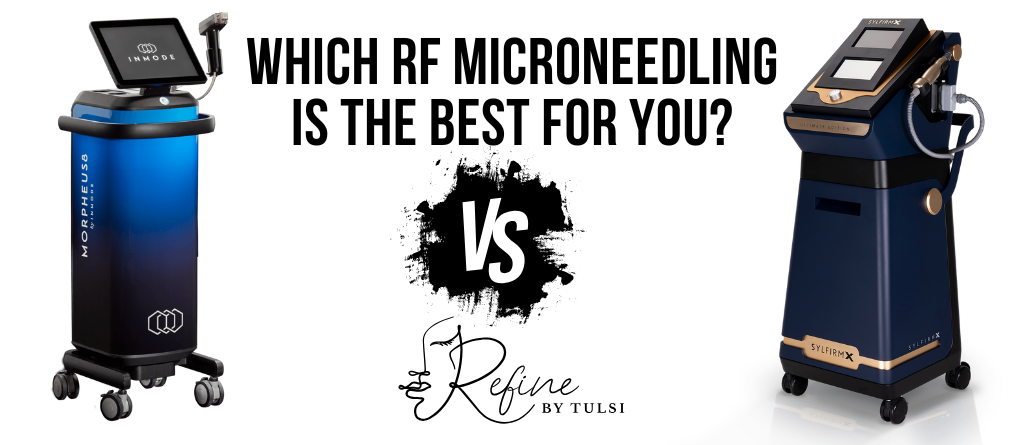
RF microneedling is one of the most effective treatments in modern aesthetics — combining the collagen-stimulating power of microneedling with the deep-tissue remodeling of radiofrequency energy. But not all RF microneedling devices are the same. The three names you’ll see most often — Sylfirm X, Morpheus8, and Potenza — use different technology, treat different depths, and have very different capabilities.
If you’re comparison-shopping (and you should be), the differences matter. Especially if you have melasma, rosacea, or pigmentation concerns — because only one of these devices was designed to treat those conditions safely.
At Refine by Tulsi, we use the Sylfirm X. This guide explains what makes it different — and gives you an honest assessment of all three devices so you can decide for yourself.
What All Three Devices Share
Before the differences, the common ground. All three devices combine microneedling (tiny needles creating controlled micro-injuries in the skin) with radiofrequency energy (heat delivered through those needles into the deeper layers of tissue). This dual mechanism stimulates collagen and elastin production at multiple depths, tightens skin, improves texture, and addresses concerns from fine lines to acne scarring to skin laxity.
All three require a series of treatments (typically 3–4 sessions), involve 2–5 days of downtime (redness, mild swelling), and deliver progressive results over 3–6 months as new collagen builds. They’re all safe for most skin types when used correctly, and they all require an experienced operator to achieve optimal results.
So what’s actually different?
The Key Differentiator: Continuous Wave vs Pulsed Wave
Most RF microneedling devices — including Morpheus8 and Potenza — deliver radiofrequency energy in a continuous wave (CW). This means a steady stream of heat energy from the needle tip into the tissue. It’s effective for collagen remodeling and skin tightening, but it generates significant thermal energy that spreads through surrounding tissue.
Sylfirm X is the only RF microneedling device that offers both continuous wave AND pulsed wave (PW) modes. Pulsed wave delivers RF energy in ultra-short bursts — heating the target tissue while allowing cooling between pulses. This dramatically reduces thermal spread, making it safe for conditions that other RF devices can worsen: melasma, rosacea, and vascular pigmentation.
This dual-wave capability isn’t an incremental improvement — it’s a fundamentally different approach that expands who can be treated and what conditions can be addressed.
Sylfirm X vs Morpheus8 vs Potenza
Three leading RF microneedling platforms. Here’s what each one brings to the table.
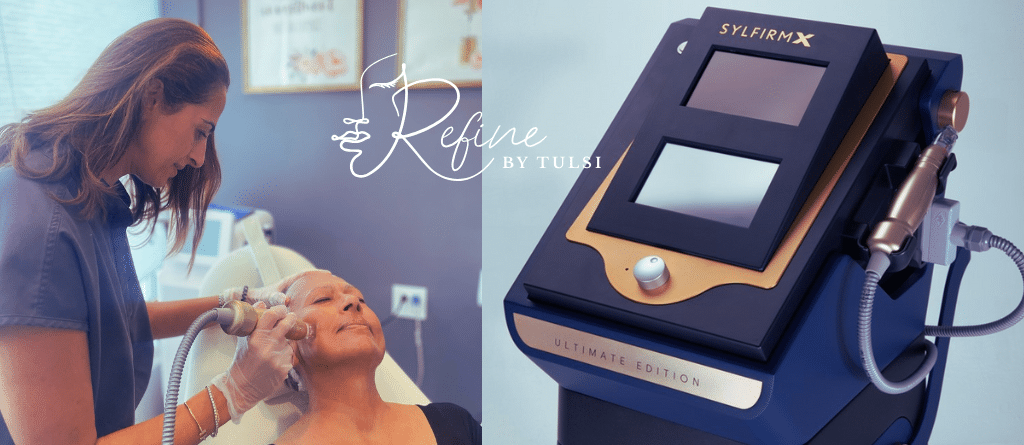
Sylfirm X We Offer
The only RF microneedling device with dual-wave technology — both continuous wave for collagen remodeling and pulsed wave for pigmentation, melasma, and vascular conditions. Treats the widest range of concerns with the highest precision.
Morpheus8
InMode’s RF microneedling platform known for deep tissue penetration. Delivers continuous wave RF at depths up to 8mm (with body tip). Strong for skin tightening and body contouring. Limited by continuous-wave-only delivery.
Potenza
Cynosure’s RF microneedling platform with multiple tip options (monopolar, bipolar, coated, non-coated). Versatile hardware with numerous configurations. Delivers continuous wave RF with some newer tip options for varied energy delivery.
Wondering which RF microneedling device is right for your skin? Book a consultation at refinebytulsi.com/book — we’ll assess your concerns and explain exactly what Sylfirm X can do for you.
The Full Comparison Table
| Factor | Sylfirm X ✓ | Morpheus8 | Potenza |
|---|---|---|---|
| RF energy mode | Pulsed Wave + Continuous Wave | Continuous Wave only | Continuous Wave (mono/bipolar) |
| Max needle depth (face) | 4.0mm | 4.0mm | 3.5mm |
| Melasma treatment | Yes — PW mode targets abnormal vasculature | Not recommended (thermal worsening) | Not recommended |
| Rosacea treatment | Yes — PW mode reduces vascular component | Use with caution | Use with caution |
| Skin tightening | Yes (CW mode) | Yes (strong — deep penetration) | Yes (moderate) |
| Acne scarring | Excellent | Excellent | Good |
| Fine lines/wrinkles | Excellent | Good | Good |
| Body treatment | Face and neck focus | Yes (8mm body tip) | Limited |
| Fitzpatrick IV–VI safety | Safe (PW mode minimizes thermal risk) | Caution required | Caution required |
| Downtime | 1–3 days | 3–5 days | 2–5 days |
| Comfort | Moderate (with numbing) | Moderate-high (deeper penetration) | Moderate (with numbing) |
| Sessions recommended | 3–4 | 3–4 | 3–4 |
Why Pulsed Wave Changes Everything for Melasma and Pigmentation
This is the capability that separates Sylfirm X from every other RF microneedling device on the market — and it deserves detailed explanation because it matters enormously for a large number of patients.
Melasma affects approximately 5 million Americans — disproportionately women, disproportionately patients with darker skin tones. It’s one of the most frustrating skin conditions to treat because most energy-based devices make it worse: the heat they generate stimulates melanocytes to produce more pigment, creating a rebound effect that can be worse than the original condition.
Sylfirm X’s pulsed wave mode was specifically designed to address this. Instead of delivering continuous heat (which stimulates melanocytes), PW mode delivers ultra-short bursts of RF energy that target the abnormal blood vessels feeding pigmentation — without generating enough sustained heat to trigger melanocyte activation.
The mechanism is different from continuous wave in a fundamental way:
- CW mode (all devices) → heats tissue broadly → stimulates collagen + tightening → risks melanocyte activation in pigmentation-prone skin
- PW mode (Sylfirm X only) → targets abnormal vasculature specifically → disrupts the blood supply feeding pigment production → reduces melanin without thermal melanocyte stimulation
This is why we can safely treat melasma, rosacea, and post-inflammatory hyperpigmentation with Sylfirm X at Refine by Tulsi — and why clinics using Morpheus8 or Potenza often have to turn these patients away or risk worsening their condition.
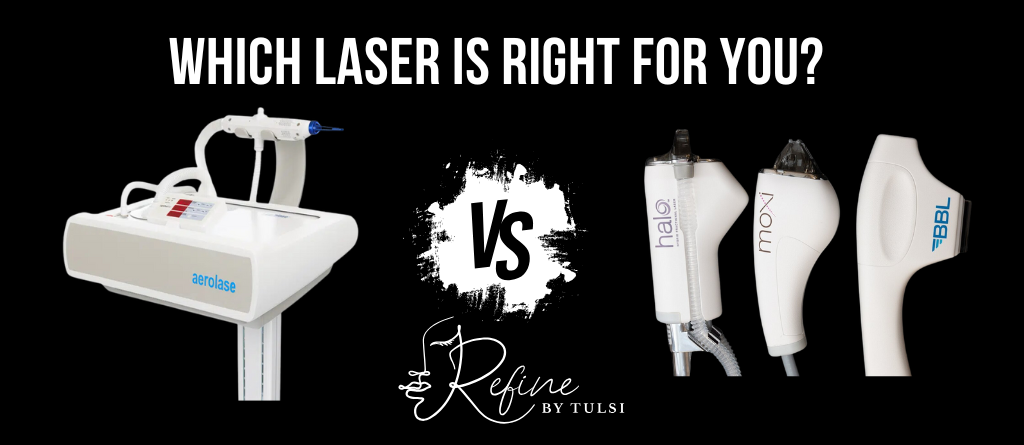
For melasma patients, we typically combine Sylfirm X PW mode with Aerolase (for surface pigment and redness), targeted chemical peels, and medical-grade skincare for a comprehensive pigmentation protocol.
Honest Takes on Each Device
Sylfirm X: Our Choice
Strengths: Only dual-wave RF microneedling device. Treats melasma, rosacea, and pigmentation safely (PW mode) while delivering excellent skin tightening and collagen remodeling (CW mode). Shorter downtime than Morpheus8. Safe across all Fitzpatrick types. Excellent for acne scarring, fine lines, skin tightening, pore size reduction, and overall skin quality improvement.
Limitations: Primarily designed for face and neck. If your primary concern is body skin tightening (abdomen, arms, thighs), Morpheus8’s deeper body tip has an advantage. Sylfirm X’s maximum depth of 4mm is excellent for the face but doesn’t match Morpheus8’s 8mm body capability.
Morpheus8: The Depth Leader
Strengths: Deepest penetration available (up to 8mm with body tip). Strong for skin tightening, particularly on the body. Extensive marketing and clinical data. Good for patients whose primary concern is skin laxity and who don’t have pigmentation or melasma concerns.
Limitations: Continuous wave only — no pulsed wave option. Cannot safely treat melasma, rosacea-related pigmentation, or PIH. Greater downtime than Sylfirm X (3–5 days vs 1–3 days). Higher discomfort level due to deeper energy delivery. Caution required on darker skin tones. The deeper the treatment, the more thermal energy spreads — which increases both downtime and risk.
Potenza: The Versatile Workhorse
Strengths: Multiple tip configurations (monopolar, bipolar, coated, non-coated) provide flexibility. Monopolar tips deliver deeper energy; bipolar tips offer more superficial, precise treatment. Good all-around device for clinics that want one platform to cover various concerns.
Limitations: Continuous wave only — same melasma/rosacea limitations as Morpheus8. Shallower maximum depth (3.5mm) compared to both Sylfirm X (4mm) and Morpheus8 (4mm face). The versatility of tip options can be a disadvantage if the operator doesn’t have deep expertise — more configurations means more room for suboptimal choices.
Which Device Should You Choose?
Choose Sylfirm X if:
- You have melasma or stubborn pigmentation — it’s the only RF microneedling device that can treat these safely
- You have rosacea or redness alongside skin laxity or texture concerns
- You have a darker skin tone (Fitzpatrick IV–VI) and want the lowest-risk RF option
- You want comprehensive facial rejuvenation: tightening + texture + pigmentation + pores
- You want shorter downtime (1–3 days vs 3–5)
- You want to combine with Aerolase, peels, or PRF for a layered protocol
- Your primary treatment area is the face and neck
Consider Morpheus8 if:
- Your primary concern is body skin tightening (abdomen, arms, thighs) — the 8mm body tip is a genuine advantage
- You have no melasma, pigmentation, or rosacea concerns
- You have fair skin and maximum depth of collagen remodeling is the priority
- You’re comfortable with 3–5 days of visible downtime
Consider Potenza if:
- Your provider uses Potenza and has extensive experience with the platform
- You need basic RF microneedling for texture and mild tightening without pigmentation concerns
- You have fair skin with no melasma, PIH, or rosacea
How We Use Sylfirm X at Refine by Tulsi
Sylfirm X is the centerpiece of our skin rejuvenation protocols. We combine it strategically with our full treatment menu:
- Sylfirm X + CO2 Laser Resurfacing — our most powerful combination. Sylfirm X remodels deeper tissue with RF; CO2 resurfaces the epidermis. Together they create synergistic collagen stimulation at every depth. For patients with significant textural damage, scarring, or advanced aging.
- Sylfirm X + Aerolase — Sylfirm X (PW mode) addresses deep pigmentation and vascular issues; Aerolase targets surface redness and pigment. Our go-to melasma and rosacea combination.
- Sylfirm X + PRF or PRP — applying growth factors immediately after RF microneedling amplifies the collagen-stimulating response. Particularly effective for acne scarring and overall skin quality.
- Sylfirm X + GHK-Cu peptide therapy — systemic collagen stimulation (peptide) plus localized RF remodeling. The inside-out plus outside-in approach to skin quality.
- Sylfirm X + SkinBetter Science or Alastin skincare — medical-grade topicals enhance and maintain results between sessions.
Real Patient Experiences
I’d tried Morpheus8 at another clinic for my melasma and it made it significantly worse. The pigmentation darkened and spread after treatment. It took months to calm down. When I found Refine by Tulsi, Dr. Kotecha explained the continuous wave vs pulsed wave difference and why Morpheus8 wasn’t appropriate for my condition. She treated me with Sylfirm X pulsed wave mode and the melasma has improved more in three sessions than it had in two years of topicals. I wish someone had explained this to me before the Morpheus8.
I wanted skin tightening along my jawline and improvement in my acne scars. Dr. Kotecha recommended Sylfirm X in continuous wave mode for the tightening and a combined CW+PW protocol for the scarring. Three sessions in and the texture improvement is dramatic. My pores are smaller, the scars are flattening, and my jawline looks more defined. The downtime was just a day of redness — way less than I expected from RF microneedling.
I’m Black with Fitzpatrick VI skin and I’ve been turned away from RF microneedling at two clinics. They said the risk of hyperpigmentation was too high. Refine by Tulsi was the first practice that said yes — Dr. Kotecha explained that Sylfirm X’s pulsed wave mode was specifically designed to be safe for darker skin tones. I’ve done three sessions now with zero PIH. My skin texture is better than it’s been in years. Representation in device choice matters.
Frequently Asked Questions
How many Sylfirm X sessions do I need?
Most patients see optimal results with 3–4 sessions spaced 4–6 weeks apart. Melasma may require 4–6 sessions. Mild skin tightening and texture improvement may be visible after 2 sessions. We provide a personalized treatment plan based on your specific concerns.
What’s the downtime like?
Typically 1–3 days of redness and mild swelling — similar to a moderate sunburn. Most patients are comfortable returning to work the next day with mineral sunscreen and light makeup. This is shorter than Morpheus8’s typical 3–5 day recovery.
Does it hurt?
We apply topical numbing cream 30–45 minutes before treatment. With numbing, most patients rate discomfort at 3–5 out of 10 — a warm, prickling sensation. The treatment itself takes 20–30 minutes depending on the area.
Can I combine Sylfirm X with filler or Botox?
Yes, with appropriate timing. We typically recommend Sylfirm X before or at least 2 weeks after filler or neurotoxin treatments to avoid displacing product. Your treatment plan will be sequenced appropriately.
How much does Sylfirm X cost at Refine by Tulsi?
Pricing varies based on treatment area and protocol (PW, CW, or combination). Full face sessions typically range from $600–$1,200. Package pricing is available for treatment series. We’ll provide exact pricing during your consultation based on your personalized treatment plan.
Is Sylfirm X better than regular microneedling?
For skin tightening, melasma, rosacea, and deeper collagen remodeling — yes, significantly. The addition of RF energy delivers results that mechanical microneedling alone cannot achieve. Standard microneedling is still excellent for general skin quality, especially when combined with PRF. For many patients, the optimal protocol includes both: Sylfirm X for intensive remodeling sessions and standard microneedling with PRF for maintenance between.
The Bottom Line
All three RF microneedling devices stimulate collagen and improve skin quality. But Sylfirm X’s dual-wave technology gives it capabilities that Morpheus8 and Potenza simply don’t have:
- If you have melasma or pigmentation → Sylfirm X (the only safe RF option)
- If you have rosacea → Sylfirm X (PW mode targets the vascular component)
- If you have darker skin → Sylfirm X (lowest thermal risk)
- If you want tightening + texture + pigmentation in one device → Sylfirm X (dual-wave covers all three)
- If you want shorter downtime → Sylfirm X (1–3 days vs 3–5)
- If your primary concern is body skin tightening → consider Morpheus8 (deeper body tip)
At Refine by Tulsi, we chose Sylfirm X because it lets us treat the widest range of patients and the widest range of conditions — without compromise. When you combine it with CO2 laser, Aerolase, PRF, and peptide therapy, it becomes the centerpiece of a skin rejuvenation strategy that no single device can match alone.
Ready for RF Microneedling That Actually Treats Your Concern?
Schedule your Sylfirm X consultation at our Lincoln Park or Logan Square location. We’ll assess your skin, identify whether pulsed wave, continuous wave, or a combination protocol is right for you, and build a plan that delivers real results.
About Dr. Tulsi Kotecha
Dr. Tulsi Kotecha is the founder and medical director of Refine by Tulsi, a physician-led aesthetic and wellness practice with locations in Lincoln Park and Logan Square, Chicago. She specializes in advanced energy-based treatments, injectable artistry, peptide therapy, and integrative longevity medicine. Learn more about Dr. Kotecha.
This article is for educational purposes and does not constitute medical advice. RF microneedling should be administered under the guidance of a qualified physician. Individual results may vary.