
Hormone Optimization in Chicago
Tested, not guessed. Treated by a physician, monitored over time.
Hot flashes, exhaustion, weight that won't move, low libido, brain fog, broken sleep — for many women and men, these trace back to hormones. Hormone optimization at Refine by Tulsi means real lab testing, an individualized plan using FDA-approved therapies first, and ongoing monitoring — guided by what the current evidence actually supports.
- Lab-Guided
- Women & Men
- Monitored
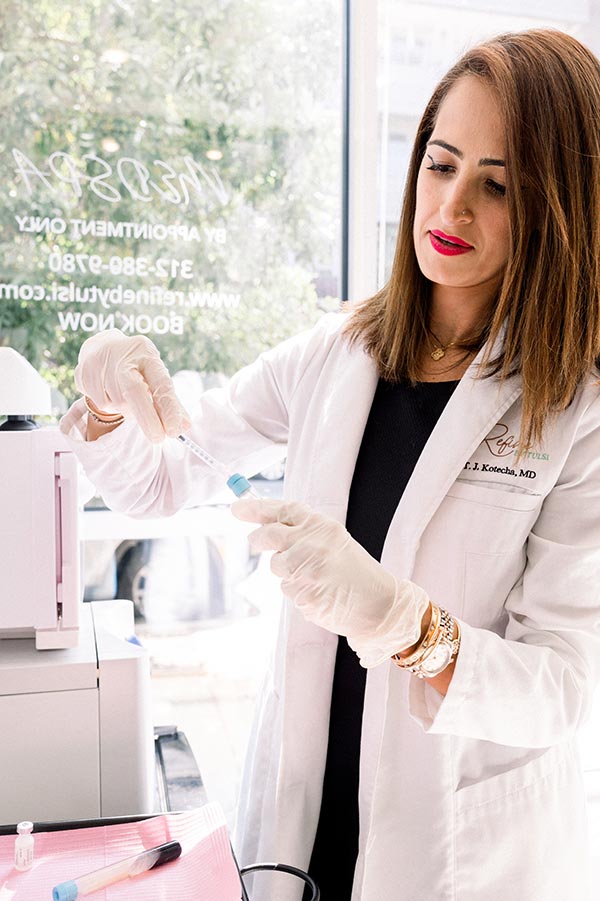
What is hormone optimization?
Hormone optimization is physician-supervised care that restores hormones toward a healthy range when symptoms and lab testing confirm they're off. For women, that usually means menopause and perimenopause hormone therapy — estrogen, progesterone and sometimes testosterone — for symptoms like hot flashes, night sweats, sleep disruption, mood changes and low libido. For men, it means testosterone therapy when symptoms are matched by confirmed low levels on morning labs. At Refine by Tulsi in Chicago, treatment starts with comprehensive testing, uses FDA-approved options first, and is monitored with follow-up labs. It's individualized, results vary, and it works alongside — not instead of — your primary care.
The warning labels came off. Here's what that actually means.
For over twenty years, menopause hormone therapy carried a "black box" warning — the FDA's most serious alert — and it scared a generation of women away from treatment. That guidance came from an early reading of the Women's Health Initiative that we now understand was incomplete.
In November 2025, the FDA announced it would remove those boxed warnings. The change took effect in February 2026.
The warnings about cardiovascular disease, breast cancer and probable dementia were removed from the labels of estrogen-containing hormone therapy products. Updated labeling emphasizes something clinicians have argued for years: timing matters — starting therapy before age 60, or within 10 years of menopause, gives the best balance of benefit and risk.
This does not mean hormone therapy is risk-free, or right for everyone. It means the conversation can finally be an honest, individualized one — which is how we've always approached it. Book a consultation and we'll walk through what it means for you.
Signs your hormones may be the reason
These symptoms are common — and commonly dismissed as stress or age. They're worth testing, because if hormones are the cause, they're treatable.
Perimenopause & menopause
- Hot flashes and night sweats
- Sleep that no longer restores you
- Mood changes, anxiety or irritability
- Brain fog and lost mental sharpness
- Low libido and vaginal dryness or discomfort
- Weight gain — especially around the middle
- Irregular cycles, fatigue and joint aches
Low testosterone
- Persistent fatigue despite adequate sleep
- Low libido or erectile changes
- Loss of muscle and strength
- Increased body fat, especially abdominal
- Low mood, motivation or drive
- Brain fog and poor concentration
- Poor recovery from training
Symptoms alone aren't a diagnosis — plenty of other conditions cause them too. That's why we test before we treat, and why a physician reviews the whole picture.
Hormone therapy for women and men
Two distinct clinical pathways, one standard: test, treat with what's proven, then monitor.
Menopause hormone therapy
Estrogen and progesterone — as patches, gels, sprays, pills or low-dose vaginal estrogen — for hot flashes, night sweats, genitourinary symptoms and sleep. FDA-approved products are proven for these symptoms; some are also approved for osteoporosis prevention. Part of Refine Her.
Testosterone therapy for men
Offered when symptoms are confirmed by two low morning testosterone levels — not on symptoms alone. Benefits can include sexual function, energy, mood, muscle and bone density. Monitored with follow-up labs including hematocrit. Part of Refine Him.
Thyroid & metabolic support
Thyroid and metabolic markers are checked alongside sex hormones, because they drive the same symptoms — fatigue, weight, mood and brain fog. Where weight is the barrier, we can add medical weight management.
How we practice — and what we won't do
Hormones are one of the most over-marketed corners of medicine. Here's exactly where we stand, so you know what you're walking into.
FDA-approved options first
FDA-approved bioidentical hormones exist — estradiol patches, gels and sprays, and micronized progesterone — with known dosing, quality control and safety data. We start there. Compounded formulations are considered only where an FDA-approved option won't work for you.
Honest about "bioidentical"
"Bioidentical" is a marketing term, not a safety guarantee — the FDA and Endocrine Society have both said so. Compounded hormones and pellets are not FDA-approved, and major bodies including ACOG and The Menopause Society advise against their routine use when approved options exist. We won't tell you otherwise.
Tested, then monitored
We treat based on validated blood testing and your symptoms — not saliva panels or a one-size protocol. Then we re-test, because the right dose is the one that keeps working safely for you, and monitoring is how the risks get managed.
If hormone therapy isn't right for you — or if something else is driving your symptoms — we'll tell you that too, and help you find the right care.
Patch, gel, pill, injection — or pellet?
How a hormone is delivered changes how steady it is, how easily it's adjusted, and how well it's studied.
Pellets are marketed hard, and patients ask about them constantly. Here's the straight answer: most hormone pellets are compounded and not FDA-approved, their dosing can be inconsistent, and once implanted they can't be removed if your levels run too high. ACOG and The Menopause Society advise against routine use of compounded hormone therapy — and ACOG specifically recommends against pellets for delivering testosterone. There's no reliable evidence that pellets outperform FDA-approved options. That's why they aren't our default, and why we'd rather have this conversation with you honestly than sell you a convenient story.
An honest look at candidacy
Hormone therapy may suit you if you…
- Have symptoms that match what your labs show
- Are within about 10 years of menopause or under 60 (for women starting therapy)
- Have symptoms plus confirmed low testosterone on morning labs (for men)
- Want an individualized plan with follow-up testing, not a fixed protocol
- Want a physician who'll discuss the real risks alongside the benefits
It may not be right if you…
- Have a history your physician flags — certain cancers, clots or liver disease
- Are pregnant, or (for men) actively trying to conceive
- Have had a thromboembolic event, which calls for real caution
- Want testosterone for anabolic or performance use — that's not what this is
- Expect hormones to fix symptoms that have another cause
Every one of these is a conversation, not a rule. A consultation and the right labs are the only way to know where you land — and your physician will be straight with you either way.
From symptoms to a plan that's monitored
Consultation
A physician takes your symptoms seriously, reviews your history and risk factors, and decides what's worth testing.
Comprehensive labs
Blood testing of sex hormones, thyroid and metabolic markers — men's testosterone confirmed on morning draws — so we treat data, not guesses.
Your plan
Your physician builds an individualized plan using FDA-approved therapies first, and reviews the benefits, risks and alternatives with you.
Re-test & adjust
Follow-up labs and symptom review confirm the dose is working and safe. Your plan is adjusted over time — this is ongoing care, not a prescription.
Two physicians, one standard of care

Dr. Tulsi Kotecha, MD
Board-certified in Internal Medicine and Aesthetic Medicine and trained at University College London and the University of Bristol, Dr. Kotecha built Refine around regenerative and longevity medicine — and around telling patients the truth about what the evidence supports.

Dr. Laura Ruof
Dr. Ruof leads Refine's longevity and hormone-optimization programs, specializing in menopause, metabolic health and whole-body vitality — integrating advanced diagnostics with evidence-based care for energy, sleep, clarity and long-term health.
Hormone therapy in Chicago, answered
What is hormone optimization?
Hormone optimization is physician-supervised care that restores hormones toward a healthy range when your symptoms and lab testing confirm they're off. For women it usually means menopause or perimenopause hormone therapy; for men it means testosterone therapy when symptoms are matched by confirmed low levels. It starts with comprehensive blood testing, uses FDA-approved therapies first, and is monitored with follow-up labs.
Did the FDA remove the black box warning on hormone therapy?
Yes. In November 2025 the FDA announced it would remove the boxed warnings from menopausal hormone therapy products containing estrogen, and the change took effect in February 2026. The warnings about cardiovascular disease, breast cancer and probable dementia were removed, and updated labeling emphasizes that benefits are most favorable when therapy begins before age 60 or within 10 years of menopause. One boxed warning remains: endometrial cancer risk for systemic estrogen-alone products.
Is hormone therapy safe?
For most healthy women who start near the onset of menopause, the benefits generally outweigh the risks — which is why the FDA removed the broad boxed warnings in 2025. But safe doesn't mean risk-free or right for everyone. Risk depends on your age, how long since menopause, the dose and route, and your health history, including any history of certain cancers or blood clots. That's a conversation to have with a physician who knows your labs.
Are bioidentical hormones or pellets better?
Not necessarily. "Bioidentical" is a marketing term, and the FDA and Endocrine Society have both said so — importantly, FDA-approved bioidentical options already exist, like estradiol patches and micronized progesterone. Compounded hormones and pellets are not FDA-approved, their dosing can be inconsistent, and pellets can't be removed if levels run high. ACOG and The Menopause Society advise against routine use of compounded hormone therapy when approved options exist, and ACOG specifically advises against pellets for testosterone.
Do you offer testosterone therapy for men?
Yes, where it's clinically indicated. Testosterone therapy is offered to men who have symptoms and confirmed low testosterone on two morning blood draws — not on symptoms alone, and never for anabolic or performance use. Your physician reviews benefits, risks and alternatives, and monitors you with follow-up labs including hematocrit. Large trial evidence has been reassuring on cardiac safety in men for whom therapy is indicated, but it isn't risk-free, so appropriate selection and monitoring matter.
When is the best time to start hormone therapy?
For women, the evidence points to a window: starting before age 60 or within about 10 years of the onset of menopause gives the most favorable balance of benefit and risk, and the FDA's updated labeling now reflects that age-specific guidance. Starting later isn't automatically off the table, but the calculation changes — so it's worth having the conversation sooner rather than waiting out your symptoms.
How do you test hormones?
With validated blood testing, interpreted alongside your symptoms and history. For women that typically includes sex hormones plus thyroid and metabolic markers; for men, testosterone is confirmed on two fasting morning draws, since levels vary through the day. We don't base treatment on saliva panels, which aren't recommended for guiding hormone dosing. After treatment starts, we re-test to confirm the dose is working and safe.
Does this replace my primary care or gynecologist?
No. Hormone optimization at Refine works alongside your primary care and gynecologic care — it doesn't replace them, and it isn't a substitute for primary or emergency care. Keep your regular physician for general health, screenings like mammograms and any acute or serious medical needs. We're glad to coordinate so everyone is working from the same picture.
How do I get started, and how much does it cost?
Start with a consultation in Lincoln Park or Logan Square. Your physician reviews your symptoms and history, orders the right labs, and builds a plan once results are back. Hormone care is also included in our Refine Her and Refine Him memberships, which bundle consults, lab panels and ongoing optimization. Pricing depends on the plan and any labs or medications, and is confirmed at your consultation.
Stop guessing. Get your hormones tested and read properly.
Book a consultation with a Refine physician in Chicago. We'll test what matters, tell you honestly what the results mean, and build a plan only if it's the right call for you.
(618) 298-8574Chicago, IL 60614
Chicago, IL 60647
Medical disclaimer: This page is general educational information, not medical advice, diagnosis or a guarantee of outcome, and it is not a substitute for primary, gynecologic or emergency care. Hormone therapy is prescribed only after medical evaluation and laboratory testing, and only where clinically appropriate; benefits, risks, contraindications and monitoring are reviewed individually with your physician, and results vary. Regulatory and labeling guidance for hormone therapy changed in 2025–2026 and continues to evolve — your physician will discuss the current guidance as it applies to you. Compounded hormone preparations, including pellets, are not FDA-approved, and major medical organizations advise against their routine use when FDA-approved options exist. Testosterone therapy is not offered for anabolic or performance-enhancing use. Please consult a qualified physician about your individual health.