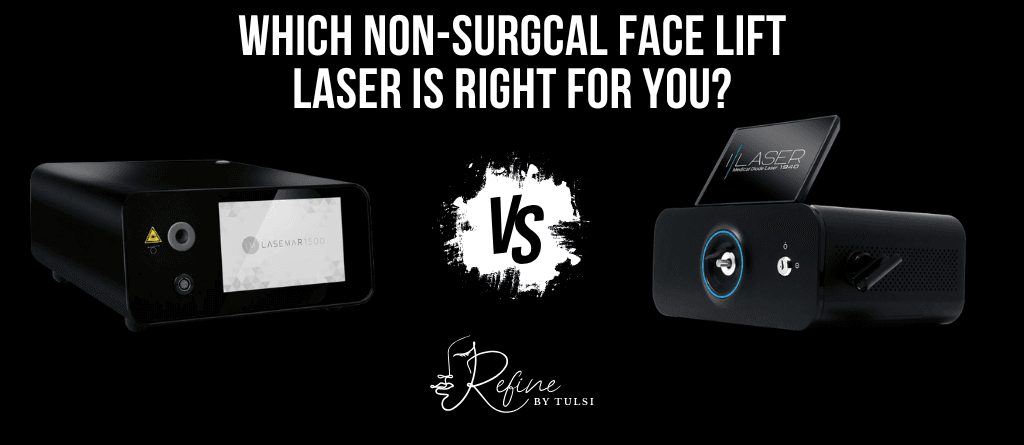
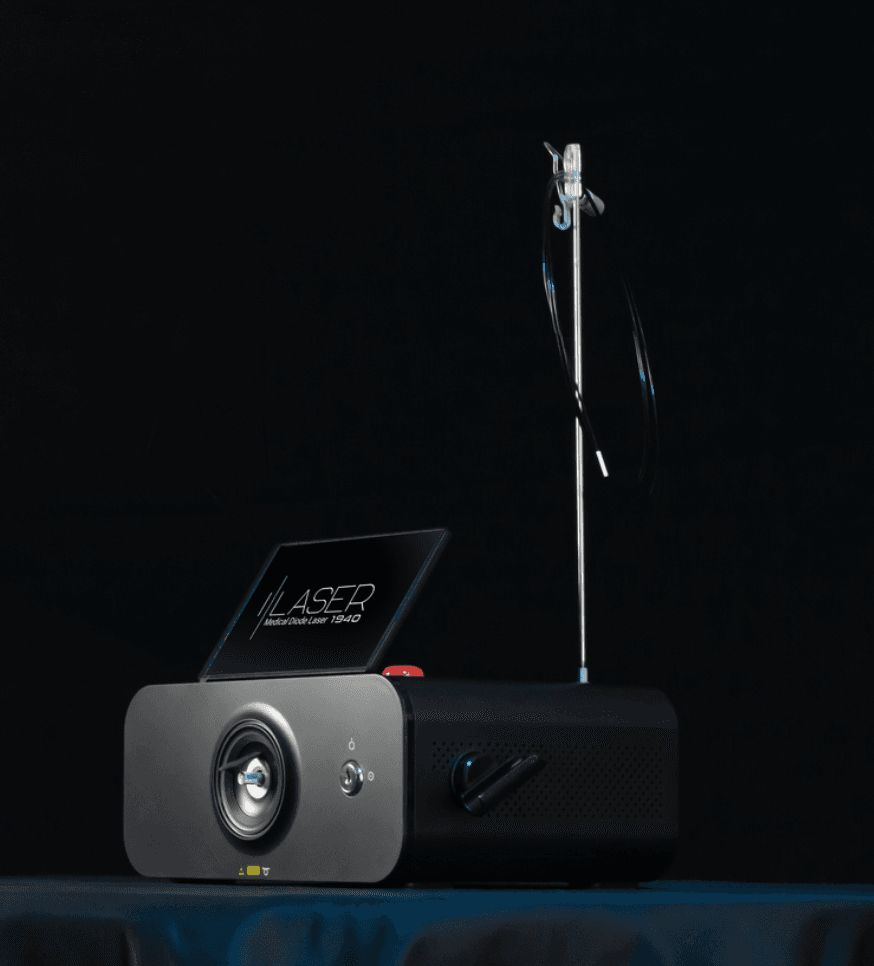
Same idea — a laser lift under the skin, no surgery. Different wavelength. Here’s the one we use.
If you’ve been researching Endolift in Chicago, you’re looking for a minimally-invasive laser that tightens skin and reduces localized fat without a scalpel. Refine by Tulsi offers exactly that category of treatment with the physician-performed iLaser 1940 — the same approach, delivered at a different laser wavelength. This page compares the two honestly, so you can decide with real information.
- Physician-Performed
- No Surgery
- Face · Body · Eyes
What’s the difference between Endolift and the iLaser 1940?
They’re the same type of treatment — a minimally-invasive laser lift that works beneath the skin through a hair-thin fiber, with no surgery, to tighten skin and reduce localized fat. The main difference is the laser wavelength. Endolift® uses a 1470 nm laser; Refine by Tulsi uses the iLaser 1940 at 1940 nm — a wavelength absorbed more strongly by water, which concentrates its energy for precise, controlled tightening. If you were researching Endolift in Chicago, the iLaser 1940 is our physician-preferred option for a non-surgical facelift and body tightening. Both are FDA-cleared devices (which is not the same as “FDA-approved”), results build gradually and vary, and neither replaces a surgical facelift for significant sagging.
1470 nm vs 1940 nm — what it actually means
Both wavelengths heat tissue to tighten skin and reduce fat. They just do it with slightly different emphasis, because of how light of each wavelength is absorbed.
Absorbed by water and fat
The 1470 nm wavelength is taken up by both water and lipids and penetrates a little deeper, which gives it a strong affinity for reducing localized fat while it tightens — a reason it’s well known for the lower face and jawline.
Deeper · fat affinityAbsorbed more strongly by water
The 1940 nm wavelength is absorbed by water much more strongly, so its energy is deposited more precisely and in a more controlled way — well suited to targeted, measured skin tightening, while still addressing localized fat and cellulite.
Precise · controlled tighteningNeither wavelength is universally “better.” Both are excellent, FDA-cleared tools — what matters most is the wavelength matched to your goal, and the physician performing the treatment.
Endolift vs the iLaser 1940
An honest, feature-by-feature look at how the two compare.
The wavelength is only half of it
Two things decide how a laser lift turns out: the right tool, and the right hands. Here’s why the iLaser 1940 earns its place at Refine.
Precise, controlled tightening
The 1940 nm wavelength’s strong water absorption lets us place energy exactly where we want it — a measured, controlled approach that suits delicate, visible areas.
One laser, many areas
We use the iLaser 1940 for a non-surgical facelift and jawline, for body tightening with localized fat and cellulite, and even around the eyes — so your plan is built around you, not one zone.
Physician-performed, honestly scoped
Dr. Kotecha performs the treatment and will tell you plainly when a laser lift fits — and when your sagging calls for a surgical facelift instead.
Bottom line: whether a page calls it Endolift or iLaser, you’re choosing a minimally-invasive laser lift. We’d rather you choose it for the right reasons — the wavelength matched to your goal, and a physician you trust.
A non-surgical lift — for face and body
The same minimally-invasive laser, applied to the areas that most often make people look older or heavier than they feel.
Non-surgical facelift
Softening a loose jawline, jowls and under-chin fullness, and tightening the lower face — a non-surgical lift for mild-to-moderate laxity.
Body tightening
Firming lax skin and reducing localized fat and cellulite on areas like the abdomen, arms and knees — explore skin tightening & body.
Non-surgical blepharoplasty
The same precise laser, used gently to tighten mild hooding and crepey eyelid skin — see non-surgical blepharoplasty.
An honest look at candidacy
A laser lift may suit you if you…
- Have mild-to-moderate skin laxity on the face, jawline, neck or body
- Have small, localized pockets of fat rather than overall weight to lose
- Want real tightening without surgery, incisions or long downtime
- Were considering Endolift and want a physician-performed equivalent
- Have realistic expectations about a gradual, non-permanent result
Surgery may suit you better if you…
- Have significant, heavy sagging or a lot of excess skin
- Want a dramatic, long-lasting, one-time correction
- Are looking for weight loss rather than localized contouring
- Have a condition or medication that makes a laser procedure unwise
- Need a true lift of deeper facial structures, not skin tightening
A consultation settles it. Your physician will tell you honestly whether the iLaser 1940 will meet your goals — or whether a surgical option is the better investment.
From consultation to a lifted look
Consultation
A physician maps your concern areas, confirms the iLaser 1940 is right for you, and sets honest expectations.
Comfort
The area is numbed with local anesthesia; most people are comfortable and awake throughout.
The treatment
A hair-thin fiber delivers 1940 nm energy beneath the skin through tiny entry points — no incisions.
Recovery & results
Expect a few days of swelling or bruising. Tightening is partly immediate and builds over 3–6 months.
The hands matter as much as the laser

Dr. Tulsi Kotecha, MD
Board-certified in Internal Medicine and Aesthetic Medicine and trained at University College London and the University of Bristol, Dr. Kotecha performs the iLaser 1940 herself — because with a minimally-invasive laser, technique and judgment decide the result. Her approach is natural, conservative and honest: the right wavelength, in the right plane, for the right candidate — and a straight answer when surgery is the better path.
More about Dr. KotechaYour questions, answered honestly
What’s the difference between Endolift and the iLaser 1940?
They’re the same type of treatment — a minimally-invasive laser lift that works beneath the skin through a hair-thin fiber to tighten skin and reduce localized fat, with no surgery. The main difference is the laser wavelength: Endolift® uses 1470 nm, while the iLaser 1940 uses 1940 nm, which is absorbed more strongly by water for precise, controlled tightening. Both are FDA-cleared devices, both are done under local anesthesia, and both give gradual results.
Do you offer Endolift at Refine by Tulsi?
We offer the same category of treatment using the iLaser 1940 rather than the Endolift® system. If you came across Endolift while researching a non-surgical laser lift, the iLaser 1940 is our physician-performed equivalent in Chicago — a minimally-invasive subdermal laser that tightens skin and reduces localized fat, just at the 1940 nm wavelength instead of 1470 nm.
Is the iLaser 1940 as good as Endolift?
Both are excellent, FDA-cleared, minimally-invasive laser lifts, and neither is universally “better.” They use different wavelengths with slightly different emphasis — 1470 nm penetrates a little deeper with strong fat affinity, while 1940 nm is absorbed more strongly by water for precise tightening. What determines your result more than the brand name is the wavelength matched to your goal and the skill of the physician performing it, which is why we keep ours physician-performed.
What does the 1470 nm vs 1940 nm wavelength difference actually mean?
Wavelength changes how the laser’s energy is absorbed in tissue. At 1470 nm, energy is taken up by both water and fat and travels a little deeper, which lends itself to fat reduction alongside tightening. At 1940 nm, energy is absorbed by water much more strongly, so it’s deposited more precisely and in a more controlled way — well suited to measured skin tightening while still addressing localized fat and cellulite. Both heat tissue to stimulate collagen; the emphasis just differs.
Is this a surgical facelift?
No. A laser lift — whether Endolift or the iLaser 1940 — is a minimally-invasive, non-surgical treatment that tightens skin and reduces small pockets of fat. “Non-surgical facelift” is a nickname, not surgery. It suits mild-to-moderate laxity and does not reposition deeper facial structures or remove large amounts of excess skin the way a surgical facelift does. When your sagging is significant, we’ll tell you surgery is the better option.
What areas can the iLaser 1940 treat?
We use it across the face and body: the lower face and jawline for a non-surgical lift, under-chin fullness, and the neck; the abdomen, arms, knees and other areas for skin tightening with localized fat and cellulite; and, used gently, around the eyes for mild eyelid tightening. Your physician builds a plan based on your anatomy and goals during the consultation.
Is it FDA-approved?
The iLaser 1940 is an FDA-cleared laser device, as is the Endolift® system — and “FDA-cleared” is not the same as “FDA-approved.” No laser lift can be marketed as an FDA-approved cure for aging or sagging, and we’re precise about that language. What matters is that the treatment is performed by a physician, on appropriate candidates, with honest expectations.
What’s the downtime, and when will I see results?
Most people have a few days of swelling and possible bruising around the treated area, far less than a surgical facelift but not zero. You may notice some tightening early, but the fuller result builds gradually over roughly three to six months as your skin remodels collagen. Because it works with your own collagen rather than removing tissue, results are not permanent, and they vary from person to person.
Researching Endolift? Meet your Chicago option.
Book a consultation to see whether the iLaser 1940 is the right non-surgical laser lift for your face or body — with a physician who’ll give you a straight comparison and an honest answer.
(618) 298-8574Chicago, IL 60614
Chicago, IL 60647
Medical disclaimer & trademark notice: Endolift® is a trademark of its respective owner; Refine by Tulsi is not affiliated with, sponsored by, or endorsed by it, and references to Endolift are made only to compare similar treatments. “Non-surgical facelift” and “non-surgical blepharoplasty” are descriptive nicknames for minimally-invasive laser skin-tightening treatments; they are not surgery and not equivalent to a surgical facelift or eyelid surgery. The iLaser 1940 is an FDA-cleared laser device — “FDA-cleared” is not the same as “FDA-approved,” and no specific outcome is promised. These treatments are intended for mild-to-moderate skin laxity and localized fat, are not a weight-loss treatment, and results are gradual, not permanent, and vary by individual; minimally-invasive laser procedures carry risks including swelling, bruising, and, less commonly, changes in skin pigmentation or texture. All treatments require an in-person medical evaluation and are provided only where clinically appropriate; when surgery is more suitable, a referral is recommended. This page is general educational information, not medical advice. Please consult a qualified physician about your individual care.