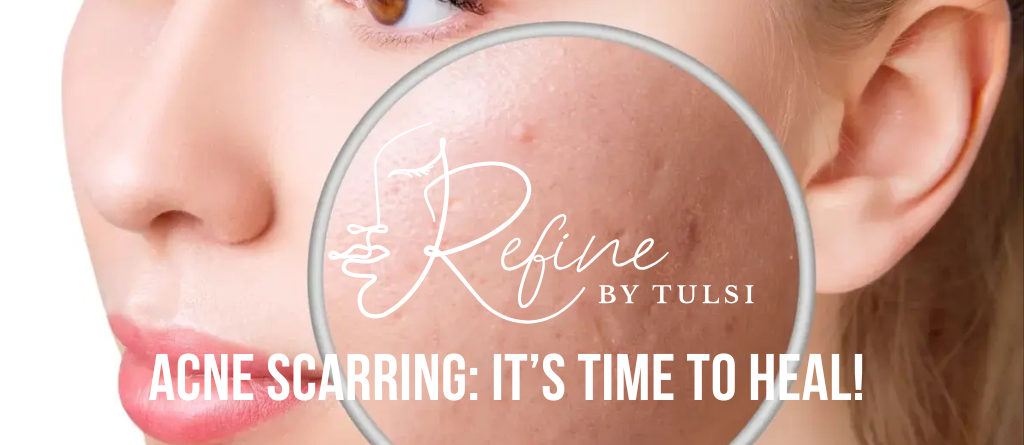
The 5 Types of Acne Scars — and How Each Is Treated
Most patients have more than one type. Identifying which you have is not academic — it determines which treatments will work and which will waste your money.
Why the type matters more than the treatment
Acne scars form when a breakout penetrates deeply enough to damage the tissue beneath the surface. As the skin heals, it either loses collagen — leaving an indentation — or overproduces it, leaving a raised scar. Separately, inflammation can leave discoloration behind without changing the skin’s texture at all.
Acne scarring is a depth problem. Resurfacing a tethered scar will not lift it, and releasing a tether will not smooth surface texture.
That is the single most useful thing to understand. A laser that treats the surface beautifully will do almost nothing for a scar anchored to the tissue below it. Below, each type — and what actually addresses it.
1. Ice-pick scars
Narrow, deep, V-shaped punctures extending well into the dermis. They look like small, sharp holes, are often less than 2mm across, and are the most stubborn to treat because their depth exceeds what most surface treatments reach.
Best addressed by: CO₂ laser resurfacing and fractional depth work. Some very deep ice-pick scars are better served by punch excision than by resurfacing.
2. Boxcar scars
Broad depressions with sharp, defined vertical edges — shallow craters, most common on the cheeks and temples. The defined edge is what makes them visible: light catches the rim.
Best addressed by: CO₂ laser resurfacing and Sylfirm X RF microneedling , which soften the edges and stimulate collagen to raise the floor of the scar.
3. Rolling scars
Wide, shallow, wave-like depressions that give the skin an undulating appearance. Crucially, rolling scars are caused by fibrous bands tethering the skin downward to the tissue beneath. The surface itself may be relatively normal.
You can resurface a rolling scar perfectly and it will still look depressed, because the problem is not the surface — it is the anchor pulling it down.
This is what subcision addresses, and it is the reason subcision has no substitute among the laser and microneedling options.
Best addressed by: subcision to release the bands, followed by PRF or Sculptra to prevent re-adhesion.
4. Hypertrophic and keloid scars
Raised, firm scars caused by collagen overproduction during healing. More common on the chest, back, and jawline than on the face. Keloids extend beyond the original wound boundary; hypertrophic scars stay within it.
Best addressed by: steroid injection, laser therapy, and physician assessment first. These respond to entirely different treatments than atrophic scars, and aggressive resurfacing can worsen them.
5. Post-inflammatory pigmentation and erythema
These are not true scars. The skin’s texture is intact — what remains is colour.
Post-inflammatory hyperpigmentation (PIH)
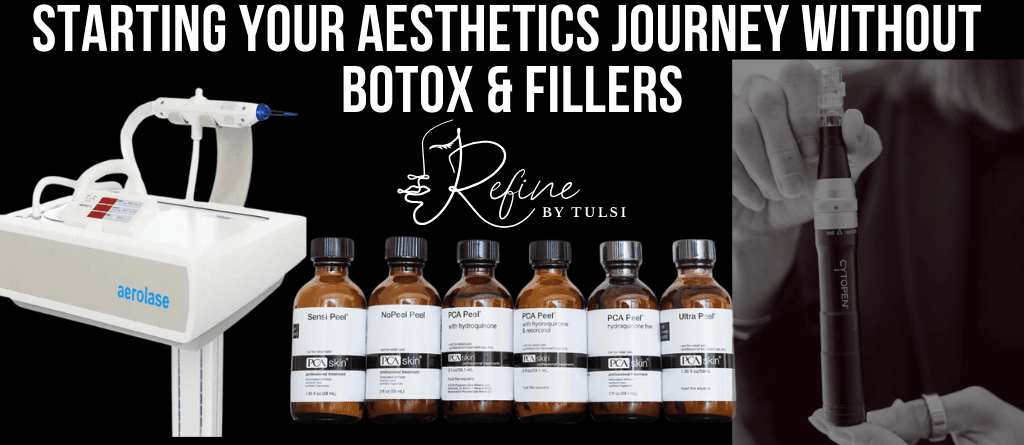
Flat brown or dark marks left after a breakout, more common and more persistent in deeper skin tones. Best addressed by: Aerolase NeoClear® and chemical peels selected for your skin tone.
Post-inflammatory erythema (PIE)
Pink or red flat marks caused by residual vascular dilation, more common in lighter skin tones. Best addressed by: vascular-targeting laser therapy.
Aggressive lasers carry a genuine risk of worsening pigmentation in deeper Fitzpatrick types. Device selection, conservative depth settings, and pre-treatment priming are not optional refinements here — they are the difference between improvement and harm.
What to do next
Most patients have a combination — boxcar scars on the temples, rolling scars on the cheeks, and lingering pigmentation from last year’s breakouts. A good plan sequences treatments rather than stacking them, with healing time between.
And one honest expectation: scarring is improved, not erased. Substantial smoothing and evenness are realistic. Perfection is not, and anyone promising it is selling something.
Frequently asked questions
Examine your skin under angled light rather than straight-on illumination — shadows reveal depth and edges that flat light hides. Ice-pick scars look like sharp small holes, boxcar scars have defined vertical edges, and rolling scars create a wave-like undulation. Most people have more than one type, which is why an in-person assessment is worthwhile.
Ice-pick scars are generally the most stubborn because their depth exceeds what most surface treatments reach. Very deep ice-pick scars may be better served by punch excision than by resurfacing.
No. Scarring is meaningfully improved rather than erased. Most patients see substantial smoothing and evening of texture and tone with a well-sequenced plan. Combination therapy consistently outperforms any single treatment.
Usually not. Post-inflammatory hyperpigmentation and erythema are colour changes, not textural scars — the skin’s surface is intact. They respond to different treatments than true atrophic scars, and many fade over time with sun protection alone.
Yes. Treating scars while breakouts are ongoing creates new scarring and complicates healing. Active acne should be well controlled first — sometimes with Aerolase, which can address active acne and scarring together.
Let’s map your scars.
Book a consultation with Dr. Kotecha for an honest assessment of your scar type, your options, and realistic expectations.
Book a Consultation Acne Scar Treatment Chicago (618) 298-8574Medical disclaimer: This article is for general educational purposes and is not medical advice, diagnosis, or treatment. It does not establish a physician-patient relationship. Treatments described are provided only after an in-person medical evaluation and are not appropriate for everyone. Dosing ranges, timelines, and pricing reflect typical figures and vary by individual. Individual results vary. Regulatory status of compounded substances changes; verify current status with your physician. Please consult a qualified healthcare provider before beginning any therapy.