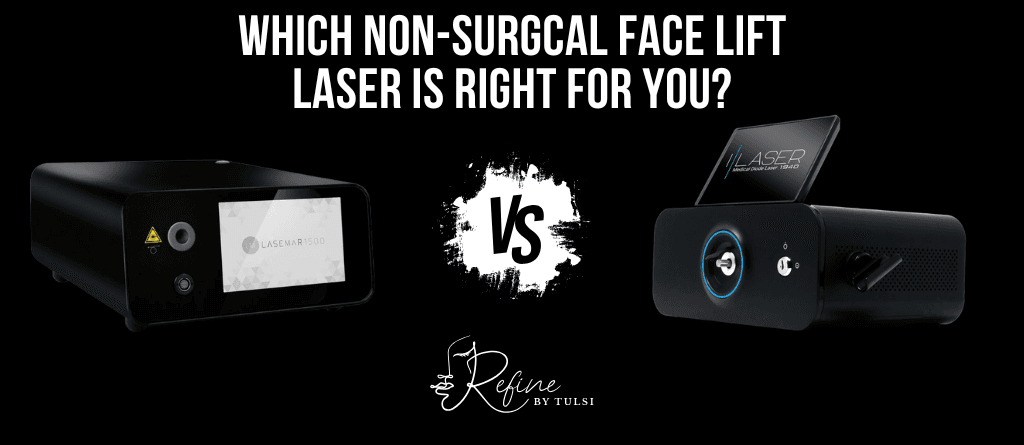
iLaser After GLP-1 Weight Loss: Tightening Loose Skin on the Face and Body — Without Surgery
You did the hard thing. You lost the weight on Ozempic, Wegovy, Mounjaro, or Zepbound, and the number on the scale finally reflects the work. But now there’s a new frustration nobody warned you about: the skin. Loose along the jaw and neck. Crepey on the arms. Sagging on the abdomen and thighs. The body you worked for is hidden under skin that hasn’t caught up.
This is one of the most common — and least discussed — consequences of rapid GLP-1 weight loss. And it leaves people stuck between two unappealing options: live with it, or undergo surgery. There’s a third path. At Refine by Tulsi, the iLaser tightens loose skin on both the face and the body non-surgically — no incisions, no scars, dramatically less downtime. This guide explains how it works for post-weight-loss skin specifically.
Why GLP-1 Weight Loss Leaves Loose Skin
Your skin is elastic, but it has limits. When it’s stretched over a larger body for years and then that volume disappears — especially quickly — the skin often can’t retract fully to fit the smaller frame. What’s left is laxity: loose, sometimes crepey skin that hangs or folds where it used to be taut.
GLP-1 medications make this especially common for a few reasons:
- The weight loss is often rapid and significant. The faster and larger the loss, the less time skin has to adapt, and the more laxity results.
- Collagen and elastin may already be declining. For patients over 40, the skin’s natural retraction ability is reduced — so it doesn’t “shrink back” the way younger skin might.
- Fat loss is global. GLP-1 medications reduce fat everywhere, including the face, arms, and areas where deflation shows most as loose skin.
- Muscle can be lost too. Without protein and resistance training, some lean mass is lost alongside fat, worsening the deflated, loose appearance.
Face and Body Are the Same Problem
The loose skin on your body and the gaunt, hollow look on your face (“Ozempic face”) are two faces of the same phenomenon: skin left behind when volume deflates faster than skin can retract. That’s why a complete approach treats both — and why iLaser, which works on face and body alike, is such a useful tool for GLP-1 patients.
How iLaser Tightens Post-Weight-Loss Skin
Laser skin tightening works by delivering controlled thermal energy into the deeper layers of the skin. That heat does two things at once: it causes existing collagen fibers to contract immediately — a subtle, instant tightening — and it triggers a wound-healing response that stimulates the production of new collagen and elastin over the following months.
For skin that’s lost its taut fit after weight loss, this is exactly the mechanism needed: it prompts the skin to rebuild its own structural support and retract, firming and smoothing progressively as the new collagen forms. The result builds over 2–3 months and looks natural precisely because it develops gradually — your own tightened skin, not a surgical pull.
Where iLaser Helps After GLP-1 Weight Loss
On the Face & Neck
- Loose skin along the jawline and lower face
- Crepey, sagging skin on the neck
- Overall firmness and subtle lifting
- Skin quality alongside Ozempic face volume restoration
- Tone, texture, and resurfacing
On the Body
- Loose, crepey skin on the arms
- Laxity on the abdomen after weight loss
- Sagging skin on the thighs
- Crepiness on the décolletage and chest
- Tone and texture improvement
The Non-Surgical Sweet Spot
iLaser is ideal for mild to moderate skin laxity — the kind that bothers you but isn’t severe. For very large amounts of hanging skin after major weight loss (think 100+ pounds), surgical skin removal may still be the better answer, and we’ll tell you honestly at consultation. But for the large majority of GLP-1 patients — those with moderate loosening, not extreme excess — laser tightening offers real improvement without the scars, anesthesia, and weeks of recovery that surgery requires.
When to Start — Timing Matters
One of the most valuable things about being treated by a physician who manages both your weight loss and your skin is timing. There are two strategies, and the right one depends on where you are:
Starting skin-supporting treatments while you’re still losing helps the skin adapt as it goes, reducing the laxity you’re left with. Paced weight loss, protein and muscle preservation, and collagen support all help the skin keep up. Prevention is always easier than correction.
For tightening the laxity that’s already developed, it’s generally best to treat once your weight has stabilized, so the skin isn’t a moving target. iLaser then firms and remodels the skin to fit your new, maintained frame.
This is exactly why coordinated, physician-supervised weight loss beats a disconnected telehealth prescription: your provider can plan the skin strategy alongside the weight loss instead of leaving you to deal with the aftermath alone.
What to Expect
Most patients feel warmth during treatment and may have redness afterward, depending on the protocol intensity. Because results come from newly stimulated collagen, they build gradually rather than appearing overnight — a natural-looking improvement that develops over the months following treatment. Your specific protocol, downtime, and number of sessions are tailored to your skin, the area, and your goals at consultation.
Left with loose skin after your GLP-1 weight loss? Book a consultation at refinebytulsi.com/book. We’ll assess your skin on the face and body and tell you honestly what iLaser can do — and whether it’s the right tool for you.
iLaser Is Part of a Complete Post-Weight-Loss Plan
Skin laxity after weight loss rarely travels alone — it usually comes with lost volume and reduced skin quality. That’s why the best results come from a layered plan rather than any single treatment:
- Restore lost volume. On the face, collagen biostimulators like Sculptra and targeted dermal filler rebuild the structure that deflated — the foundation iLaser then tightens over.
- Tighten and firm the skin. iLaser for face and body laxity, often paired with RF microneedling (Sylfirm X), which tightens through a complementary mechanism.
- Support collagen from within. GHK-Cu peptide therapy, good protein intake, and IV nutrient support help the skin rebuild and maintain results.
- Coordinate with your weight management. Keeping your weight stable and preserving muscle protects and prolongs every skin result.
This whole-picture approach — volume, skin tightening, and internal support together — is exactly how we treat Ozempic face and the broader effects of GLP-1 weight loss. iLaser is the non-surgical tightening piece that makes the body results as satisfying as the number on the scale.
Real Patient Experiences
I lost 60 pounds on Mounjaro and was thrilled — until I saw the loose skin on my arms and stomach. I thought my only option was surgery. Dr. Kotecha treated the areas with iLaser and over a couple of months the skin firmed up noticeably. It’s not surgery-level, but the improvement made me finally feel comfortable in my new body. No scars, minimal downtime.
The skin on my neck and jawline went loose after my weight loss, and my face looked hollow on top of it. Dr. Kotecha coordinated the whole thing — filler to restore the volume, iLaser to tighten the skin. Treating both at once is what made it look natural instead of just ‘less saggy.’ I wish more people knew this was possible without going under the knife.
Frequently Asked Questions
Will iLaser tighten loose skin from major weight loss?
For mild to moderate laxity — yes, it can meaningfully firm and improve skin on both the face and body. For very large amounts of hanging skin (typically after 100+ pounds of loss), surgical removal may still be necessary. We assess honestly at consultation and tell you which category you’re in.
Can it really treat body areas, not just the face?
Yes. Laser tightening can improve loose, crepey skin on the arms, abdomen, thighs, neck, and chest — making it one of the few non-surgical options for the body laxity that GLP-1 weight loss commonly leaves behind.
Should I wait until I’ve finished losing weight?
For tightening established laxity, it’s generally best to treat once your weight has stabilized so the skin isn’t still changing. That said, skin-supporting strategies during weight loss help prevent laxity in the first place. We plan the timing based on where you are in your journey.
How does it compare to RF microneedling?
Both tighten skin and stimulate collagen through different energy delivery. They’re complementary and often combined for post-weight-loss skin. The right mix depends on the area, your skin, and your tone — we determine it at consultation. See our RF microneedling guide for more.
Should I stop my GLP-1 medication because of the skin?
Generally no — the medication is delivering real health and weight benefits. The goal is to address the skin, not abandon a treatment that’s working. We’d much rather coordinate your weight management with skin tightening than have you reverse your progress.
Is it safe for all skin tones?
Laser safety across skin tones depends on the device and settings. We assess your skin type carefully and select appropriate parameters — and where RF microneedling is a safer choice for your tone, we’ll recommend that instead. Your safety drives the treatment choice.
The Bottom Line
Loose skin after GLP-1 weight loss is common, frustrating, and rarely discussed before you’re living with it. But surgery isn’t your only option. The iLaser tightens mild to moderate skin laxity on both the face and the body — non-surgically, with no scars and far less downtime — by prompting your skin to rebuild its own collagen and retract to your new frame.
At Refine by Tulsi, we treat it as part of a complete plan: restore the volume, tighten the skin, and coordinate with your weight management — so the body you worked for finally looks the way it feels.
You Lost the Weight. Now Firm the Skin.
Book a consultation at our Lincoln Park or Logan Square location. We’ll assess your post-weight-loss skin on the face and body and build a non-surgical tightening plan — honest about what iLaser can achieve and where it fits.
About Dr. Tulsi Kotecha
Dr. Tulsi Kotecha is the founder and medical director of Refine by Tulsi, a physician-led medical spa with locations in Lincoln Park and Logan Square, Chicago. She uniquely coordinates medical weight loss with non-surgical skin tightening, collagen biostimulators, and RF microneedling for complete face-and-body results. Learn more about Dr. Kotecha.
This article is for educational purposes and does not constitute medical advice. Weight loss medications and laser treatments should be administered under the guidance of a qualified physician. Individual results may vary. Candidacy and protocol are determined at consultation; some cases of significant skin excess may require surgical treatment.