NAD+ and Your Mitochondria: Everything You Need to Know
If you’ve spent any time in the longevity world, you’ve heard about NAD+. It’s in every podcast, every supplement aisle, every IV menu. But most of what’s said about it is either hype (“the anti-aging molecule!”) or jargon so dense it tells you nothing useful. So here’s the honest, grounded version: what NAD+ actually is, what your mitochondria actually do, why both decline with age, and what — realistically — can be done about it.
The short version: NAD+ is the molecule your cells use to turn food and oxygen into usable energy. Your mitochondria are the engines that run that process. As NAD+ levels fall with age, those engines run less efficiently — and that single bottleneck quietly touches your energy, your recovery, your metabolism, and how your cells repair themselves.
At Refine by Tulsi, NAD+ therapy is a core part of how we approach cellular health and longevity medicine. This guide explains the science in plain language — and where physician supervision actually matters.
First, What Are Mitochondria?
You learned the phrase in school: mitochondria are the “powerhouse of the cell.” That’s true, but it undersells them. Mitochondria are tiny organelles inside nearly every cell in your body, and their main job is to produce ATP — the energy currency that powers essentially everything you do. Every heartbeat, every thought, every muscle contraction, every repair process runs on ATP made by mitochondria.
Cells that work hardest have the most mitochondria. A heart muscle cell can contain thousands. Your brain, despite being about 2% of your body weight, consumes roughly 20% of your energy — because neurons are mitochondria-dense and energy-hungry. When mitochondria underperform, the tissues that depend on them most — brain, heart, muscle — feel it first.
Critically, mitochondria don’t just make energy. They also regulate cell death, manage oxidative stress, and signal to the rest of the cell about its metabolic state. When they decline, it’s not just an energy problem — it’s a whole-cell problem.
Where NAD+ Comes In
NAD+ (nicotinamide adenine dinucleotide) is a coenzyme found in every living cell. Think of it as the essential “helper molecule” that makes mitochondrial energy production possible. Without enough NAD+, the machinery that converts nutrients into ATP simply can’t run at full capacity.
NAD+ does two big jobs:
- It’s central to energy production. NAD+ shuttles electrons through the metabolic pathways inside mitochondria that ultimately generate ATP. It cycles between two forms — NAD+ and NADH — picking up and dropping off electrons thousands of times a second. No NAD+, no efficient energy production.
- It fuels your cellular repair and signaling systems. NAD+ is the required fuel for a family of enzymes called sirtuins and for PARPs — proteins involved in DNA repair, gene regulation, inflammation control, and the cellular maintenance processes associated with healthy aging. These enzymes literally consume NAD+ to do their work.
The Core Idea in One Sentence
NAD+ is both the spark that lets your mitochondria turn fuel into energy and the fuel that powers your cells’ repair and maintenance crews — which is why a decline in NAD+ shows up as both low energy and slower repair.
Why NAD+ Declines With Age
Here’s the problem: NAD+ levels fall substantially as you age. Research suggests NAD+ in many tissues can decline by roughly half between young adulthood and middle age, and continues dropping from there. Several things drive this:
- Production slows. The body’s ability to synthesize NAD+ from precursors becomes less efficient over time.
- Consumption rises. Age brings more DNA damage and inflammation, which means PARPs and other NAD+-consuming enzymes work overtime — burning through the available supply.
- An enzyme called CD38 increases. CD38, which degrades NAD+, rises with age and chronic inflammation, accelerating the loss.
- Lifestyle accelerants. Chronic stress, poor sleep, excess alcohol, metabolic dysfunction, and a sedentary lifestyle all deplete NAD+ faster.
The result is a vicious cycle: less NAD+ means less efficient mitochondria, which means more oxidative stress and damage, which means more demand on NAD+-consuming repair enzymes, which depletes NAD+ further. This downward spiral is one reason the “tired but technically healthy” feeling becomes so common in the 40s and beyond.
What Low NAD+ and Tired Mitochondria Actually Feel Like
You don’t experience “low NAD+” as an abstract lab value. You experience it as symptoms — the kind that often get dismissed as “just getting older”:
- Persistent fatigue that sleep doesn’t fully fix
- Slower recovery from exercise, illness, or stress
- Brain fog and reduced mental stamina, especially in the afternoon
- Reduced exercise capacity — workouts that used to feel easy now feel harder
- Metabolic sluggishness — weight that’s harder to manage, energy that crashes
- A general sense of running at 80% even when nothing is clearly “wrong”
These are exactly the complaints we hear from high-functioning patients in their 40s and 50s — and they overlap heavily with declining hormones and growth hormone, which is why NAD+ is rarely the whole story (more on that below).
How NAD+ Therapy Works
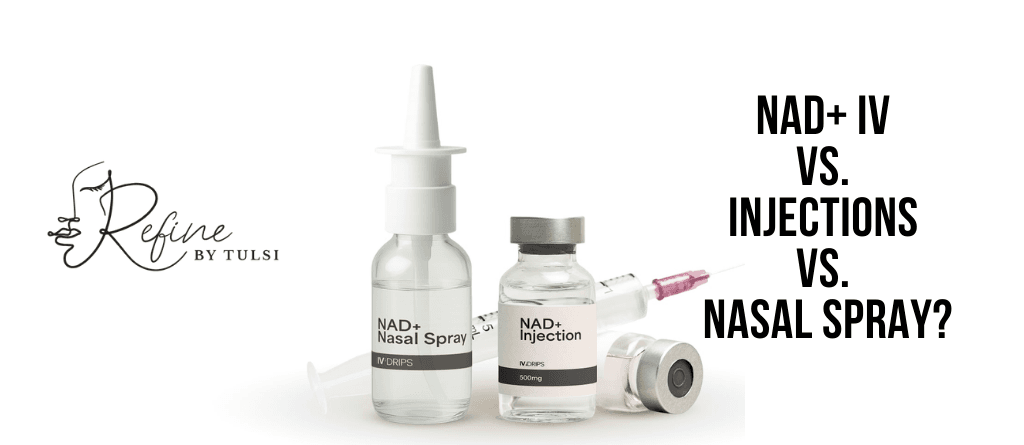
Because NAD+ itself is a large molecule that’s poorly absorbed when taken orally, the most effective ways to raise cellular NAD+ involve either direct delivery or precursor supplementation:
| Approach | How it works | Best for |
|---|---|---|
| IV NAD+ | Delivers NAD+ directly into the bloodstream, bypassing digestion for maximum bioavailability | Noticeable energy/clarity restoration; loading protocols |
| NAD+ injections | Subcutaneous dosing for convenient, ongoing maintenance between IVs | Sustained maintenance, at-home convenience |
| Precursors (NMN / NR) | Oral compounds the body converts into NAD+ over time | Daily baseline support alongside IV/injections |
| Lifestyle | Exercise, fasting, sleep, and reducing alcohol all support NAD+ naturally | The foundation under any protocol |
At Refine by Tulsi, NAD+ IV therapy is the centerpiece for patients who want the most direct restoration, often paired with maintenance injections and precursor support. Many patients describe the effect as a gradual “lifting of the fog” — more sustained energy, clearer thinking, and better recovery over a series of sessions rather than a single dramatic jolt.
An Honest Note on Expectations
NAD+ is not a miracle and not a substitute for sleep, movement, and good metabolic health. The research in humans is still developing, and effects vary person to person. What NAD+ therapy reliably does is support the cellular energy and repair machinery that age depletes — best thought of as one well-chosen tool within a coordinated plan, not a standalone cure. Anyone promising guaranteed, dramatic results from NAD+ alone is overselling it.
Why NAD+ Works Better as Part of a Coordinated Plan
This is the part most NAD+ content skips. Cellular energy doesn’t exist in a vacuum. The same fatigue, brain fog, and slow recovery driven by low NAD+ are also driven by declining hormones, growth hormone, nutrient deficiencies, poor sleep architecture, and inflammation. Treating NAD+ in isolation — the way most IV-drip menus do — addresses one input while ignoring the others.
That’s why we integrate NAD+ into a broader picture:
- Hormone optimization — testosterone, estrogen, thyroid, and growth hormone all profoundly affect energy and recovery. NAD+ works better on a corrected hormonal foundation.
- Peptide therapy — growth-hormone-supporting peptides like CJC/Ipamorelin complement NAD+ by improving the deep sleep where repair happens.
- IV nutrient therapy — magnesium, B vitamins, and other cofactors the mitochondria need to run, alongside the NAD+ itself.
- Lab-based assessment — fatigue can stem from low iron, thyroid dysfunction, or vitamin deficiencies that no amount of NAD+ will fix. An MD checks first.
We make the full case for this integrated approach in our companion piece on why a fragmented longevity plan underperforms a coordinated one. The short version: NAD+ is a strong tool, but tools work best in a system.
Wondering whether your fatigue is NAD+, hormones, or something else entirely? Book a consultation at refinebytulsi.com/book. We’ll assess the whole picture before recommending anything.
Real Patient Experiences
I’d tried NAD+ drips at a walk-in IV bar and felt almost nothing. At Refine by Tulsi, Dr. Kotecha ran labs first and found my thyroid and ferritin were both low on top of the cellular fatigue. She treated all of it together — NAD+, thyroid, iron — and the difference was night and day. The NAD+ alone was never going to work because it wasn’t the whole problem.
The afternoon brain fog was the worst part of my day for years. A series of NAD+ IVs combined with the peptide protocol Dr. Kotecha put me on genuinely lifted it. I don’t crash at 3pm anymore. It wasn’t one magic drip — it was the combination, done in the right order, that finally worked.
Frequently Asked Questions
What’s the difference between NAD+ and NMN or NR?
NMN and NR are precursors — building blocks your body converts into NAD+. NAD+ IV therapy delivers the molecule itself directly. Many protocols use both: IV/injectable NAD+ for direct restoration and oral precursors for daily baseline support.
How quickly will I feel a difference?
It varies. Some patients notice improved clarity and energy within the first few sessions; for others it’s more gradual over a series. NAD+ tends to work as cumulative support rather than an instant jolt. Lifestyle and any underlying issues (sleep, hormones, nutrients) heavily influence the response.
Is NAD+ IV therapy safe?
Administered by trained medical professionals at appropriate rates, NAD+ IV therapy is generally well tolerated. Infusing too quickly can cause temporary chest tightness, flushing, or nausea, which is why the drip rate matters — and why physician-supervised administration is preferable to a rushed walk-in drip.
Can NAD+ reverse aging?
No honest clinician will claim that. NAD+ supports the cellular energy and repair systems that decline with age, which can meaningfully improve how you feel and function. But “reversing aging” is marketing language, not science. We position NAD+ as cellular support within a coordinated plan — not a fountain of youth.
Who is a good candidate?
Adults experiencing age-related fatigue, slow recovery, brain fog, or those building a proactive longevity plan. As always, an evaluation comes first — because the right answer for your fatigue might be NAD+, or hormones, or addressing a deficiency, or all three.
The Bottom Line
NAD+ is genuinely important — it’s the coenzyme that lets your mitochondria turn fuel into energy and powers the repair systems that keep cells healthy. It declines substantially with age, and that decline is felt as fatigue, slow recovery, and mental fog. Restoring it through physician-supervised NAD+ therapy can meaningfully support energy and cellular health.
But the real lesson is that NAD+ works best as one coordinated piece of a larger picture — alongside hormone optimization, peptides, nutrient support, and a real medical evaluation. At Refine by Tulsi, that’s exactly how we use it.
Ready to Restore Your Cellular Energy — the Right Way?
Book a consultation at our Lincoln Park or Logan Square location. We’ll assess what’s actually driving your fatigue and design a coordinated plan, with NAD+ where it fits.
About Dr. Tulsi Kotecha
Dr. Tulsi Kotecha is the founder and medical director of Refine by Tulsi, a physician-led medical spa with locations in Lincoln Park and Logan Square, Chicago. She specializes in NAD+ therapy, peptide therapy, hormone optimization, and integrative longevity medicine. Learn more about Dr. Kotecha.
This article is for educational purposes and does not constitute medical advice. NAD+ and related therapies should be administered under the guidance of a qualified physician. Individual results may vary. Statements regarding NAD+ have not been evaluated as treatment for any specific disease.