
Peptides for Anti-Aging: How They Target the Biology of Aging — From Within
Most anti-aging approaches work from the outside in. A cream sits on the surface. A laser resurfaces the top layers. A filler replaces lost volume. All of these have real value — but they address the visible results of aging, not the biology driving it. Peptides work differently. They go after the mechanisms themselves.
Aging isn’t one process — it’s the gradual slowdown of the signals that tell your cells to make collagen, produce growth hormone, repair tissue, and maintain themselves. Peptides are those signals. Used correctly, under medical supervision, they can reactivate the pathways that aging suppresses — supporting skin, structure, recovery, and cellular health from the inside.
At Refine by Tulsi, peptide therapy is a core part of how we approach anti-aging — not as a replacement for great skincare and aesthetics, but as the internal layer that makes everything else work better. This guide explains the biology, the key anti-aging peptides, and how they fit into a complete plan.
Why We Age: The Mechanisms Peptides Target
To understand how peptides help, it helps to understand what’s actually happening beneath the surface as we age. A few key shifts drive most of what we see and feel:
- Collagen production declines. You lose roughly 1% of your collagen per year after your mid-20s — and far more, faster, after menopause. Less collagen means thinner skin, more wrinkles, weaker connective tissue, and slower healing.
- Growth hormone falls. GH production peaks in youth and declines steadily with age, affecting body composition, skin quality, recovery, sleep depth, and energy.
- Cellular repair slows. The systems that fix damage, clear out worn cells, and maintain tissue all become less efficient — so damage accumulates faster than it’s repaired.
- Inflammation rises. A low-grade, chronic inflammatory state (often called “inflammaging”) accelerates tissue breakdown and contributes to visible aging and stiffness.
- Cellular aging accumulates. Over time, cells lose their ability to divide and function optimally, contributing to the gradual decline of every tissue.
Conventional aesthetics treat the outcomes of these shifts. Anti-aging peptides aim at the shifts themselves — sending the signals that prompt collagen synthesis, growth hormone release, tissue repair, and cellular maintenance. That’s the fundamental difference, and why they complement rather than compete with topical and procedural treatments.
Inside-Out, Not Instead-Of
Peptides are not a replacement for skincare, injectables, or energy-based treatments — they’re the internal foundation those treatments build on. The most striking anti-aging results come from combining inside-out support (peptides, nutrition, hormones) with outside-in treatments (skincare, microneedling, lasers, injectables). Each amplifies the other.
The Key Anti-Aging Peptides
Peptides That Target the Biology of Aging
Each addresses a different mechanism. Most plans use two or three, matched to your goals — not all of them.
GHK-Cu
A copper peptide and one of the most studied collagen stimulators available. Signals fibroblasts to produce collagen, elastin, and the moisture-binding molecules that keep skin plump — directly countering age-related collagen loss. Also supports wound healing and hair follicle health.
CJC-1295 / Ipamorelin
A growth hormone secretagogue pairing that prompts your body to produce its own GH — rather than injecting synthetic hormone. Supports leaner body composition, better skin quality, deeper sleep, and faster recovery, all of which decline as natural GH falls.
Epithalon
A telomerase-supporting peptide studied for its role in cellular longevity and sleep quality. Associated with supporting telomere maintenance — the protective caps on chromosomes that shorten with age — and with antioxidant activity. Used in short cyclical courses.
BPC-157 & TB-500
A regenerative pairing that supports tissue repair, reduces inflammation, and accelerates recovery of gut lining, tendons, ligaments, and muscle. As the body’s repair capacity slows with age, these peptides help maintain the healing efficiency of youth.
Curious which anti-aging peptides fit your goals and biology? Most people need two or three, not all of them. Book a consultation at refinebytulsi.com/book — we run labs and build the protocol around you.
GHK-Cu: The Anti-Aging Peptide for Skin
Of all the anti-aging peptides, GHK-Cu deserves special attention because it targets the single most visible sign of aging: the decline of skin quality driven by collagen loss.
GHK-Cu (glycyl-L-histidyl-L-lysine copper) is a naturally occurring peptide-copper complex your body produces in decreasing amounts as you age — plasma levels drop substantially between your 20s and your 60s. It’s one of the most extensively researched regenerative peptides, and it’s associated with the ability to:
- Signal collagen and elastin production — the structural proteins responsible for firmness, elasticity, and that youthful “bounce”
- Support glycosaminoglycan synthesis — the moisture-binding molecules that keep skin hydrated and plump from within
- Promote wound healing and tissue repair — supporting skin recovery and overall regeneration
- Support hair follicle health — relevant for age- and hormone-related thinning
- Provide antioxidant and anti-inflammatory support — helping protect skin from the oxidative stress that accelerates aging
At Refine by Tulsi, we use GHK-Cu both systemically (for whole-body collagen support) and topically (for targeted skin quality). It’s especially powerful combined with collagen-stimulating procedures — the internal signal amplifying the external treatment.
Where Peptides Meet Aesthetics: The Combination That Works
This is where anti-aging peptides become genuinely powerful for our patients. Collagen-stimulating procedures create controlled micro-injury that prompts the skin to rebuild — and peptides supply the internal signals that support that rebuilding. Pairing them tends to produce better results than either alone:
- Peptides + microneedling — GHK-Cu supports the collagen response that microneedling triggers
- Peptides + RF microneedling — internal collagen support alongside deep radiofrequency remodeling
- Peptides + PRF therapy — your own growth factors plus peptide signaling for regeneration
- Peptides + collagen biostimulators — Sculptra rebuilds structure while peptides support systemic collagen synthesis
- Peptides + laser resurfacing — supporting the skin’s healing and collagen response after treatment
This inside-out-plus-outside-in philosophy is the foundation of how we approach comprehensive rejuvenation — the same thinking behind our facial balancing and skin-quality programs.
Beyond Skin: Peptides and Whole-Body Aging
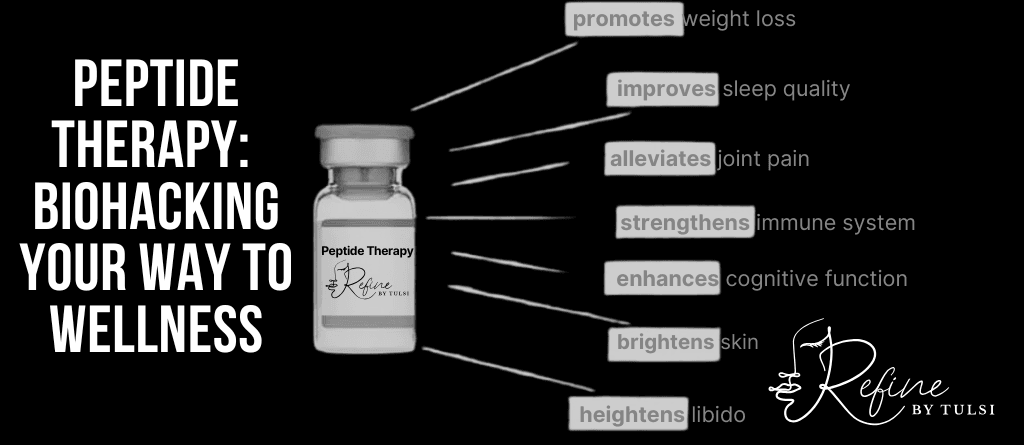
Anti-aging isn’t only about how you look — it’s about how you function. The peptides that support skin also support the systems that make you feel younger:
- Body composition — as growth hormone declines, fat accumulates and muscle is harder to maintain; GH-supporting peptides help counter this
- Recovery and joints — the slower healing of age responds to regenerative peptides (see our guide on peptides when your joints start to hurt in your 40s)
- Sleep and energy — deep, restorative sleep declines with age; several peptides support sleep architecture and daytime energy
- Cellular longevity — the proactive, long-view layer for those focused on healthspan, not just appearance
For patients taking a comprehensive approach, peptides integrate into our broader longevity medicine — alongside hormone optimization, NAD+, and nutrition. We make the case for treating these together rather than in isolation in our piece on coordinated longevity care.
An Honest Word on Expectations
Peptides are a genuinely useful tool, but they’re not magic and not a substitute for the basics — sleep, movement, protein, sun protection, and not smoking still matter most. The human research on some anti-aging peptides is still developing, and effects vary from person to person. We describe what peptides support and are associated with, not guaranteed outcomes. Anyone promising to “reverse aging” with a peptide is overselling it.
Why Anti-Aging Peptides Must Be Physician-Supervised
Peptides are widely sold online as “research chemicals,” and self-treating is common — and risky. These are bioactive signaling molecules, not supplements. Physician supervision provides what the DIY route can’t:
- Verified, pharmaceutical-grade sourcing — online peptides are frequently impure, mislabeled, or degraded
- Correct dosing and protocol design — matched to your labs and goals, not a forum’s copy-paste stack
- Health-history and interaction review — some peptides are inappropriate for certain conditions
- Lab monitoring — tracking the markers that matter, before and during
- Integration — coordinated with your hormones, skincare, and overall plan
We go deep on this in our dedicated guide to why physician-supervised peptide therapy should be non-negotiable. The short version: with bioactive compounds, supervision isn’t bureaucracy — it’s what makes them safe and effective.
Already using peptides you bought online? Bring them to a consultation at refinebytulsi.com/book. We’ll assess what you have honestly and transition you to verified, monitored therapy that actually works.
What Anti-Aging Peptide Therapy Looks Like at Refine by Tulsi
- Comprehensive assessment — full consultation, health history, and targeted labs before anything is prescribed
- Personalized protocol — the right two or three peptides for your goals, whether that’s skin quality, body composition, recovery, or longevity
- Pharmaceutical-grade sourcing — every compound from a licensed compounding pharmacy
- Aesthetic integration — peptides paired with the right microneedling, PRF, biostimulator, or laser treatments for compounding results
- Ongoing monitoring — check-ins and repeat labs, with the protocol adjusted to your response
Real Patient Experiences
I’d done microneedling for years with good results, but adding GHK-Cu took it to another level. My provider explained the peptide supports collagen from the inside while the microneedling works from the surface. Six months in, my skin has a firmness and glow it hadn’t had in a decade. The combination is what did it — neither alone was as good.
I came in thinking about my skin, but Dr. Kotecha looked at the whole picture — my sleep, my recovery, my body composition were all part of aging too. A GH-supporting peptide plus GHK-Cu, coordinated with my skincare, made me feel as much younger as I looked. It’s anti-aging that goes deeper than the surface.
Frequently Asked Questions
Do anti-aging peptides actually work?
Peptides like GHK-Cu are well-studied for supporting collagen synthesis and skin quality, and GH-supporting peptides have clear effects on the body’s own growth hormone production. That said, human research on some anti-aging applications is still developing, and results vary. We’re honest about what’s well-supported versus emerging, and we describe what peptides support rather than promising to “reverse aging.”
Are they better than skincare or injectables?
They’re not a replacement — they’re a complement. Skincare and injectables work from the outside in; peptides work from the inside out. The best results come from combining them, which is exactly how we design plans. Peptides make your topical and procedural treatments work better, not obsolete.
Which anti-aging peptide is best for skin?
GHK-Cu is the standout for skin — it’s one of the most studied collagen-stimulating peptides and can be used both by injection and topically. It pairs especially well with microneedling and PRF for compounding collagen benefits.
Are anti-aging peptides safe?
Under physician supervision — with verified sourcing, correct dosing, and monitoring — peptides are generally well tolerated for appropriate candidates. The real risks come from the DIY route: unverified online products and guessed doses. Supervision is what makes them safe, which is why we only offer physician-prescribed, monitored protocols.
How soon will I see results?
It depends on the peptide and goal. Skin changes from GHK-Cu typically show over 4–12 weeks; body-composition and recovery effects from GH-supporting peptides over 4–8 weeks. Cellular-longevity peptides are used cyclically with a longer-term view. We set realistic timelines at your consultation.
Can I combine peptides with my current aesthetic treatments?
Yes — and we encourage it. Peptides are designed to integrate with microneedling, RF microneedling, biostimulators, and laser treatments. Coordinating them under one physician is how you get the compounding, inside-out-plus-outside-in effect.
The Bottom Line
Anti-aging peptides are different from creams, lasers, and fillers in one fundamental way: they target the biology of aging rather than its surface results. By signaling collagen production (GHK-Cu), growth hormone release (CJC/Ipamorelin), tissue repair (BPC-157/TB-500), and cellular maintenance (Epithalon), they support the systems that aging suppresses — from the inside.
But their real power is as a complement, not a replacement. Combined with great skincare, microneedling, biostimulators, and the rest of a thoughtful aesthetic plan — and supervised by a physician — peptides are the internal layer that makes everything else work better. At Refine by Tulsi, that’s exactly how we use them.
Age From the Inside Out
Book a consultation at our Lincoln Park or Logan Square location. We’ll assess your skin, your goals, and your labs, then build an anti-aging peptide protocol — coordinated with the right aesthetic treatments for compounding results.
About Dr. Tulsi Kotecha
Dr. Tulsi Kotecha is the founder and medical director of Refine by Tulsi, a physician-led medical spa with locations in Lincoln Park and Logan Square, Chicago. She specializes in integrative longevity medicine, combining peptide therapy, hormone optimization, and regenerative aesthetics for inside-out results. Learn more about Dr. Kotecha.
This article is for educational purposes and does not constitute medical advice. Peptide therapy should be administered under the guidance of a qualified physician. Individual results may vary. Statements regarding peptides have not been evaluated as treatment for any specific disease, and the regulatory status of specific peptides varies.