You’ve got sun damage, redness, broken capillaries, or uneven pigmentation — and you know some kind of light-based treatment can help. But then you start researching and discover there are multiple technologies that all seem to do the same thing: IPL, BBL, and Aerolase. Different names, different acronyms, different price points, and wildly different claims.
They’re not the same. The technology behind each device determines how effectively it treats your concern, how comfortable the treatment is, how much downtime you’ll have, and — critically — whether it’s safe for your skin tone.
At Refine by Tulsi, we use the Aerolase Neo Elite — and we chose it deliberately over IPL and BBL. This guide explains why, while giving you an honest assessment of all three technologies so you can make an informed decision.
The Physics That Actually Matters: Pulse Duration
Before comparing devices, you need to understand one concept: pulse duration. It’s the single most important differentiator between light-based devices, and it determines everything — efficacy, comfort, safety, and who can safely be treated.
Pulse duration is how long the device delivers energy to your skin per pulse. Think of it like touching a hot pan:
- Touch it for 3 seconds — you get burned. The heat has time to spread from the surface into surrounding tissue, causing collateral damage.
- Touch it for a fraction of a second — you feel warmth but no burn. The energy hits the target and dissipates before it can damage surrounding tissue.
This is exactly what happens in your skin. A longer pulse allows heat to spread beyond the target (the pigment, the blood vessel, the melanin) into surrounding tissue — causing pain, swelling, and risk of burns or post-inflammatory hyperpigmentation. A shorter pulse delivers energy precisely to the target with minimal heat spread.
The 650-Microsecond Advantage
Aerolase Neo Elite uses a 650-microsecond pulse duration — far shorter than IPL (typically 10–30 milliseconds) or BBL (varies, but generally in the millisecond range). This means energy reaches the chromophore (pigment or hemoglobin) and is absorbed before significant heat can transfer to surrounding tissue. The result: effective treatment with dramatically less pain, less inflammation, less downtime, and — most importantly — safety across all skin tones, including Fitzpatrick IV–VI.
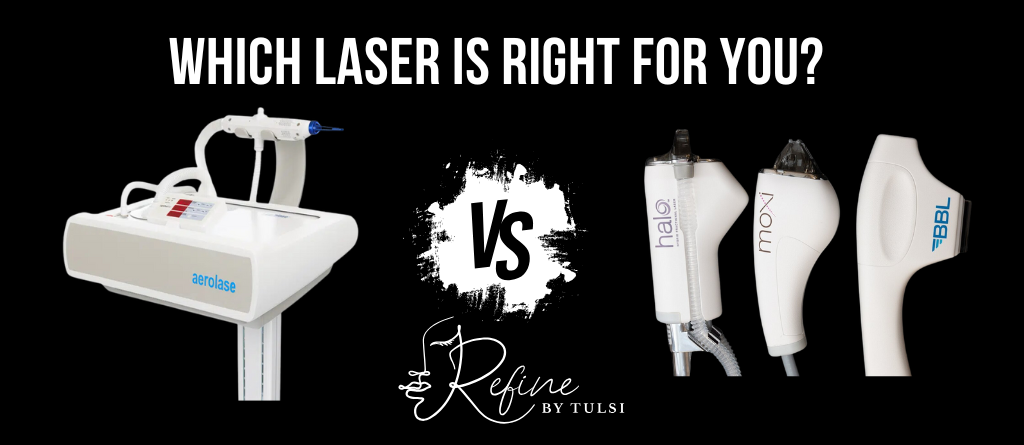
Aerolase Neo vs IPL vs BBL
Same goal — treating redness, pigmentation, and sun damage. Very different technology under the hood.
Aerolase Neo Elite We Offer
A true Nd:YAG laser with a proprietary 650-microsecond pulse. Treats pigmentation, redness, rosacea, acne, fine lines, and vascular lesions — safely across all skin tones with virtually no downtime.
IPL (Intense Pulsed Light)
The original light-based treatment. Uses a broad spectrum of wavelengths filtered to target pigment and hemoglobin. Effective for sun damage in lighter skin tones, but limited by longer pulse durations and skin tone restrictions.
BBL (BroadBand Light)
Sciton’s proprietary enhanced IPL platform. More precise filtering and cooling than standard IPL, with additional protocols (Forever Young BBL, HERO). Better than generic IPL but still constrained by broad-spectrum physics and skin tone limitations.
Not sure which treatment is right for your skin? Book a consultation at refinebytulsi.com/book — we’ll assess your skin type, concerns, and goals and recommend the right approach.
The Full Comparison Table
| Factor | Aerolase Neo ✓ | IPL | BBL |
|---|---|---|---|
| Technology type | True laser (1064nm Nd:YAG) | Broad spectrum light | Enhanced broad spectrum |
| Pulse duration | 650 microseconds | 10–30 milliseconds | Milliseconds (variable) |
| Wavelength precision | Single wavelength (maximum precision) | Broad spectrum (filtered) | Broad spectrum (better filters) |
| Fitzpatrick I–III (light skin) | Safe and effective | Safe and effective | Safe and effective |
| Fitzpatrick IV–VI (medium-dark) | Safe and effective | Not recommended (burn/PIH risk) | Limited (IV with caution; V–VI not recommended) |
| Pain during treatment | Minimal warm sensation | Moderate snapping/stinging | Moderate snapping |
| Numbing required | No | Often yes | Often yes |
| Downtime | None | 2–5 days | 2–7 days |
| Rosacea treatment | Excellent | Good for mild redness | Good for mild-moderate |
| Active acne treatment | Yes | Limited | Some protocols |
| Melasma safe | Yes (appropriate settings) | Risk of worsening | Risk of worsening |
| Combine same day with other treatments | Yes | Usually not | Usually not |
The Skin Tone Issue: Why This Matters More Than Anything
This is the single most important differentiator — and the one most clinics gloss over.
IPL and BBL are not safe for medium to dark skin tones. This isn’t a marketing claim — it’s physics. Broad-spectrum light devices deliver energy across a range of wavelengths, some of which are preferentially absorbed by melanin in the skin (not just the target pigment). In darker skin tones (Fitzpatrick IV–VI), this melanin absorption can cause burns, blistering, and post-inflammatory hyperpigmentation — the exact problem the patient came in to fix.
Aerolase’s 1064nm Nd:YAG wavelength has lower melanin absorption than the shorter wavelengths used in IPL/BBL, and its 650-microsecond pulse minimizes heat spread. This combination makes it safe and effective across all skin tones — a claim IPL and BBL fundamentally cannot make.
In Chicago — one of the most ethnically diverse cities in the country — this isn’t a niche advantage. It’s essential. At Refine by Tulsi, we serve patients of every skin tone and background, and we chose Aerolase specifically because we refuse to offer a device that excludes a significant portion of our community.
What Aerolase Treats That IPL and BBL Can’t (or Shouldn’t)
Rosacea
Aerolase is one of the most effective treatments for rosacea-related redness and flushing. The 1064nm wavelength targets hemoglobin in dilated blood vessels while the short pulse avoids the inflammatory flare that longer-pulse devices trigger in rosacea-sensitive skin. Many rosacea patients have tried IPL or BBL and found their redness temporarily improved but their flare patterns worsened — the heat from longer pulses triggers the very inflammation they’re trying to treat.
Active Acne
Aerolase’s NeoClear protocol targets the bacteria, inflammation, and sebaceous gland activity driving active acne — all in one treatment. IPL and BBL are not designed for active acne. If your concern is active breakouts alongside redness or pigmentation, Aerolase treats both simultaneously. This pairs well with chemical peels and HydraFacials for a comprehensive acne protocol.
Melasma
Melasma is notoriously treatment-resistant and easily worsened by heat. IPL and BBL carry significant risk of triggering rebound hyperpigmentation in melasma patients. Aerolase’s ultra-short pulse minimizes heat accumulation, making it one of the safer light-based options — especially when combined with Sylfirm X’s pulsed-wave mode, which is specifically designed for pigmentation disorders.
Post-Treatment Combination
Because Aerolase causes virtually no inflammation or skin barrier disruption, it can be combined with other treatments in the same session. Common same-day combinations at Refine by Tulsi include Aerolase + microneedling, Aerolase + chemical peel, or Aerolase + HydraFacial.
An Honest Take: When IPL or BBL Might Be Appropriate
We believe in transparency. Here’s when IPL or BBL could be reasonable:
- Extensive sun damage with multiple discrete brown spots (Fitzpatrick I–II only) — IPL and BBL can aggressively target multiple sun spots in a single session. The spots darken, crust, and flake off over 5–7 days. For patients with very fair skin who don’t mind visible downtime, this approach delivers satisfying visible results. Aerolase achieves the same outcome more gradually with zero downtime.
- Patients who want visible proof of treatment — Some patients psychologically prefer to “see it working” — the darkening, crusting, and shedding feels like evidence. Aerolase’s no-downtime approach can feel like “nothing happened” even though the pigment is clearing just as effectively over the series.
Which Treatment Should You Choose?
Choose Aerolase if:
- You have medium to dark skin (Fitzpatrick IV–VI) — it’s the only safe option of the three
- You have rosacea and need a treatment that won’t trigger flares
- You have active acne alongside redness or pigmentation
- You have melasma and need the lowest-risk light-based approach
- You want zero downtime — no crusting, no darkening, no hiding
- You want to combine with microneedling, peels, or facials in the same visit
- You’re building a long-term skin maintenance plan with regular quarterly treatments
Consider IPL or BBL if:
- You have very fair skin (Fitzpatrick I–II) with extensive discrete sun spots
- You prefer to see visible crusting and shedding as evidence of treatment
- You’re comfortable with 2–7 days of social downtime
- You don’t have rosacea, active acne, or melasma
How We Use Aerolase at Refine by Tulsi
Aerolase Neo Elite is one of our most versatile devices. We use it standalone and as a complement to our full menu:
- Aerolase + Sylfirm X RF Microneedling — surface pigmentation/redness (Aerolase) + deeper collagen remodeling and tightening (Sylfirm X)
- Aerolase + Microneedling with PRP/PRF — acne scarring, texture, and overall rejuvenation
- Aerolase + Chemical Peels — pigmentation, sun damage, and brightening
- Aerolase + HydraFacial — our most popular “glow” combination for event prep
- Aerolase + CO2 Laser — Aerolase for maintenance between intensive CO2 resurfacing sessions
- Aerolase + GHK-Cu peptide therapy — internal collagen stimulation paired with external laser rejuvenation
Real Patient Experiences
I’d been getting IPL at another clinic for sun damage on my cheeks. It worked — spots would darken and flake off — but I’d have a week of looking like my face was peeling. I switched to Aerolase at Refine by Tulsi and the same spots are clearing over a series of treatments with literally no downtime. I go during my lunch break. No one at work knows.
I’m South Asian with Fitzpatrick V skin and I was told by two other clinics that IPL wasn’t safe for me. One actually turned me away. Dr. Kotecha treated my hyperpigmentation and rosacea with Aerolase and I had zero issues — no burns, no PIH, just gradual clearing over four sessions. Having a device that’s actually safe for my skin tone isn’t a luxury. It should be the standard.
My rosacea got worse after IPL at another practice. The redness improved temporarily but the flushing episodes became more frequent and intense. Dr. Kotecha explained that the heat from longer-pulse IPL can trigger rosacea inflammation even while reducing surface redness. She switched me to Aerolase and the flushing calmed down significantly. My baseline redness is lower and I haven’t had a major flare in months.
Frequently Asked Questions
Does Aerolase hurt?
Most patients describe a mild warm sensation — significantly less than IPL’s “rubber band snap.” No topical numbing is required. The 650-microsecond pulse delivers energy too quickly for pain receptors to fully register.
How many sessions do I need?
Most concerns require 3–6 sessions spaced 3–4 weeks apart. Mild redness or pigmentation may improve in 3 sessions. Rosacea, acne, and more significant sun damage typically require 4–6.
Can I go back to work immediately?
Yes — there’s no visible downtime. You may have mild pinkness for 30–60 minutes, similar to a light flush after exercise. No crusting, no peeling, no need to cancel plans.
Is Aerolase better than CO2 laser?
Different tools for different jobs. CO2 laser resurfacing is more aggressive for deep wrinkles, severe textural damage, and advanced scarring — with 5–10 days of significant downtime. Aerolase is gentle, no-downtime treatment for redness, pigmentation, rosacea, and skin tone. Many patients use both.
How much does Aerolase cost?
Treatments start at $250 per session depending on area treated. Package pricing available for treatment series. We also offer Aerolase as part of combination packages with microneedling, peels, and facials.
Can Aerolase treat my body, not just my face?
Absolutely. Common body areas include neck, chest/décolletage (sun damage), hands (age spots), and legs (spider veins). Also effective for laser hair removal across all skin tones.
The Bottom Line
All three technologies can improve sun damage and pigmentation in fair-skinned patients. But when you factor in skin tone safety, comfort, downtime, versatility, and the ability to treat rosacea, acne, and melasma — Aerolase Neo Elite stands alone.
- If you have any skin tone darker than very fair → Aerolase (IPL and BBL are not safe)
- If you have rosacea → Aerolase (won’t trigger flares)
- If you have active acne + pigmentation → Aerolase (treats both simultaneously)
- If you want zero downtime → Aerolase (no crusting, no peeling)
- If you want to combine with other treatments same day → Aerolase (gentle enough to layer)
At Refine by Tulsi, we chose Aerolase because it lets us treat every patient who walks through our door — regardless of skin tone, sensitivity, or lifestyle constraints. That’s not a compromise. That’s better technology.
Ready for Clearer, More Even Skin — Without the Downtime?
Schedule your Aerolase consultation at our Lincoln Park or Logan Square location. We’ll assess your skin type, identify the right approach, and build a treatment plan that works with your schedule.
About Dr. Tulsi Kotecha
Dr. Tulsi Kotecha is the founder and medical director of Refine by Tulsi, a physician-led aesthetic and wellness practice with locations in Lincoln Park and Logan Square, Chicago. She specializes in advanced laser and energy-based treatments, injectable artistry, and integrative longevity medicine. Learn more about Dr. Kotecha.
This article is for educational purposes and does not constitute medical advice. Laser and light-based treatments should be administered under the guidance of a qualified physician. Individual results may vary.