
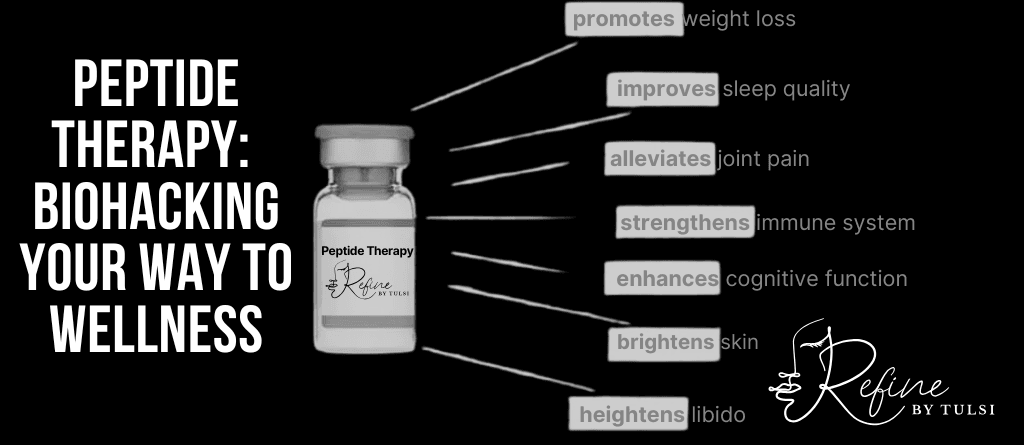
You’ve read the books. You track your HRV. You’ve cold plunged. You own a red light panel, a continuous glucose monitor, and a supplement stack that takes 15 minutes to swallow every morning. You’ve ordered peptides from three different online retailers. You listen to every longevity podcast. You know the difference between NAD+ and NMN, between rapamycin and metformin, between CJC-1295 and tesamorelin.
And you’re still guessing.
That’s not a criticism — it’s a diagnosis. Self-directed biohacking is the self-taught version of a discipline that requires medical expertise. The impulse is correct: you want to optimize your health, extend your healthspan, and perform at your best for as long as possible. The execution is the problem. Without labs, monitoring, drug interaction review, and physician oversight, biohacking is an expensive experiment with no control group.
At Refine by Tulsi, we don’t dismiss biohacking — we elevate it. We take the same tools biohackers use (peptides, hormones, NAD+, IV therapy) and apply them with the precision of physician-led medicine: comprehensive diagnostics, personalized protocols, pharmaceutical-grade sourcing, ongoing monitoring, and accountability.
Here’s why Chicago’s most sophisticated health optimizers are making the switch.
The Five Limits of Self-Directed Biohacking
1. No Baseline, No Measurement, No Progress
The first thing we ask patients who come from biohacking backgrounds: “What were your labs before you started?” Most don’t have an answer. They started taking peptides, supplements, or over-the-counter hormone precursors based on symptoms and podcast recommendations — without ever establishing a biochemical baseline.
Without pre-treatment labs, you can’t know if something is working, not working, or causing a problem you can’t feel yet. “I feel better” is valuable but subjective. Objective data — IGF-1 levels, inflammatory markers, fasting insulin, thyroid function, hormone panels — tells a different and often more important story.
At Refine by Tulsi, every protocol starts with comprehensive labs and every protocol is measured against objective data at 8–12 weeks. No guessing.
2. Unverified Product Quality
The peptides, supplements, and compounds available online are unregulated. Purity ranges from excellent to dangerous. Independent testing has found online “research” peptides with incorrect concentrations, bacterial contamination, degradation from improper storage, and entirely wrong peptide sequences.
You wouldn’t take prescription medication from an unverified source. Peptides are bioactive compounds that alter hormonal signaling, inflammatory pathways, and cellular function. The sourcing matters. We use exclusively licensed 503A/B compounding pharmacies with cGMP standards and third-party purity verification.
3. No Drug Interaction Review
Biohackers often stack multiple compounds simultaneously — peptides, hormones, supplements, nootropics — without understanding how they interact. Growth hormone secretagogues can worsen insulin resistance in predisposed individuals. Thyroid-stimulating compounds can cause arrhythmias in patients with undiagnosed cardiac conditions. Immune-modulating peptides can be contraindicated in autoimmune patients.
A physician reviews your complete medication list, health history, and lab results before prescribing anything. The internet doesn’t.
4. No Monitoring = No Safety Net
Chronic use of growth hormone secretagogues elevates IGF-1. If IGF-1 rises too high and stays there unchecked, the theoretical cancer risk increases. Testosterone supplementation affects hematocrit, liver function, and PSA. GLP-1 medications require monitoring for pancreatitis markers.
These aren’t theoretical concerns — they’re measurable parameters that require regular lab monitoring. Self-directed biohackers either don’t check these markers or check them sporadically without understanding the clinical significance. Physician-led protocols include mandatory monitoring at defined intervals.
5. No Integration = Diminished Returns
The most sophisticated biohackers treat each intervention in isolation: this peptide for sleep, that supplement for focus, this device for recovery. But human biology is an integrated system. Hormone levels affect how peptides work. Gut health affects how nutrients are absorbed. Sleep quality affects how growth hormone is released. Inflammatory status affects how everything responds.
Physician-led longevity medicine treats the system, not the symptom. Peptides, hormones, NAD+, IV therapy, metabolic medicine, and ongoing medical oversight are integrated into one coherent protocol where each intervention amplifies the others.
This Isn’t Anti-Biohacking. It’s Pro-Precision.
We respect the biohacking community’s intellectual rigor and proactive health philosophy. Many of our patients started as biohackers and brought impressive knowledge to their first consultation. What we add isn’t skepticism — it’s the diagnostic infrastructure, pharmaceutical-grade sourcing, medical accountability, and integrative protocol design that turns smart experimentation into precise medicine.
What Physician-Led Longevity Medicine Actually Looks Like
Step 1: Advanced Diagnostics
Not the basic panel your primary care doctor runs. Our initial assessment includes complete hormone panel (total and free testosterone, estradiol, progesterone, DHEA-S, SHBG, full thyroid, cortisol rhythm), metabolic markers (fasting insulin, glucose, HbA1c, comprehensive lipid panel, homocysteine, uric acid), inflammatory markers (hs-CRP, ferritin), organ function (comprehensive liver and kidney panels), IGF-1, vitamin D, B12, magnesium, and nutrient status. For advanced patients, we can add genetic markers, microbiome analysis, and cardiovascular risk panels.
Step 2: Protocol Design Based on Data
Your protocol isn’t based on what worked for a podcaster. It’s based on your labs, your symptoms, your medical history, your medications, and your goals. Two men the same age with the same complaints can receive fundamentally different protocols because their biochemistry is different. That individualization is the entire point.
Step 3: Pharmaceutical-Grade Interventions
Every peptide is sourced from licensed compounding pharmacies. Every hormone is prescribed and monitored by a physician. Every IV therapy is administered in-office by trained medical professionals. The supply chain is controlled, verified, and accountable.
Step 4: Ongoing Monitoring and Adjustment
Labs every 8–12 weeks. Clinical check-ins monthly. Protocol adjustments based on objective data intersected with subjective experience. If something isn’t working, we know within weeks — not months. If something is working too aggressively, we catch it before it becomes a problem.
Step 5: Integration Across Domains
At Refine by Tulsi, longevity medicine isn’t siloed. Peptides, hormones, NAD+, IV nutrient therapy, metabolic medicine, and even aesthetic treatments are coordinated by the same physician who knows your complete picture. The internal optimization (peptides + hormones) and external optimization (Sylfirm X + Sculptra + facial balancing) work together because they’re designed by the same team.
The Biohacker-to-Patient Journey: What Patients Tell Us
I spent $15,000 on biohacking over two years — peptides from online retailers, a supplement stack from five different brands, a CGM, red light, cold plunge, the works. I felt marginally better but I had no idea if it was the peptides or the placebo effect. When I came to Refine by Tulsi, Dr. Kotecha ran labs and found my IGF-1 was elevated higher than she was comfortable with, my liver enzymes were up, and I was taking three supplements that were redundant with each other. She rebuilt my protocol from scratch: two peptides (not five), proper hormone optimization, and actual monitoring. I feel genuinely better now — and I know it’s working because the data says so. The biohacking was the expensive version of guessing. This is medicine.
I’m an engineer and I approached my health the way I approach systems — research, test, iterate. But I was missing the diagnostic layer. I could measure my HRV and sleep with a wearable, but I couldn’t measure my IGF-1, my inflammatory markers, or my thyroid antibodies with an Apple Watch. Dr. Kotecha provided the diagnostic infrastructure I needed to make my biohacking actually data-driven instead of anecdote-driven. Same philosophy, better execution.
I was buying peptides from three different online sources and had no idea if they were the same quality. When Dr. Kotecha tested one of them, the purity was below what the label claimed. I was injecting a degraded product every night for months and wondering why it wasn’t working. Switching to pharmacy-sourced peptides through a physician was the single biggest upgrade in my entire health optimization journey. The product quality is the foundation everything else depends on.
Frequently Asked Questions
Will you judge me for self-administering peptides?
Not even slightly. Many of our best patients came from biohacking backgrounds. We respect the initiative and the knowledge. What we add is the medical framework that makes it safe, precise, and measurable. No judgment — just better infrastructure.
Is physician-led longevity medicine more expensive than DIY biohacking?
The per-month cost is often comparable — and sometimes lower when you eliminate redundant supplements, unused peptides, and products that weren’t working. The lab work and physician oversight add cost, but they also add the accountability that prevents wasted spending. Many patients find they spend less total because every dollar goes toward something objectively useful.
Can I keep some of my biohacking practices?
Absolutely. Cold exposure, sauna, exercise optimization, sleep hygiene, fasting protocols — these lifestyle interventions have genuine evidence behind them and complement physician-led medicine perfectly. What we replace is the unmonitored, unverified pharmaceutical-grade interventions: online peptides, unmonitored hormones, and unstudied supplement stacks.
What programs do you offer?
For men: our concierge medicine program integrates peptide therapy, hormone optimization, NAD+, and advanced diagnostics with ongoing physician access. For women: our Refine Her program provides comprehensive hormonal and peptide optimization. Both include regular labs, protocol adjustments, and the integration of internal wellness with external aesthetic treatments.
The Bottom Line
Biohacking got the philosophy right: your health is your responsibility, proactive optimization beats reactive treatment, and the tools exist to extend your healthspan dramatically. Where it falls short is execution — unverified products, unmonitored protocols, no baseline data, and no medical accountability.
Physician-led longevity medicine takes the same tools — peptides, hormones, NAD+, IV therapy, metabolic medicine — and applies them with diagnostic precision, pharmaceutical-grade sourcing, medical oversight, and integrative protocol design. It’s not a step backward from biohacking. It’s the next step forward.
At Refine by Tulsi, we built our concierge medicine and Refine Her programs for exactly this transition — smart people who want the same interventions, done right, with data, under medical supervision. Because your health deserves the same precision you bring to everything else in your life.
Ready to Upgrade from Biohacking to Precision Medicine?
Schedule your longevity consultation at our Lincoln Park or Logan Square location. Bring your current stack — we’ll assess what’s working, what’s not, and build a data-driven protocol that replaces guesswork with medicine.
About Dr. Tulsi Kotecha
Dr. Tulsi Kotecha is the founder and medical director of Refine by Tulsi, with locations in Lincoln Park and Logan Square, Chicago. She specializes in physician-supervised peptide therapy, hormone optimization, NAD+ therapy, and integrative longevity medicine for high-performers transitioning from self-directed biohacking to precision medical care. Learn more about Dr. Kotecha.
This article is for educational purposes and does not constitute medical advice. Peptide and hormone therapy should be administered under the guidance of a qualified physician. Individual results may vary.