
You’re doing everything right — eating clean, exercising, sleeping eight hours — and you still feel like a different person. The brain fog won’t lift. The weight keeps shifting to your midsection. Your sleep is fractured. Your skin has lost its glow. And your doctor’s answer is “it’s just perimenopause.”
It’s not “just” anything. What you’re experiencing is a cascade of hormonal shifts that affect nearly every system in your body — and peptide therapy is one of the most precise tools available to address it.
But peptides don’t work in isolation. The most powerful protocols combine targeted peptide therapy with bioidentical hormone replacement therapy (BHRT) — addressing the root hormonal decline while simultaneously optimizing the downstream systems that hormones support.
At Refine by Tulsi, we use both through our physician-led Refine Her women’s wellness program. This guide explains every peptide we use for menopausal women, how they work alongside hormone therapy, and how the Refine Her program brings it all together.
Prefer to skip straight to answers? The fastest way to know what will actually help is a consultation with Dr. Kotecha or Dr. Ruof — symptoms reviewed, labs run, a plan built for your body. Book at refinebytulsi.com/book or call (618) 298-8574.
What Are Peptides — and Why Do They Matter During Menopause?
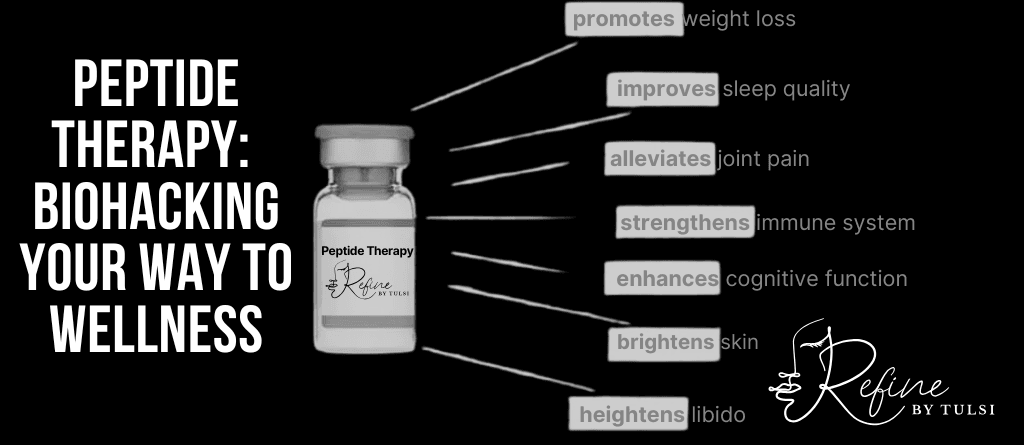
Peptides are short chains of amino acids — essentially small proteins that act as signaling molecules in your body. They tell specific cells to do specific things: produce more growth hormone, reduce inflammation, improve gut lining integrity, stimulate collagen, regulate sleep cycles, or enhance sexual function.
Your body naturally produces thousands of peptides. But during perimenopause and menopause, several critical pathways slow down:
- Growth hormone (GH) production declines — affecting muscle mass, fat metabolism, skin quality, and recovery
- Inflammatory markers increase — contributing to joint pain, brain fog, and metabolic dysfunction
- Sleep architecture degrades — less deep sleep means less cellular repair, less growth hormone release, and more fatigue
- Collagen synthesis drops dramatically — women lose roughly 30% of their collagen in the first five years of menopause, accelerating skin aging, joint stiffness, and connective tissue weakness
- Gut lining integrity weakens — leading to increased inflammation, food sensitivities, and nutrient malabsorption
- Sexual function changes — declining hormones reduce libido, arousal, and tissue health
Peptide therapy doesn’t replace what menopause takes away — it reactivates the pathways that menopause suppresses. Think of peptides as targeted instructions that remind your body how to function at a level it’s forgotten.
The Peptides That Matter Most for Menopause
Key Peptides for Menopausal Women
Different peptides target different symptoms. Here’s what each one does and who it’s best for.
CJC-1295 / Ipamorelin
A growth hormone secretagogue combination that stimulates your body’s natural GH production. Supports fat loss, lean muscle retention, deep sleep, and recovery — without injecting synthetic growth hormone.
Selank
An anxiolytic and nootropic peptide that modulates GABA and serotonin pathways. Reduces anxiety, improves focus, and supports cognitive clarity — the antidote to menopause brain fog.
DSIP
Delta Sleep-Inducing Peptide promotes deep, restorative delta-wave sleep — the sleep phase most disrupted by declining estrogen and progesterone. Improves sleep architecture without sedation or dependency.
BPC-157
A healing peptide derived from gastric juice that repairs gut lining, reduces systemic inflammation, and accelerates tissue recovery. The foundational peptide for whole-body restoration during menopause.
GHK-Cu
A copper peptide and one of the most potent collagen stimulators available. Triggers production of collagen, elastin, and glycosaminoglycans — directly counteracting the accelerated collagen loss of menopause. Also promotes wound healing and hair follicle health.
Thymosin Beta-4 (TB-500)
A regenerative peptide that promotes tissue repair, reduces inflammation, and supports cardiovascular health. Accelerates healing of tendons, ligaments, and muscles — particularly valuable for active women experiencing slower recovery during menopause.
PT-141 (Bremelanotide)
The only FDA-approved peptide for hypoactive sexual desire disorder (HSDD) in premenopausal women, also used off-label in menopausal women. Works on the central nervous system — not the vascular system — to increase desire and arousal from the brain down.
Epithalon
A telomerase-activating peptide that supports telomere length — the protective caps on your chromosomes that shorten with age. Promotes cellular longevity, improves sleep quality, and has antioxidant properties that combat accelerated aging during menopause.
Peptide protocols are physician-prescribed and personalized. Most women don’t need all eight — they need the right two or three. Book a consultation at refinebytulsi.com/book to discuss what protocol fits your needs.
The Full Peptide Comparison
| Peptide | Primary Target | Best For | Administration | Time to Results |
|---|---|---|---|---|
| CJC/Ipamorelin | Growth hormone | Body composition, energy, recovery | Injection, nightly | 4–8 weeks |
| Selank | GABA/serotonin | Brain fog, anxiety, focus | Nasal spray, daily | 1–3 weeks |
| DSIP | Sleep architecture | Insomnia, fragmented sleep | Injection, nightly | 1–2 weeks |
| BPC-157 | Gut lining, inflammation | Gut health, joint pain, healing | Oral or injection | 2–4 weeks |
| GHK-Cu | Collagen, skin quality | Skin aging, hair thinning, tissue repair | Injection or topical | 4–12 weeks |
| TB-500 | Tissue repair | Slow recovery, tendon/joint pain | Injection | 2–4 weeks |
| PT-141 | Central nervous system | Low libido, decreased arousal | Injection, as needed | 30–60 minutes |
| Epithalon | Telomerase activation | Cellular aging, longevity | Injection, cyclical | 4–12 weeks |
GHK-Cu: The Menopause Collagen Peptide Worth Knowing About
GHK-Cu deserves special attention because it addresses one of the most visible — and most frustrating — effects of menopause: accelerated skin aging.
Women lose approximately 30% of their dermal collagen in the first five years after menopause. After that, the decline continues at roughly 2% per year. This isn’t just about wrinkles — it’s about skin thickness, elasticity, wound healing, and the structural integrity of every connective tissue in your body.
GHK-Cu (glycyl-L-histidyl-L-lysine copper) is a naturally occurring peptide-copper complex that your body produces in decreasing amounts as you age. It’s one of the most extensively studied regenerative peptides, with research demonstrating its ability to:
- Stimulate collagen I, III, and V production — the structural proteins responsible for skin firmness, elasticity, and vascular integrity
- Increase elastin synthesis — restoring the “bounce” and resilience that menopausal skin loses
- Activate glycosaminoglycan production — the molecules that hold moisture in your skin (think: natural hyaluronic acid production)
- Promote hair follicle health — supporting thickness and growth in menopausal women experiencing hair thinning
- Reduce inflammation and oxidative damage — protecting cells from the accelerated aging that menopause drives
- Enhance wound healing — supporting tissue repair throughout the body, from skin to gut lining
At Refine by Tulsi, we use GHK-Cu both systemically (subcutaneous injection) for whole-body collagen support and topically for targeted skin quality improvement. For menopausal women, it pairs exceptionally well with microneedling and PRF therapy — amplifying the collagen-stimulating effects of both treatments.
Wondering if collagen loss is behind your skin, hair, or joint changes? A consultation includes the lab work to find out. Schedule with Dr. Kotecha or Dr. Ruof at refinebytulsi.com/book or call (618) 298-8574.
Bioidentical Hormone Therapy: The Foundation Peptides Build On
Here’s something we tell every patient at their first consultation: peptides are powerful, but they work best when the hormonal foundation is in place.
During menopause, your body stops producing adequate levels of the hormones that regulate virtually every system — estrogen, progesterone, testosterone, and DHEA. Peptides can optimize the downstream effects of those hormonal changes, but they can’t replace the hormones themselves.
That’s why our approach at Refine by Tulsi combines bioidentical hormone replacement therapy (BHRT) with targeted peptide protocols. BHRT addresses the root cause. Peptides address the systems that hormones alone don’t fully restore.
The Hormones We Optimize
Estrogen (Estradiol)
The primary female sex hormone. Declining estrogen drives hot flashes, night sweats, vaginal dryness, bone density loss, cardiovascular changes, and skin aging. Drops approximately 35% between ages 35–50 and falls dramatically at menopause. BHRT restores estradiol to optimal physiological levels using bioidentical forms — molecularly identical to what your body naturally produces.
Progesterone
The calming, sleep-promoting hormone. Drops approximately 75% during perimenopause — often the first hormone to decline. Low progesterone drives anxiety, insomnia, irritability, and irregular cycles. Micronized progesterone is the bioidentical form we use, particularly effective for sleep quality and mood stabilization.
Testosterone
Not just a male hormone. Women produce testosterone in the ovaries and adrenal glands, and it plays a critical role in libido, muscle mass, bone density, energy, and cognitive function. Testosterone declines gradually starting in the late 20s and continues through menopause. Optimizing testosterone is often the missing piece for women with persistent fatigue and low libido.
DHEA
The precursor hormone — your body converts DHEA into both estrogen and testosterone. DHEA levels peak in your 20s and decline steadily. Supplementing DHEA supports the body’s ability to produce downstream hormones and has independent benefits for immune function, bone density, and adrenal health.
How Hormones and Peptides Work Together
Think of it as a two-layer system:
Layer 1: BHRT restores the hormonal foundation. Estrogen, progesterone, and testosterone replacement address the root decline — stopping hot flashes, restoring sleep quality, improving mood, and protecting bones and cardiovascular health.
Layer 2: Peptides optimize the systems that hormones support but don’t fully restore. Growth hormone production (CJC/Ipamorelin), collagen synthesis (GHK-Cu), deep sleep architecture (DSIP), gut health (BPC-157), and cognitive function (Selank) all benefit from targeted peptide support even when hormones are optimized.
Why One Without the Other Isn’t Enough
BHRT without peptides: You address the hormonal root cause but may still experience suboptimal growth hormone levels, persistent brain fog, slow recovery, or accelerated collagen loss — because these pathways need their own specific signals.
Peptides without BHRT: You’re optimizing downstream systems while the upstream hormonal deficit continues. It’s like putting premium gas in a car with a failing engine — the fuel quality matters, but the engine needs to work too.
BHRT + peptides together: The hormonal foundation is restored. The downstream systems are individually optimized. Every pathway is getting the signals it needs. This is the comprehensive approach — and it’s why our patients see transformative results.
Common Hormone + Peptide Protocols at Refine by Tulsi
- BHRT + CJC/Ipamorelin + GHK-Cu — The core anti-aging protocol. Hormones restore the foundation, CJC/Ipamorelin optimizes growth hormone for body composition and recovery, GHK-Cu rebuilds collagen. Ideal for women 45–55 experiencing the full spectrum of menopausal changes.
- BHRT + Selank + DSIP — The brain fog and sleep protocol. Progesterone replacement addresses baseline sleep and anxiety. Selank provides additional cognitive support. DSIP targets deep sleep architecture directly. For women whose primary complaints are mental clarity and sleep disruption.
- BHRT + BPC-157 + TB-500 — The active woman’s recovery protocol. Hormones support muscle and bone health. BPC-157 heals the gut and reduces systemic inflammation. TB-500 accelerates tendon and joint recovery. For athletes, runners, and fitness-focused women who can’t recover like they used to.
- BHRT + PT-141 + testosterone optimization — The sexual wellness protocol. Testosterone replacement addresses the hormonal component of libido. PT-141 provides an additional central nervous system signal for desire and arousal. For women experiencing significant changes in sexual function and desire.
- BHRT + GHK-Cu + Epithalon — The longevity protocol. Hormones protect cardiovascular, bone, and metabolic health. GHK-Cu rebuilds collagen and connective tissue. Epithalon supports telomere length and cellular longevity. For women taking a proactive, long-term approach to aging.
Not sure which protocol fits you? That’s exactly what a consultation is for — we match the combination to your symptoms and labs, not a template. Book at refinebytulsi.com/book to map out your personalized plan.
What a Peptide + Hormone Protocol Looks Like at Refine by Tulsi
Step 1: Comprehensive Assessment
Your journey starts with a full consultation — not a prescription. We review your symptoms, health history, current medications, and order targeted lab work including a complete hormone panel (estradiol, progesterone, testosterone, DHEA-S, thyroid, cortisol), inflammatory markers, metabolic panel, and nutrient status. This determines both your hormone needs and which peptides are appropriate.
Step 2: Hormone Foundation First
For most menopausal women, we start with BHRT — establishing the hormonal foundation before adding peptides. This allows us to see how much improvement hormones alone provide and identify what still needs targeted peptide support. Rushing to add everything at once makes it impossible to know what’s working.
Step 3: Targeted Peptide Layering
Once hormones are optimized (typically 4–8 weeks), we layer in 1–2 targeted peptides based on your remaining symptoms. Most women don’t need all eight peptides — they need the right two or three, chosen based on their specific symptom profile and lab results.
Step 4: Training and Supplies
If your protocol includes subcutaneous injections, we train you in-office at our Lincoln Park or Logan Square location. The needles are tiny (insulin-style), the injection takes 15 seconds, and most patients are comfortable self-administering after one training session. Nasal sprays and oral peptides require no training.
Step 5: Monitoring and Adjustment
We check in at 4 weeks, 8 weeks, and 12 weeks. Labs are repeated at 8–12 weeks to objectively measure hormonal and metabolic changes. Peptide protocols are adjusted based on how you feel and what the data shows. This isn’t “set it and forget it” medicine — it’s iterative, data-driven optimization.
Real Patient Experiences in Chicago
I was 47 and felt like my brain had been replaced with cotton. I’d forget words mid-sentence. I couldn’t focus on anything past 2pm. Dr. Kotecha started me on bioidentical progesterone and estradiol, then Dr. Ruof added Selank nasal spray and CJC/Ipamorelin at night. Within three weeks the fog started lifting. By two months, I felt like myself again. My husband noticed before I did — he said I was “back.”
I’d gained 15 pounds in 18 months despite working out five days a week and eating cleaner than I ever had. My trainer was baffled. Turns out my growth hormone had tanked alongside my estrogen and testosterone. Dr. Kotecha started BHRT and added CJC/Ipamorelin plus GHK-Cu for my skin. In four months I dropped the weight, but the surprise was my skin — Kim (my aesthetics provider) thought I was cheating on her. The collagen peptide made a visible difference.
Night sweats were waking me up three to four times a night. Even with progesterone, I wasn’t getting deep sleep. Adding DSIP was a game-changer. I sleep through the night now. I wake up feeling rested instead of exhausted. That one change cascaded into better energy, better mood, and better workouts. Sleep was the missing piece that hormones alone didn’t fully fix.
The hardest part of menopause for me wasn’t the hot flashes — it was losing my desire. My relationship was suffering and I felt broken. Dr. Ruof optimized my testosterone and added PT-141 for me to use as needed. The testosterone gave me a baseline improvement, but the PT-141 was the thing that brought actual desire back. I cried the first time it worked. It’s not talked about enough — this is a real medical issue with real solutions.
Your story could be the next one. Every protocol starts with one conversation. Schedule your consultation at our Lincoln Park or Logan Square location — book online at refinebytulsi.com/book or call (618) 298-8574.
Refine Her: Where Hormones, Peptides, and Longevity Come Together
Everything described in this guide — hormone optimization, peptide therapy, advanced diagnostics, and ongoing physician oversight — lives inside Refine Her, our physician-led women’s wellness program.
Refine Her isn’t a one-time treatment or a quick fix. It’s a comprehensive, membership-based program designed to support women through every stage of hormonal change — from early perimenopause through post-menopause and beyond. It was built by Dr. Tulsi Kotecha and Dr. Ruof specifically because most hormone programs focus on labs and prescriptions — they miss the peptides, the metabolism, the gut health, the collagen loss, the sexual wellness, and the longevity markers that make the difference between “adequate” and “thriving.”
Refine Her looks at the whole woman — hormones, metabolism, inflammation, gut health, skin quality, and longevity markers — and builds a plan that addresses all of it.
Membership Tiers
- Comprehensive hormone optimization (estrogen, progesterone, testosterone, thyroid, adrenal)
- Basic peptide protocol included
- Expanded diagnostic testing
- Metabolic and weight support with nutrition guidance
- Ongoing physician oversight and check-ins
- Aesthetic credits toward treatments
- Access to Refine Her community and exclusive events
- Everything in Balance, plus:
- Concierge-level longevity care
- Advanced diagnostic testing (metabolic, inflammatory, nutrient panels)
- Advanced peptide protocols (multiple peptides)
- Regenerative therapies (IV therapy, NAD+)
- Quarterly rejuvenation treatments
- Priority scheduling and extended consultations
Who Refine Her Is For
Refine Her is for women in their 30s through 60s who feel like something is “off” — changes in mood, sleep, metabolism, energy, skin, or sexual function — and are ready for a holistic, physician-led approach that goes deeper than routine labs or symptom management. You don’t need to be in full menopause. Many women begin in perimenopause, when early testing and intervention can prevent symptoms before they escalate.
Refine Her Is Not Just a Program — It’s a Community
Beyond the clinical care, Refine Her members gain access to a community of women navigating the same transitions — exclusive events, open conversations, education, and the support of physicians who understand women’s unique health journeys. Because transformation happens faster when women come together.
Your Physicians
Dr. Tulsi Kotecha is the founder of Refine by Tulsi and the architect of the Refine Her program. A board-certified physician specializing in personalized aesthetics, regenerative medicine, and longevity-focused wellness, Dr. Kotecha designed Refine Her to bridge the gap between how women feel and how they could feel with the right support.
Dr. Ruof leads the Refine Her longevity and hormone optimization programs, focusing on perimenopause, menopause, metabolic health, and whole-body vitality. Her care model combines advanced diagnostic testing, precision bioidentical hormone therapy, and evidence-based longevity strategies to restore energy, clarity, sleep, and long-term health for women navigating midlife transitions.
Frequently Asked Questions
Are peptides safe during menopause?
Yes, when prescribed and monitored by a physician. The peptides we use at Refine by Tulsi have established safety profiles and are sourced from licensed compounding pharmacies. Side effects are generally mild — injection site irritation, temporary water retention, or vivid dreams (common with GH secretagogues). All peptide protocols are monitored with regular check-ins and lab work.
Do I need to be on HRT to use peptides?
No. Peptides can be used independently. However, for most menopausal women, the results are significantly better when the hormonal foundation is in place first. Think of it as building a house — hormones are the foundation, peptides are the rooms you furnish. The rooms are more useful with a solid foundation underneath.
What’s the difference between peptides and hormones?
Hormones (estrogen, progesterone, testosterone) are the molecules your body is losing during menopause. BHRT replaces them directly. Peptides are signaling molecules that optimize the systems those hormones support — growth hormone production, collagen synthesis, sleep architecture, gut health, and more. They complement each other; they don’t replace each other.
How long until I notice a difference?
It depends on the peptide and what you’re treating. Selank (brain fog) can show effects within 1–3 weeks. DSIP (sleep) typically improves sleep within the first two weeks. PT-141 (libido) works within 30–60 minutes of administration. CJC/Ipamorelin (body composition) takes 4–8 weeks. GHK-Cu (skin quality) shows visible improvements in 4–12 weeks. We set realistic timelines during your consultation.
Can I travel with peptides?
Yes. Injectable peptides require refrigeration and TSA-compliant packaging — we provide travel kits and guidance. Nasal spray peptides like Selank are easily portable with no special storage requirements. Oral peptides like BPC-157 capsules travel like any supplement.
How much does a peptide + hormone protocol cost?
Our Refine Her Balance tier ($599/month) includes hormone optimization and basic peptide protocols. The Thrive tier ($1,299/month) includes advanced peptide protocols, regenerative therapies, and concierge-level longevity care. Individual peptide prescriptions outside the membership typically range from $200–$500/month depending on which peptides are prescribed.
Are bioidentical hormones safe?
Bioidentical hormones are molecularly identical to the hormones your body naturally produces. They’re derived from plant sources and are available in FDA-approved formulations. When prescribed and monitored by a physician using appropriate lab work and clinical assessment, BHRT has a strong safety profile. We individualize every protocol based on your risk factors, health history, and ongoing monitoring.
I’m only 38 — is it too early for this?
Not at all. Perimenopause can begin in your mid-to-late 30s — and many women start experiencing symptoms (irregular cycles, mood changes, early sleep disruption, subtle energy shifts) years before they realize it’s hormonal. Early testing and intervention can prevent symptoms from escalating and preserve long-term bone, cardiovascular, and metabolic health. Refine Her is designed for women in their 30s through 60s.
The Bottom Line
Menopause doesn’t just take your hormones — it disrupts the downstream systems those hormones support. The most effective approach addresses both layers: BHRT restores the hormonal foundation, and targeted peptide therapy optimizes the systems that hormones alone don’t fully restore.
For busy Chicago women who feel like they’re doing everything right and still falling apart, this combination — hormones plus peptides, monitored by physicians who understand both — offers a precision toolkit that goes far beyond what either therapy achieves alone.
- If your primary concern is body composition and energy → BHRT + CJC/Ipamorelin
- If your primary concern is brain fog and anxiety → BHRT + Selank
- If your primary concern is sleep → BHRT + DSIP
- If your primary concern is skin aging and collagen loss → BHRT + GHK-Cu
- If your primary concern is recovery and joint pain → BHRT + BPC-157 + TB-500
- If your primary concern is sexual wellness → BHRT + PT-141
- If you want a comprehensive longevity approach → Refine Her
At Refine by Tulsi, we don’t hand you a peptide and wish you luck. We build physician-guided protocols based on your labs, monitor your response, layer treatments strategically, and adjust as your body changes. Because menopause isn’t one thing — and the solution shouldn’t be either.
Ready to Feel Like Yourself Again?
Schedule your consultation with Dr. Kotecha or Dr. Ruof at our Lincoln Park or Logan Square location. We’ll review your symptoms, run targeted labs, and build a hormone + peptide protocol designed for your body — or explore whether the Refine Her program is the right fit.
About Dr. Tulsi Kotecha
Dr. Tulsi Kotecha is the founder and medical director of Refine by Tulsi, a physician-led aesthetic and wellness practice with locations in Lincoln Park and Logan Square, Chicago. She specializes in integrative longevity medicine, combining evidence-based therapies like peptide protocols, bioidentical hormone optimization, NAD+ therapy, and regenerative aesthetics.
Dr. Kotecha designed the Refine Her program to bridge the gap between how women feel during menopause and how they could feel with the right support — blending medical precision with personalized, whole-person care. Learn more about Dr. Kotecha.
This article is for educational purposes and does not constitute medical advice. Peptide therapy and bioidentical hormone replacement therapy should be administered under the guidance of a qualified physician. Individual results may vary.