Skin tightening is rarely about one dramatic moment. More often, it’s about a slow shift you notice in photos or in the mirror: the jawline that looks softer than it used to, the cheeks that don’t quite rebound, skin that feels thinner, less resilient.
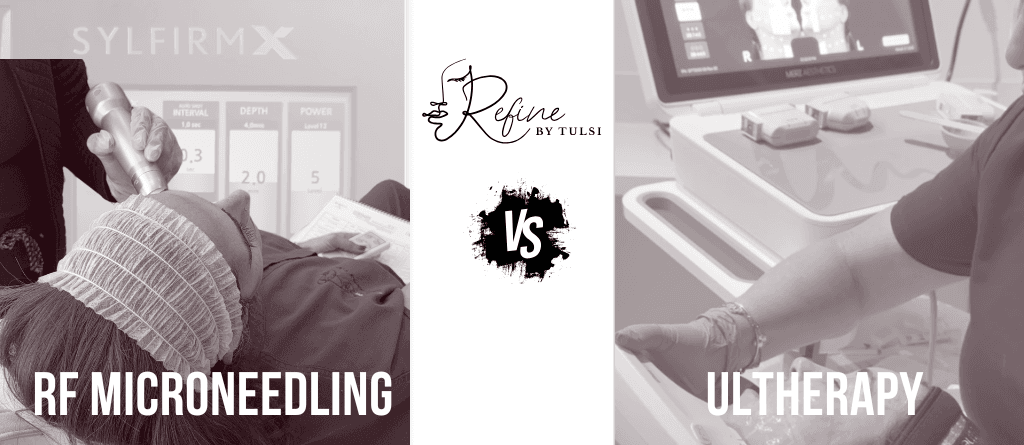
For patients looking to address these changes without surgery, two treatments are often mentioned in the same breath: RF microneedling and Ultherapy. They’re both non-surgical, both stimulate collagen, and both promise firmer skin over time. But they work very differently—and understanding those differences matters if you want results that feel natural and last.
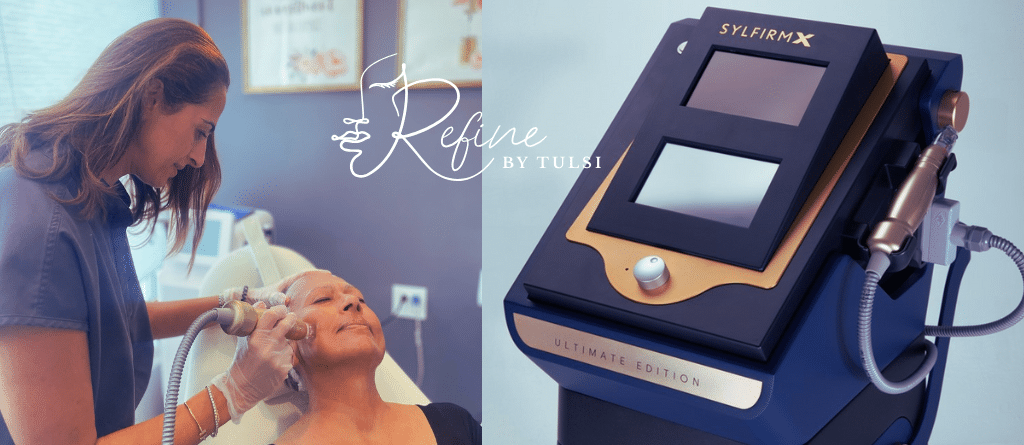
At Refine by Tulsi, for many patients, RF microneedling—specifically with Sylfirm—becomes the backbone of long-term skin quality and tightening, while other technologies are layered when appropriate.
Start with the real question: what’s actually changing?
Before choosing a device, it helps to name the problem clearly.
Some patients are bothered by:
- Crepey or thinning skin
- Loss of firmness, especially in the lower face
- Enlarged pores or uneven texture
- Early laxity without heavy sagging
Others notice:
- A softening jawline
- Mild drooping of the brows
- A sense that gravity is winning, even though the skin itself still looks “good”
These are not the same concerns—and they don’t respond to the same treatments.
How RF microneedling actually works
RF microneedling combines two mechanisms that the skin understands very well.
First, microneedles create controlled micro-injuries in the skin. This alone stimulates repair. But what makes RF microneedling different is what happens next: radiofrequency energy is delivered precisely into the dermis, the layer responsible for firmness, elasticity, and structure.
That heat triggers:
- Collagen remodeling
- Elastin stimulation
- Improved skin density
- Gradual tightening over time
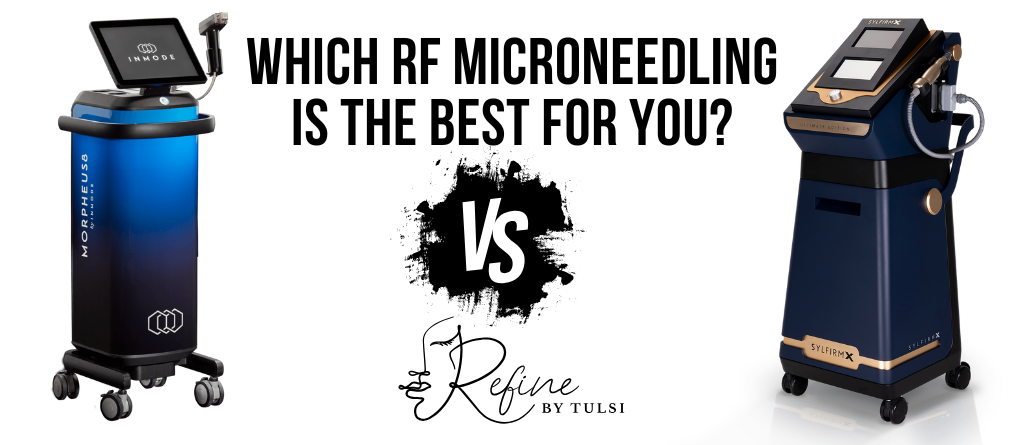
With Sylfirm RF microneedling, we’re able to control depth and energy with precision. That matters because skin is not uniform—cheeks, jawline, neck, and under-eye skin all behave differently.
Think of RF microneedling less as a “lift” and more as rebuilding the scaffolding that keeps skin resilient.
Why RF microneedling shines in real life
RF microneedling tends to excel where aging actually begins: in skin quality.
Patients often notice:
- Firmer texture
- Smoother surface
- Subtle tightening
- Improved glow and tone
- Skin that feels thicker and healthier
Importantly, these changes don’t look artificial. They accumulate quietly, which is why RF microneedling has become such a reliable option for patients who want improvement without a visible “procedure look.”
At Refine by Tulsi, Sylfirm RF microneedling is often used as a foundational treatment—something we build on over time rather than rely on once.
What Ultherapy does differently
Ultherapy uses focused ultrasound energy, not needles. Its distinguishing feature is depth.
Ultrasound energy is delivered to the SMAS layer, the deeper structural layer surgeons address during a facelift. Because of this, Ultherapy is often discussed as a non-surgical lifting option, particularly for:
- Jawline definition
- Brow positioning
- Mild skin laxity in the lower face or neck
Ultherapy doesn’t improve texture. It doesn’t refine pores. It doesn’t resurface the skin. Its role is structural tightening—helping deeper tissues resist gravity over time.
Results develop slowly, often over several months, and tend to be modest but meaningful in the right patient.
Why these treatments are often misunderstood
Both RF microneedling and Ultherapy are sometimes marketed as substitutes for surgery. That framing sets unrealistic expectations.
Neither treatment:
- Repositions tissue the way surgery does
- Removes excess skin
- Produces instant, dramatic lift
What they can do—when used correctly—is support the skin and deeper tissues so aging progresses more slowly and more gracefully.
RF Microneedling vs. Ultherapy: a clearer comparison
| Aspect | RF Microneedling (Sylfirm) | Ultherapy |
|---|---|---|
| Primary action | Collagen + elastin remodeling | Deep structural tightening |
| Skin texture improvement | Yes | No |
| Lift potential | Mild, gradual | Mild to moderate |
| Downtime | A few days of redness | Minimal |
| Best for | Skin quality, early laxity | Jawline, brow, deeper support |
| Treatment cadence | Series-based | Series-based |
For many patients, RF microneedling offers more visible, satisfying change because it improves the skin itself—the part you see every day.
Why we often lean toward RF microneedling at Refine by Tulsi
Aging rarely happens in just one layer. When skin thins and collagen declines, tightening deeper tissue alone isn’t enough.
RF microneedling addresses:
- The dermis, where collagen lives
- The texture that reflects light
- The quality that makes skin look youthful up close
That’s why we often recommend Sylfirm RF microneedling as a starting point, especially for patients in their 30s, 40s, and early 50s who want prevention and visible improvement without aggressive intervention.
It also pairs beautifully with:
A long-term tightening option to consider: The I-Laser
There is, however, a category of concern that RF microneedling and Ultherapy don’t fully address on their own: true skin tightening with fat remodeling.
This is where iLaser comes into the conversation.
iLaser targets deeper structures and fat pads, offering:
- More significant tightening
- Fat dissolution in targeted areas
- Longer-term structural change
For patients with:
- Heavier lower-face laxity
- Early jowling related to fat descent
- Post-weight-loss skin laxity
iLaser may be a better—or complementary—option. It’s not a first step for everyone, but when indicated, it provides a level of tightening that energy-based surface treatments simply can’t achieve.
Choosing the right path
The best results rarely come from asking, “Which device is best?”
They come from asking, “What does this face actually need?”
Some patients do best with:
- RF microneedling alone
- RF microneedling plus injectables
- Ultherapy layered on top of RF treatments
- iLaser when deeper tightening or fat reduction is needed
At Refine by Tulsi, the technology follows the anatomy—not the other way around.
Not Sure Which Skin Tightening Treatment Is Right for You?
RF microneedling (Sylfirm) and Ultherapy work in different layers of the skin. At Refine by Tulsi, we tailor your plan based on your anatomy, skin quality, and goals—whether that’s collagen remodeling with Sylfirm, deeper support with ultrasound, or iLaser for longer-term tightening and targeted fat reduction. A consultation will help you choose the safest, most natural path.
Book Your Skin Tightening ConsultationPhysician-led • Customized plans • Advanced tightening technologies
Final thought
Skin tightening isn’t about chasing lift. It’s about preserving structure, quality, and balance over time.
RF microneedling, particularly with Sylfirm, offers something rare: visible improvement that still looks like you. Ultherapy has a role, especially for deeper support. And for patients who need more, iLaser provides a powerful long-term option.
The key is not choosing the most aggressive treatment—but the most appropriate one.