


The hair on your head can be one of the most affirming aspects of your whole person. While it certainly does not define your beauty or your value, studies show that it can affect some people psychologically. Specifically, thinning hair or perceived hair loss can negatively impact an individual’s psyche and lead them to distress. Thankfully, convenient, non-surgical treatments exist to offer help to individuals who may be struggling with their hair, such as PRP for hair loss.
What is PRP?
PRP stands for Platelet-Rich Plasma. It’s derived from your own blood.
A small blood sample is drawn and placed into a centrifuge, which separates the blood into layers. One of those layers is plasma with a high concentration of platelets—cells best known for their role in clotting, but equally important for what they carry.
Platelets are rich in growth factors. These are signaling molecules that communicate with surrounding cells and help coordinate repair, regeneration, and healing.
PRP doesn’t introduce anything foreign into the body. It works by concentrating and redirecting signals your body already uses.
Why hair follicles respond to PRP
Hair follicles are biologically active structures. Even when hair is thinning, many follicles are still present—they’re just underperforming.
Hair loss, especially androgenetic and hormonally influenced hair loss, often involves:
- Reduced blood supply to the follicle
- Shortened growth (anagen) phase
- Increased inflammation around the follicle
- Dormant or miniaturized follicles
PRP targets several of these issues at once.
Growth factors in PRP can:
- Improve blood flow to the scalp
- Signal follicles to re-enter or extend the growth phase
- Reduce inflammatory signaling around the follicle
- Support thicker, healthier hair shafts over time
In other words, PRP doesn’t “create” new follicles. It helps existing follicles function more effectively.
What PRP does—and what it doesn’t
This distinction matters, especially for expectations.
PRP can:
- Slow active hair shedding
- Improve hair density
- Increase hair shaft thickness
- Support healthier regrowth
- Improve scalp health
PRP cannot:
- Restore hair to completely bald areas with no follicles
- Replace hair transplantation
- Work overnight
PRP works best when follicles are still present but struggling.
The hair growth cycle, briefly explained
Hair grows in cycles:
- Anagen (growth phase)
- Catagen (transition phase)
- Telogen (resting/shedding phase)
In hair loss, the growth phase shortens and more follicles remain in the resting phase. PRP’s role is to shift that balance, encouraging follicles to spend more time growing and less time dormant.
This is why PRP results take time. You’re working with biology, not forcing a cosmetic illusion.
What a PRP hair treatment actually feels like
After the blood draw and preparation, PRP is introduced into the scalp—typically through a series of small injections in areas of thinning.
Most patients describe:
- Pressure or brief stinging during injections
- Mild scalp tenderness afterward
- Minimal downtime
Redness or soreness usually resolves within a day or two. Patients can return to normal activity quickly, though strenuous exercise is often avoided for 24 hours.
Why technique and preparation matter
Not all PRP is the same.
Outcomes depend on:
- Platelet concentration
- How PRP is processed
- Injection depth and placement
- Treatment spacing
- Overall treatment plan
PRP performed without attention to these details may yield disappointing results—not because PRP “doesn’t work,” but because biology wasn’t respected.
At Refine by Tulsi, PRP is approached as a medical treatment, not a cosmetic add-on.
Who benefits most from PRP for hair loss
PRP tends to be most effective for:
- Early to moderate thinning
- Androgenetic hair loss
- Post-partum or hormonally driven shedding
- Menopausal hair thinning
- Patients seeking non-surgical options
It can be used alone or as part of a broader plan that may include:
- Microneedling or RF microneedling of the scalp
- Nutritional and hormonal evaluation
- Regenerative adjuncts such as PRF or exosomes
- Medical hair loss therapies when appropriate
Why PRP is rarely a one-time treatment
Hair loss is not static, and PRP works cumulatively.
Most patients benefit from:
- An initial series of treatments
- Followed by maintenance sessions
This allows growth factors to repeatedly signal follicles during multiple growth cycles. PRP is not about instant transformation—it’s about supporting long-term follicle health.
A note on expectations
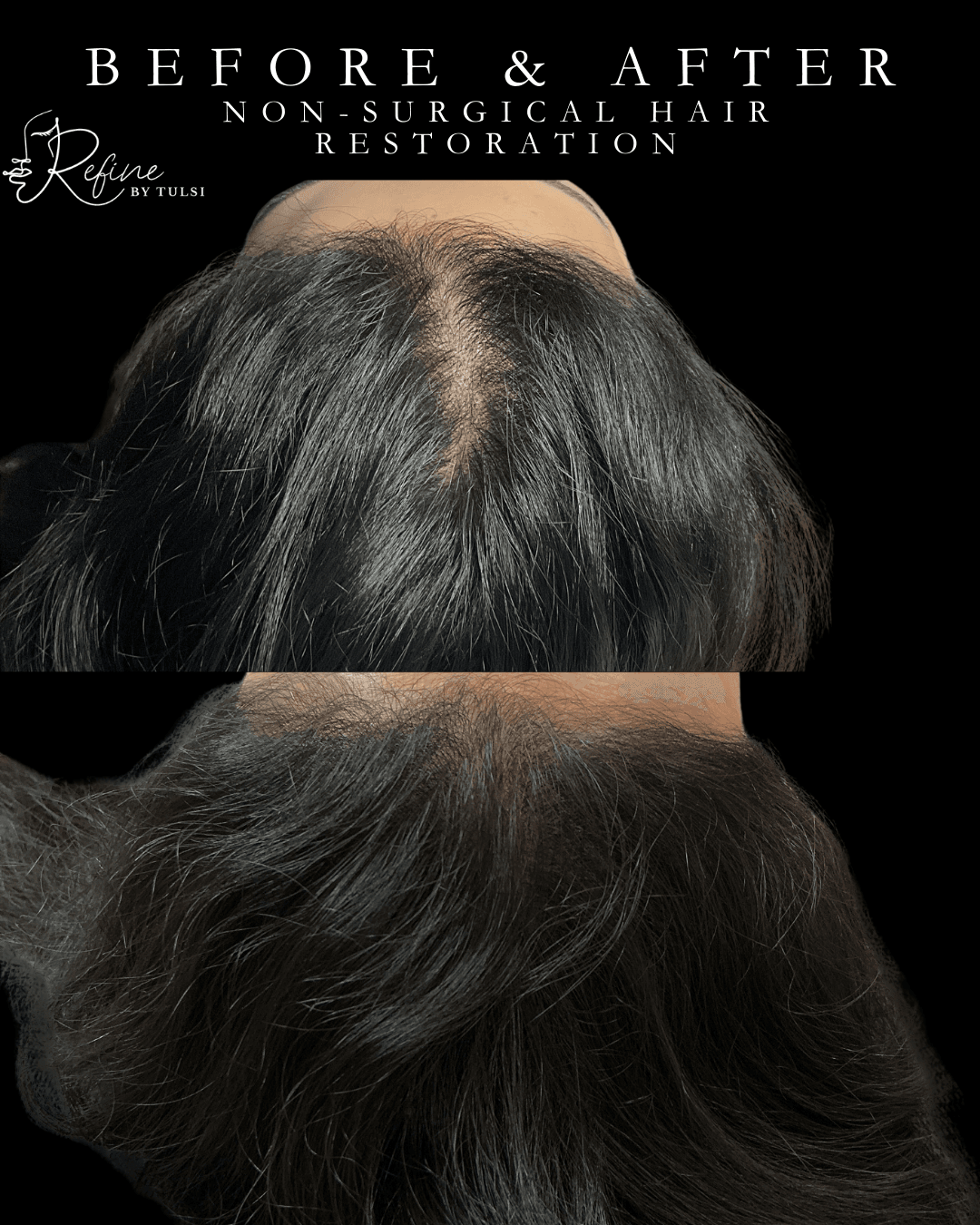
PRP doesn’t usually produce dramatic “before and after” moments overnight. What patients often notice first is:
- Less shedding
- Hair that feels thicker
- Improved scalp comfort
- Gradual improvement in density over months
These changes are subtle but meaningful—and often more sustainable than quick fixes.
Why physician-led care matters
Hair loss can be hormonal, inflammatory, genetic, nutritional—or a combination of all four.
PRP works best when it’s:
- Part of a diagnostic conversation
- Timed appropriately
- Integrated into a broader plan
- Adjusted as the body changes
At Refine by Tulsi, PRP is never offered in isolation without understanding the why behind the hair loss.
Final thought
PRP for hair loss isn’t about forcing hair to grow where it can’t. It’s about creating the right environment for follicles that still want to work.
When used thoughtfully, PRP doesn’t shout.
It nudges.
And over time, those nudges add up.
For patients who want a non-surgical, biologically intelligent approach to hair restoration, PRP remains one of the most grounded options available.
Ready to Address Hair Loss at the Root?
Whether you’re noticing early thinning, increased shedding, or hormonally driven hair loss, we take a physician-led, regenerative approach using PRP/PRF, exosomes, and advanced scalp collagen support. Start with a consultation to understand what’s driving your hair loss—and what plan will actually move the needle.
Physician-led • Regenerative scalp treatments • Personalized plans