There’s a quiet shift happening in Chicago aesthetics. Walk into any Lincoln Park coffee shop or Logan Square co-working space and you’ll overhear 30-somethings discussing preventative Botox with the same casual sophistication they discuss their skincare routines or workout plans.
But here’s what most of that conversation gets wrong: preventative Botox isn’t just “getting Botox earlier.” It’s a fundamentally different approach to facial aging—one that requires medical understanding, strategic planning, and honest assessment of whether you actually need it yet.
At Refine by Tulsi, I’ve been having this conversation with Chicago professionals for years. And the questions are always the same: When should I actually start? Will I look frozen? How do I know if I need it? And honestly, is this just clever marketing or real medicine?
Let me give you the physician-led, evidence-based answer—including when you probably don’t need Botox yet.
What Preventative Botox Actually Means
Preventative Botox isn’t about treating wrinkles you don’t have. It’s about understanding how wrinkles form in the first place—and strategically intervening before temporary lines become permanent creases.
Here’s the science: Every time you make a facial expression—squinting at your laptop, concentrating in meetings, raising your eyebrows when you’re surprised—you’re creating a dynamic line. Do this thousands of times over years, and those dynamic lines eventually etch into your skin as static lines (the kind you can see even when your face is at rest).
Dynamic vs. Static Lines: The Critical Difference
Dynamic lines: Only visible when you’re making an expression (smiling, frowning, squinting). These are caused by muscle movement.
Static lines: Visible even when your face is relaxed. These are caused by years of repeated muscle movement creating permanent creases in the skin.
Preventative Botox targets dynamic lines before they become static. Once lines are static, Botox can soften them but may not erase them completely—you’d need additional treatments like fillers or skin resurfacing.
Preventative Botox uses small, strategic doses of botulinum toxin to temporarily relax specific facial muscles—the ones creating those repeated expressions. This doesn’t freeze your face; it simply reduces the intensity of the muscle contraction, allowing the overlying skin to smooth out before permanent damage occurs.
Think of it like this: if you were training for a marathon, you wouldn’t wait until you had a stress fracture to buy proper running shoes. Preventative Botox is the proper running shoes—strategic support that prevents injury rather than treats damage after it’s done.
The Science: Why Your 30s Actually Matter
Your mid-to-late 20s through early 30s is when most people transition from purely dynamic lines to early static lines. Here’s what’s happening biologically:
- Collagen production slows: You’re producing about 1% less collagen per year after age 25
- Cell turnover decreases: Your skin isn’t regenerating as quickly, so damage accumulates
- Repeated expressions add up: By 30, you’ve made hundreds of thousands of facial expressions—that’s a lot of mechanical stress on the same areas
- Environmental damage accumulates: Years of sun exposure, pollution (hello, Chicago winters), and stress begin to show
- Fat pad descent begins: Subtle volume loss in the face changes how skin sits over muscle
For Chicago professionals specifically, there are additional factors: the stress of competitive work environments (which creates chronic muscle tension), screen time (constant squinting and forward head posture), and seasonal transitions (dry winter air accelerates skin aging).
This isn’t about vanity. It’s about understanding that your 30s are the window where strategic intervention has the highest return on investment—before you’re playing catch-up with entrenched damage.
Who Should Actually Consider Preventative Botox
Not everyone in their 30s needs Botox. Here’s my honest assessment as a physician:
You’re a Good Candidate If:
- You have visible dynamic lines when making expressions (forehead lines when you raise eyebrows, crow’s feet when you smile, frown lines between eyebrows)
- Those lines are starting to linger even when your face is relaxed—the very early stage of becoming static
- You have strong, expressive facial muscles (some people naturally have more active facial musculature)
- You have a family history of early facial aging in the areas you’re concerned about
- You want to maintain your current appearance rather than reverse existing aging
- You value a prevention-focused approach to aesthetics and wellness
You Probably Don’t Need It Yet If:
- You only see lines when you make extreme expressions (like dramatically raising your eyebrows as high as possible)
- Your skin bounces back immediately when you relax your face—no lingering lines at all
- You’re under 28 unless you have unusually strong facial musculature or significant sun damage
- You’re doing it purely because of social media pressure rather than actual visible signs
- You haven’t established a solid skincare foundation yet (sunscreen, retinoids, hydration) which should come first
The Honest Truth About Social Media Influence
Social media has normalized preventative Botox to the point where many 25-year-olds think they’re “behind” if they haven’t started. This is marketing, not medicine.
I’ve turned away patients in their late 20s who had zero visible lines because they’d been convinced by influencers that they needed to start “before it’s too late.” That’s not how facial aging works. There’s no arbitrary age where you suddenly need Botox—it’s about your individual facial anatomy, expression patterns, and visible signs.
If you’re considering preventative Botox, look in the mirror with a critical eye (or better yet, consult a physician). Are there actual lines forming, or are you reacting to content creators who are paid to promote early treatment?
How Preventative Botox Differs from Treatment Botox
| Factor | Preventative Botox (30s) | Treatment Botox (40s+) |
|---|---|---|
| Goal | Prevent static lines from forming | Soften existing static lines |
| Dosing | Lower units, strategic placement | Higher units, broader coverage |
| Results | Subtle softening, maintained mobility | More visible smoothing, relaxation |
| Frequency | Every 3-4 months initially, spacing out over time | Every 3-4 months consistently |
| Additional Treatments | Usually standalone (Botox only) | Often combined with fillers, skin treatments |
| Philosophy | Maintenance and prevention | Correction and improvement |
The key difference is dosing strategy. For preventative Botox in your 30s, I’m using conservative doses to soften muscle movement without eliminating it. You should still be able to make normal expressions—you’re just reducing the intensity of the contraction enough to prevent permanent creasing.
For someone in their 40s or 50s treating established static lines, I might use higher doses to achieve more significant muscle relaxation, often in combination with other treatments to address the skin quality and volume loss that accompany deeper aging.
Strategic Areas for Preventative Botox in Your 30s
Not all areas benefit equally from preventative treatment. Here’s where I most commonly treat Chicago professionals in their 30s:
1. Glabellar Lines (The “11s” Between Eyebrows)
This is the #1 area for preventative Botox and often the first place people see early static lines. These vertical lines between your eyebrows form from frowning, concentrating, or squinting—all things Chicago professionals do constantly during work.
Why treat early: This area etches deeply and quickly due to strong underlying muscles and relatively thin skin. Prevention here has one of the highest returns on investment.
2. Forehead Lines (Horizontal Wrinkles)
Those horizontal lines across your forehead from raising your eyebrows. Some people have naturally very expressive foreheads and develop these lines earlier.
Why treat early: Forehead lines can age you significantly and are often the first thing people notice. Conservative treatment maintains natural movement while preventing deep creasing.
Important caveat: If you treat the glabella (area between brows) but not the forehead, you can create an unnatural “Spock brow” elevation. This is why physician expertise in assessment and dosing matters.
3. Crow’s Feet (Around Eyes)
The lines that radiate from the outer corners of your eyes when you smile or squint. While smile lines are natural and even attractive, excessive crow’s feet can make eyes look tired.
Why treat early: The skin around the eyes is the thinnest on your face and shows aging first. Preventative treatment here maintains a bright, youthful eye area.
Chicago-specific note: Our winters are brutal. Squinting in bright snow glare and wincing in cold wind accelerates crow’s feet formation. Prevention is worth considering if you’re outdoors frequently.
Areas I Generally Don’t Recommend for Preventative Treatment in 30s:
- Bunny lines (nose wrinkles): Usually not prominent enough to warrant early treatment
- Lip lines: Vertical lip lines typically don’t become static until 40s+ unless you’re a smoker
- Neck bands: Platysma bands usually appear later; preventative treatment here is rarely necessary in 30s
What Results Actually Look Like (And How to Avoid the Frozen Look)
The #1 fear I hear from Chicago professionals considering Botox: “I don’t want to look frozen or overdone.”
Here’s the truth: that frozen, expressionless look you’re afraid of? That’s not a feature of Botox—it’s a failure of technique. Specifically, it happens when:
- Too many units are used (overdosing)
- Product is placed incorrectly
- The injector doesn’t understand facial anatomy
- A patient is treated with a “standard protocol” instead of individualized assessment
When done correctly for preventative purposes, Botox results should be:
- Subtle: People notice you look refreshed, not “different”
- Natural: You can still make all normal expressions
- Gradual: Takes 3-7 days to see full effect, so changes aren’t sudden
- Proportional: Softening is balanced across your face
I was terrified I’d look fake or frozen, but Dr. Kotecha walked me through exactly what to expect. She used what she called a ‘conservative dose’ on my forehead and between my brows. Within a week, I noticed I wasn’t furrowing as much when I worked, but I could still raise my eyebrows normally. My husband said I looked less tired but couldn’t pinpoint what changed. That’s exactly what I wanted.
At our Lincoln Park and Logan Square locations, my approach to preventative Botox is intentionally conservative:
- Start with lower doses: It’s easier to add more than to reverse overdoing it
- Preserve natural movement: You should be able to make normal facial expressions
- Treat strategically: Not every area needs treatment; I only treat where it’s medically indicated
- Follow-up and adjust: I see patients at 2 weeks to assess results and determine if any adjustments are needed
The Integration Approach: Botox as Part of Holistic Aesthetics
Here’s what sets Refine by Tulsi apart from standard Botox providers: we don’t treat Botox as a standalone cosmetic fix. It’s part of a comprehensive approach to facial aging that includes:
- Facial Balancing: Understanding how volume loss and structural changes affect your face overall
- Medical-grade skincare: Retinoids, antioxidants, and sun protection working synergistically with Botox
- Longevity medicine: Addressing internal factors (hormones, inflammation, nutrition) that affect how you age
- Prevention-focused strategy: Treating the whole person, not just chasing individual wrinkles
For example, if you’re experiencing accelerated facial aging due to stress-related cortisol issues or declining collagen production from hormonal changes, Botox alone won’t give you optimal results. We’d address the root cause while using Botox strategically for the visible muscle-related lines.
This is physician-led medicine, not a transactional cosmetic service.
Cost-Benefit Analysis: Investment vs. Expense
Let’s talk about money honestly. Botox in Chicago typically ranges from $12-$16 per unit. For preventative treatment in your 30s, you might need:
- Glabella (11 lines): 15-20 units = $180-$320
- Forehead: 10-20 units = $120-$320
- Crow’s feet: 12-24 units (both sides) = $144-$384
Total for comprehensive preventative treatment: $444-$1,024 every 3-4 months
That’s $1,776-$4,096 annually. Not insignificant.
The Long-Term Math
Here’s the financial case for preventative Botox: If you start preventative treatment at 32 and maintain it, by age 45 you’re likely still using similar dosing because you’ve prevented static line formation.
If you wait until 40 to start treatment, you’re now treating established static lines, which requires:
- Higher Botox doses (more units = more cost)
- Addition of fillers for static lines ($700-$1,500 per syringe)
- Potentially skin resurfacing treatments ($1,500-$4,000)
- More frequent maintenance
The prevention approach can actually cost less over a lifetime than playing catch-up later. But this only makes sense if:
- You’re treating actual visible signs (not social media anxiety)
- You can comfortably afford it without financial stress
- You view it as long-term investment, not quick fix
- You’re also investing in foundational skincare and health
Bottom line: Don’t start Botox if you’re putting it on a credit card or sacrificing retirement savings. But if you can afford it and have medical indication, the prevention strategy offers better long-term value than waiting.
Questions to Ask Your Potential Provider:
- “How many units would you use for my specific concern?” (Run from anyone who quotes units before examining you)
- “What’s your philosophy on preventative Botox vs. treatment Botox?”
- “What happens if I’m not happy with the results?”
- “How do you determine dosing for first-time patients?”
Red Flags:
- Groupon or heavy discounting (quality products and expertise have costs)
- “More is better” mentality
- Pressure to treat multiple areas immediately
- No follow-up offered
- Cookie-cutter “units per area” approach without individualized assessment
What to Expect: The Treatment Timeline
If you decide to move forward with preventative Botox at Refine by Tulsi, here’s what the process looks like:
Initial Consultation (30-45 minutes)
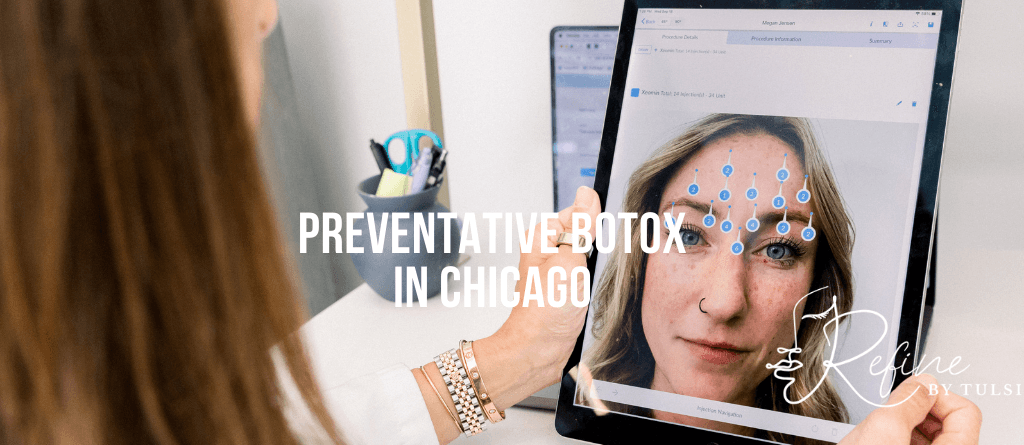
- Comprehensive facial assessment with photography
- Discussion of your goals, concerns, medical history
- Treatment plan with recommended areas and units
- Honest conversation about whether you actually need treatment yet
- Cost breakdown and timeline expectations
Treatment Appointment (15-30 minutes)
- Quick cleansing of treatment areas
- Topical numbing if desired (most people don’t need it)
- Strategic injection of predetermined units
- Post-treatment instructions
- You can return to work immediately (possible mild redness at injection sites)
Timeline After Treatment:
- Days 1-2: Possible mild tenderness or tiny bumps at injection sites (resolves within hours)
- Days 3-5: Beginning to notice subtle softening of lines
- Days 7-10: Full effect visible
- Week 2: Follow-up appointment to assess results and determine if any adjustments needed
- Months 3-4: Effects gradually wear off; time for next treatment
Important Post-Treatment Guidelines:
- No lying down flat for 4 hours after treatment
- No intense exercise for 24 hours
- No massage or pressure on treated areas for 24 hours
- Avoid alcohol and blood thinners before treatment to minimize bruising risk
Common Mistakes to Avoid
After treating hundreds of Chicago professionals, these are the most common preventative Botox mistakes I see:
1. Starting Too Early Without Medical Indication
Having Botox at 25 because influencers say you should is not the same as having Botox at 33 because you have visible dynamic lines starting to set. One is marketing; one is medicine.
2. Going to the Cheapest Provider
Your face is not the place to bargain hunt. Cheap Botox often means: diluted product, inexperienced injector, or poor assessment. This is one area where you truly get what you pay for.
3. Treating Only One Area
Treating glabella but not forehead can create unnatural brow elevation. Treating forehead without considering crow’s feet can make eye aging more apparent. An experienced injector thinks about facial balance, not just individual concerns.
4. Inconsistent Maintenance
Getting Botox once, letting it wear off completely, then getting it again months later is less effective than consistent maintenance every 3-4 months. The prevention benefit comes from keeping those muscles trained to move less.
5. Neglecting Skincare Foundation
Botox addresses dynamic lines from muscle movement. It doesn’t fix sun damage, texture issues, or skin quality. You still need sunscreen, retinoids, and proper skincare. Botox is part of the strategy, not the whole strategy.
I started Botox at 31 when I noticed my forehead lines weren’t bouncing back like they used to. I’ve been going to Dr. Kotecha every three months for two years now. The difference isn’t that I look dramatically younger—it’s that I look exactly the same as I did at 31. My friends who waited are now spending way more on multiple treatments trying to reverse aging. I’m glad I took the prevention approach.
The Bottom Line: Is Preventative Botox Right for You?
After all of this, here’s my honest take as a physician:
Preventative Botox makes sense if:
- You have visible dynamic lines that are beginning to persist when your face is relaxed
- You understand it’s a long-term commitment, not a one-time fix
- You can comfortably afford it as part of your wellness budget
- You want a prevention-focused approach to aging
- You’ve established foundational skincare habits (sunscreen, retinoids)
- You’re seeking subtle, natural results and not dramatic transformation
Preventative Botox probably isn’t right for you if:
- You have no visible lines yet and are doing it purely out of anxiety
- You’re expecting it to address concerns it can’t fix (skin texture, volume loss, sagging)
- You can’t afford consistent maintenance without financial stress
- You haven’t tried basic skincare interventions first
- You’re looking for dramatic, immediately visible change
The truth is, many people in their early-to-mid 30s don’t need Botox yet. And that’s fine. There’s no award for starting earliest.
But if you do have medical indication—if those dynamic lines are starting to stick around, if you’re noticing changes that bother you—then preventative Botox, done correctly by a qualified physician, can be a smart part of a comprehensive longevity-focused approach to aging.
Schedule Your Botox Consultation
Not sure if you’re a candidate for preventative Botox? Schedule a consultation with Dr. Tulsi Kotecha at our Lincoln Park or Logan Square location. We’ll do a comprehensive facial assessment and give you honest medical guidance—including whether you actually need treatment yet.
Book Your Consultation Call (618) 298-8574About Dr. Tulsi Kotecha
Dr. Tulsi Kotecha is the founder and medical director of Refine by Tulsi, a physician-led aesthetic and wellness practice with locations in Lincoln Park and Logan Square, Chicago. She specializes in preventative aesthetics, facial balancing, and integrative longevity medicine.
Dr. Kotecha’s approach combines evidence-based medical expertise with a prevention-focused philosophy: treating the whole person, not just individual aesthetic concerns. Her Chicago patients value her honest assessments, conservative dosing, and commitment to natural-looking results.
Learn more about Dr. Kotecha and her approach to preventative aesthetics.
This article is for educational purposes and does not constitute medical advice. Botox should be administered under the guidance of a qualified physician. Individual results may vary.