
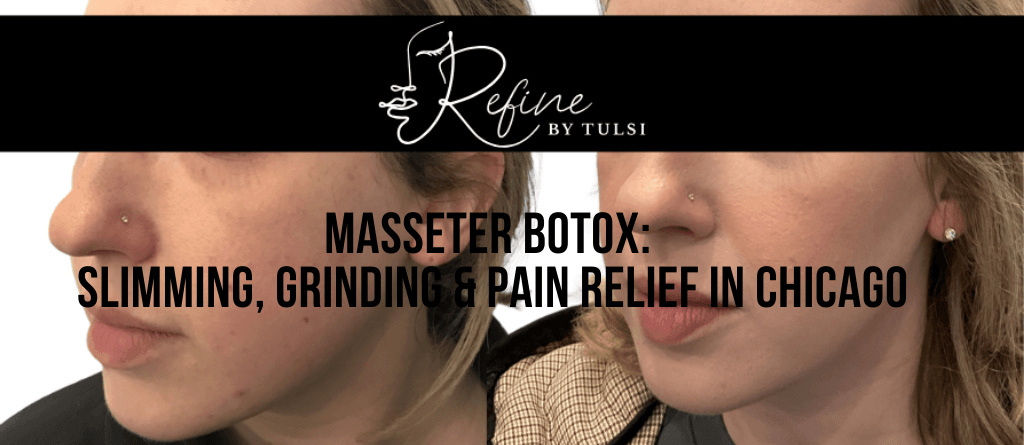
A physician’s guide to masseter neurotoxin treatment for aesthetic contouring, TMJ relief, and teeth grinding—and why the medical approach matters.
I’ve noticed an interesting shift in my Lincoln Park and Logan Square practices over the past year. More Chicago professionals are coming in asking about masseter Botox—not just for the aesthetic jaw slimming effect that’s trending on social media, but because they’re waking up with headaches, noticing jaw tension during stressful work weeks, or their dentist has mentioned teeth grinding.
This convergence of aesthetic and medical benefits is exactly what makes masseter neurotoxin treatment so compelling. It’s one of the few procedures where the functional improvements can be just as significant as the cosmetic ones. But here’s what most content online misses: how you approach masseter treatment medically determines both the safety and the sophistication of your results.
Let’s talk about what masseter Botox actually does, who benefits most, what to expect in Chicago’s professional environment, and how a physician-led approach differs from the standard med spa injection.
What Masseter Botox Actually Is (And What It Isn’t)
The masseter is one of the strongest muscles in your body relative to its size. It’s the primary muscle you use for chewing, and it’s located at the angle of your jaw. In some people, this muscle becomes hypertrophied—meaning it’s enlarged either from genetics, teeth grinding (bruxism), jaw clenching (often stress-related), or TMJ dysfunction.
When we inject neurotoxin (typically Botox, Dysport, Xeomin, or Daxxify) into the masseter muscle, we’re selectively weakening it. This serves multiple purposes:
- Aesthetic contouring: Over 4-6 weeks, the muscle atrophies slightly, creating a slimmer, more tapered lower face shape
- Functional relief: Reduced muscle activity means less tension, fewer tension headaches, and decreased tooth wear from grinding
- TMJ symptom management: Many patients with temporomandibular joint dysfunction see significant improvement in jaw pain and clicking
⚕️ Medical Perspective: Why Dose Matters
The masseter is unique because it requires higher doses than facial muscles (typically 20-40 units per side vs. 4-8 units for crow’s feet). This is where medical training becomes critical—underdosing means no results; overdosing can affect smile asymmetry or chewing function. At Refine by Tulsi, we calculate dose based on muscle mass assessment, not a one-size-fits-all approach.
The Chicago-Specific Context: Why Masseter Treatment Is Trending Here
I’m seeing masseter requests increase significantly in Chicago, and I think there are several factors at play that make this particularly relevant to our patient population:
1. Professional Stress and Jaw Clenching
Chicago’s competitive professional environment—law firms, finance, consulting, tech startups—creates the perfect storm for stress-related jaw clenching. Many of my patients don’t realize they’re clenching until I ask them to notice their jaw position during their morning commute or during a tense meeting. That chronic tension builds the masseter muscle over time.
2. The Shift Toward Subtle, Strategic Aesthetics
Chicago professionals tend to prefer sophisticated, understated results over dramatic transformations. Masseter reduction fits this aesthetic perfectly—it’s facial refinement, not facial reconstruction. The effect is subtle enough that colleagues won’t pinpoint what changed, but noticeable enough that you look more rested and proportioned.
3. Integration with Facial Balancing
At Refine by Tulsi, we rarely do masseter treatment in isolation. It’s often part of a comprehensive facial balancing strategy where we’re looking at overall facial proportions. Sometimes reducing the lower face width allows us to enhance cheekbones with Sculptra or create better jawline definition with strategic filler placement.
“I came in for masseter Botox thinking it was purely aesthetic, but Dr. Kotecha identified that my jaw tension was contributing to my chronic headaches. Three weeks after treatment, not only did my face look more tapered, but I stopped waking up with that tight, achy feeling in my jaw. It’s been transformative for both how I look and how I feel.”
— Sarah M., 34, Marketing Director, Lincoln Park
Who Benefits Most from Masseter Botox
Masseter treatment isn’t for everyone, and this is where a medical assessment becomes essential. Here’s how I think about ideal candidates:
You’re Likely a Great Candidate If:
- You have a square or wide lower face shape that you’d like to soften
- You can feel prominent muscle bulk when you clench your jaw
- You grind your teeth at night (your dentist may have mentioned this)
- You wake up with jaw soreness or tension headaches
- You notice you clench during stress or concentration
- You’ve been diagnosed with TMJ dysfunction
- You want facial slimming without altering bone structure
You May Not Be a Good Candidate If:
- Your wide lower face is due to bone structure, not muscle (we can assess this)
- You have a very lean face with minimal muscle mass (treatment could look hollowing)
- You require strong masseter function for professional reasons (wind instrument musicians, for example)
- You’re pregnant or breastfeeding
The Diagnostic Assessment
During consultation at our Lincoln Park or Logan Square locations, I have patients clench their jaw while I palpate the masseter. This tells me muscle mass, symmetry, and whether the bulk is muscular vs. structural. I also ask about grinding, headaches, and jaw clicking—these functional symptoms often improve dramatically with treatment.
The Treatment Experience: What to Expect in Chicago
One of the most common questions I get is about the treatment process itself. Here’s the reality at Refine by Tulsi:
During Treatment
The injection process itself takes about 10-15 minutes. We typically inject 3-5 points per masseter muscle, using a very fine needle. Most patients describe the sensation as similar to getting Botox in other facial areas—a brief pinch with each injection.
We often combine masseter treatment with other facial neurotoxin (forehead, crow’s feet, etc.) in the same appointment, making it an efficient use of time for busy Chicago professionals. You can absolutely schedule this during a lunch break and return to work immediately.
Immediately After
There’s typically minimal downtime. You might have slight redness at injection sites that resolves within an hour. I advise patients to avoid:
- Lying down for 4 hours post-treatment
- Vigorous exercise for 24 hours
- Massaging or applying pressure to the area
- Alcohol for 24 hours (can increase bruising risk)
The Timeline of Results
This is where masseter treatment differs significantly from other neurotoxin applications:
| Timeline | What’s Happening | What You’ll Notice |
|---|---|---|
| Days 1-3 | Neurotoxin begins blocking muscle signals | Possibly subtle reduction in clenching urge |
| Week 1-2 | Muscle activity significantly reduced | Less jaw tension, fewer morning headaches |
| Weeks 3-4 | Muscle begins to atrophy from reduced use | Subtle visual slimming becomes noticeable |
| Weeks 6-8 | Peak aesthetic and functional results | Maximum jaw contouring and symptom relief |
| Months 3-6 | Results gradually fade as muscle rebuilds | Shape and symptoms gradually return to baseline |
The key insight here: masseter results take longer to develop than other Botox treatments because we’re not just relaxing muscle, we’re causing muscle atrophy. This means if you have an important event, you need to plan at least 6-8 weeks ahead for peak results.
“As someone who works in consulting and travels frequently, the fact that masseter Botox has virtually no downtime was crucial. I had it done on a Friday afternoon at the Logan Square location, flew to New York Saturday morning for client meetings, and nobody had any idea I’d had a procedure. The results took about a month to fully develop, but the reduction in my jaw clenching started within the first week.”
— Michael T., 42, Strategy Consultant, West Loop
Masseter Botox vs. Other Jaw Treatments: Making the Right Choice
I often have patients ask how masseter neurotoxin compares to other jaw contouring or TMJ treatments. Here’s my honest assessment:
| Treatment | Best For | Results Timeline | Longevity | Considerations |
|---|---|---|---|---|
| Masseter Botox | Muscle bulk reduction, TMJ relief, teeth grinding | 6-8 weeks for full effect | 3-6 months | Requires maintenance, no downtime, reversible |
| Jawline Filler | Weak jawline, jowls, adding definition to lower third | Immediate | 12-18 months | Adds volume rather than reducing; can be combined |
| Kybella for Submental | Submental fat (double chin), not jaw muscle | 6-12 weeks | Permanent | Addresses fat, not muscle; different target area |
| TMJ Night Guard | Protecting teeth from grinding | Immediate protection | Ongoing use | Protects teeth but doesn’t reduce muscle size or tension |
| Jaw Surgery | Severe jaw misalignment, structural bone issues | 6-12 months for full healing | Permanent | Major procedure, significant recovery, addresses bone |
At Refine by Tulsi, we often combine masseter neurotoxin with strategic jawline filler placement. Reducing the width at the angle of the jaw while adding definition along the jawline creates a beautiful, proportional contour that looks completely natural.
The Medical vs. Med Spa Approach: Why It Matters for Masseter Treatment
This is where I need to be frank about something most blogs won’t tell you: masseter injection requires significantly more anatomical knowledge than other neurotoxin applications. Here’s why:
Complex Anatomy
The masseter has close proximity to the parotid gland, facial nerve branches, and several other critical structures. Injection too anterior can affect the smile (zygomaticus major muscle); too posterior can impact the parotid duct. This requires three-dimensional anatomical understanding, not just following dots on a diagram.
Dose Calculation
Unlike forehead or crow’s feet where there’s a relatively narrow dose range that works for most people, masseter dosing varies widely based on muscle mass. I’ve seen patients require anywhere from 20 units to 50 units per side. A physician can assess muscle bulk, understand the neurology of the injection, and adjust accordingly.
Functional Assessment
At Refine by Tulsi, we don’t just ask “Do you want a slimmer jaw?” We ask about grinding, TMJ symptoms, headaches, dental issues. This medical context changes how we approach treatment—dosing, injection pattern, follow-up timing. It’s the difference between cosmetic injection and medical aesthetics.
The Refine by Tulsi Difference
Every masseter treatment at our practice begins with a comprehensive facial analysis and functional assessment. We photograph your baseline, palpate your masseter muscle mass, assess for asymmetry, and discuss both aesthetic and functional goals. This physician-led approach means we’re not just following a standard protocol—we’re customizing treatment to your anatomy and needs.
Cost, Maintenance, and the Long-Term Perspective
Let’s talk about the practical realities of masseter treatment in Chicago:
Investment
Masseter neurotoxin typically costs more than other facial areas because it requires more units. At Refine by Tulsi, pricing is transparent and based on the number of units needed for your specific muscle mass. Most patients require 40-80 total units (both sides combined) for effective treatment.
While this represents a higher per-treatment cost than crow’s feet or forehead lines, many patients find the combined aesthetic and functional benefits make it excellent value—especially if you’re getting relief from chronic headaches or TMJ pain that would otherwise require ongoing treatment.
Maintenance Schedule
Results typically last 4-6 months, which means most patients maintain with 2-3 treatments per year. However, I’ve noticed something interesting: many patients find they need less frequent treatment over time.
The theory is that by preventing the muscle from clenching as forcefully for several months at a time, you break the habit pattern. Some of my long-term masseter patients have stretched their treatment intervals to every 6-8 months while maintaining good results.
Combining with Other Treatments
Most of my Chicago patients approach aesthetics strategically, combining treatments for comprehensive results. Common combinations with masseter neurotoxin:
- Facial balancing with fillers to create overall proportion
- Sculptra in the midface to enhance the slimming effect of masseter reduction
- RF Microneedling for skin tightening along the jawline
- Full facial neurotoxin for comprehensive rejuvenation
“I’ve been getting masseter Botox for almost two years now, and it’s become part of my regular maintenance routine along with facials and dental cleanings. The jaw slimming effect has been consistent, but the real win for me is that I’ve stopped grinding my teeth entirely. My dentist actually commented on how much better my enamel looks. It’s one of those treatments where the medical and aesthetic benefits reinforce each other.”
— Jennifer L., 39, Attorney, Gold Coast
Potential Side Effects and What to Watch For
I believe in informed consent, which means being honest about potential side effects even when they’re rare. With masseter treatment:
Common (But Temporary):
- Mild soreness at injection sites (1-2 days)
- Slight asymmetry during the first week as neurotoxin takes effect unevenly (this normalizes)
- Feeling of mild weakness when chewing very tough foods (typically subsides as you adjust)
Uncommon But Possible:
- Smile asymmetry if injection is too anterior (this is why anatomical knowledge is crucial)
- Difficulty chewing extremely hard foods if dose is too high
- Bruising at injection sites (more common if you take blood thinners)
When to Contact Your Provider:
At Refine by Tulsi, we have all patients schedule a 2-week follow-up (virtual or in-person) to assess early results. Contact us immediately if you experience significant smile asymmetry, difficulty chewing normal foods, or any concerning symptoms.
Safety Note
All masseter treatments at Refine by Tulsi are performed by Dr. Tulsi Kotecha or supervised physician associates. We maintain emergency protocols and follow-up systems specifically because we treat masseter as a medical procedure, not just a cosmetic injection. Your safety is paramount.
Beyond Aesthetics: The Functional Medicine Perspective
Here’s what sets our approach apart: at Refine by Tulsi, we don’t separate aesthetics from overall health. When a patient comes in for masseter treatment, we’re also asking about:
- Sleep quality: Teeth grinding is often worse during poor sleep or high stress
- Stress management: Jaw clenching is frequently stress-related
- Hormonal factors: Some women notice increased grinding during certain parts of their cycle or during perimenopause
- Nutritional status: Magnesium deficiency can contribute to muscle tension
This is where our Refine Her women’s wellness program and concierge medicine approach create additional value. We can address masseter hypertrophy with neurotoxin while simultaneously working on the underlying causes through hormone optimization, stress management, and peptide therapy for overall nervous system regulation.
Timing Your Treatment: Chicago Seasonal Considerations
While masseter treatment doesn’t have the same seasonal considerations as some procedures (like laser treatments), I do have some timing recommendations for Chicago patients:
Best Times to Start:
- January-February: New Year health focus, planning for spring/summer events
- September-October: Post-summer, preparing for holiday season photos
- 6-8 weeks before major events: Weddings, significant work presentations, family reunions
Maintenance Scheduling:
I recommend most Chicago patients schedule standing appointments every 4-5 months. This creates consistency and ensures you don’t let results fully wear off before retreating (which would mean starting the 6-8 week development period over again).
Key Takeaways: Making an Informed Decision
After reading this comprehensive guide, here’s what you need to remember about masseter Botox in Chicago:
- Dual Benefits: Masseter treatment offers both aesthetic jaw slimming and functional relief from TMJ, teeth grinding, and tension headaches
- Physician Expertise Matters: Complex anatomy and variable dosing requirements make this a treatment where medical training significantly impacts results and safety
- Timeline is Different: Unlike other neurotoxin treatments, masseter results develop over 6-8 weeks as the muscle atrophies
- Maintenance is Manageable: Most patients maintain results with 2-3 treatments per year, and many find they need less frequent treatment over time
- Integration Enhances Results: Masseter reduction often works best as part of comprehensive facial balancing rather than in isolation
- Medical Assessment is Essential: Not everyone with a wide jaw is a candidate—muscle vs. bone structure assessment determines suitability
Ready to Explore Masseter Treatment?
Schedule a consultation at our Lincoln Park or Logan Square location to discuss whether masseter Botox is right for your goals—aesthetic, functional, or both.
About Refine by Tulsi
Refine by Tulsi is a physician-led medical aesthetics and longevity medicine practice serving Chicago’s Lincoln Park and Logan Square neighborhoods. Under the direction of Dr. Tulsi Kotecha, MD, we offer a unique integration of sophisticated aesthetics and evidence-based wellness.
Our approach to masseter treatment reflects our broader philosophy: medical expertise combined with aesthetic artistry, always in service of natural, proportional results that enhance your inherent features rather than transforming them. We treat the whole person, not just the isolated concern.
Learn more about our approach to facial balancing, women’s wellness, and integrative medicine.
Disclaimer: This article is for educational purposes and does not constitute medical advice. Masseter neurotoxin treatment should be administered under the guidance of a qualified physician. Individual results may vary based on anatomy, muscle mass, and treatment approach. Schedule a consultation to determine if masseter treatment is appropriate for your specific needs and goals.