
PRP Joint Injections in Chicago
Between "just live with it" and surgery, there's an option that uses your own biology.
For aching knees, shoulders and other joints, platelet-rich plasma (PRP) — and its next-generation form, PRF — is drawn from your own blood and injected to calm inflammation and support the joint. Physician-led, ultrasound-guided.
- Physician-Led
- Autologous · Your Own Blood
- Ultrasound-Guided
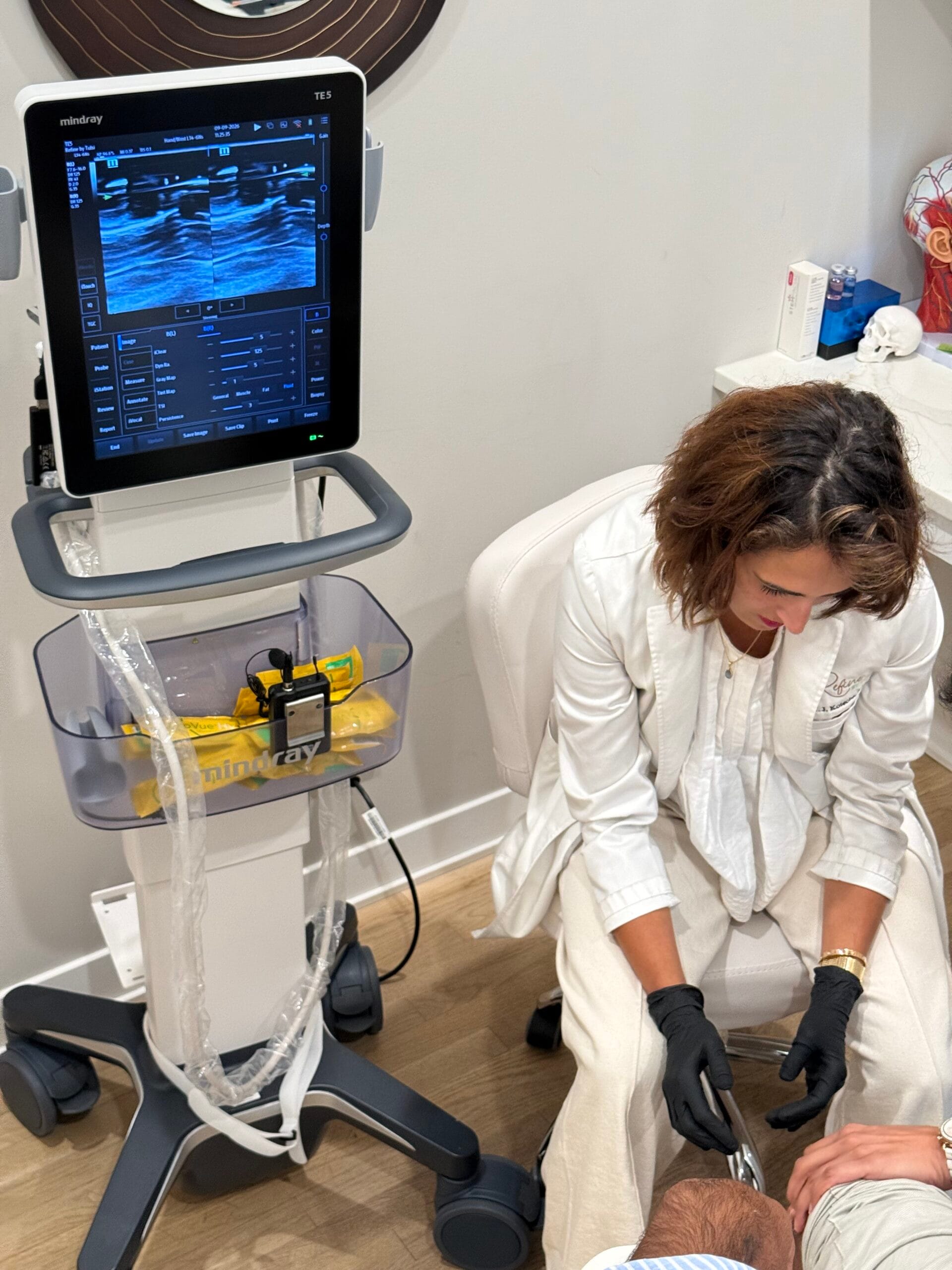
What are PRP joint injections?
PRP joint injections use platelet-rich plasma — concentrated platelets and growth factors from a small sample of your own blood — injected into a painful joint to reduce inflammation and support its natural environment. A next-generation version, PRF (platelet-rich fibrin), releases those growth factors more slowly. Both are prepared the same day and placed under ultrasound guidance, most often for joint pain and mild-to-moderate osteoarthritis. At Refine by Tulsi in Chicago they're physician-led and fully autologous — your own blood. Important: no PRP or PRF product is FDA-approved for joint or orthopedic conditions, these injections don't regrow a worn-out joint or cure arthritis, and results vary — so we're candid about who is and isn't a good candidate.
The gap between a cortisone shot and a new joint
Most joint pain gets treated at two extremes: manage it with rest, anti-inflammatories and cortisone — or, eventually, replace the joint. Cortisone can calm a flare, but repeated use may actually be hard on cartilage over time, and surgery is a big step you can't undo.
Regenerative injections live in the middle — an option for the right patient, using your body's own biology.
Instead of a synthetic drug, PRP delivers your own platelets and growth factors into the joint to quiet inflammation and support a healthier environment. For many people with earlier-stage arthritis, that can mean meaningful pain relief and better function — not a cure, and not right for everyone, but a considered step before the operating room.
Rest, physical therapy, anti-inflammatories, cortisone — helpful, but often temporary.
Your own platelet-rich plasma to calm inflammation and support the joint — for the right candidate.
Joint replacement or repair — effective, but invasive, with real recovery and irreversibility.
PRP and PRF — both from your own blood
Everything we inject is autologous: drawn from you, concentrated the same day, and returned to you. The only choice is which form of platelet concentrate best fits your joint.
PRP
A small blood draw is spun to concentrate your platelets, then injected into the joint. Those platelets release a burst of your own growth factors that calm inflammation and signal the joint to repair — the most-studied orthobiologic for knee osteoarthritis.
- From a simple blood draw, prepared same-day
- Concentrated platelets and growth factors
- The strongest evidence base in the field
PRF
PRF is a newer platelet concentrate spun more gently and without additives, so it forms a natural fibrin scaffold. That scaffold releases your growth factors more slowly and steadily — supporting the joint over days rather than minutes.
- No additives — a fully natural preparation
- A fibrin matrix for slower, sustained release
- Chosen when a longer growth-factor release is the goal
Both are fully autologous — your own blood, drawn and returned the same day. Your physician recommends PRP or PRF based on your joint and goals.
What the evidence — and the FDA — actually say
Regenerative medicine is full of overpromises. Here's the honest picture, because you deserve it before you decide.
PRP for the knee
For mild-to-moderate knee osteoarthritis, high-quality analyses show PRP outperforms hyaluronic acid and cortisone for pain and function over 6–12 months. This is the strongest evidence in the orthobiologic field.
Other joints & tendons
Shoulders, hips and chronic tendon problems may also respond to PRP, but the evidence is thinner than for the knee, so we set expectations case by case.
The regulatory reality
No PRP or PRF product is FDA-approved for joint or orthopedic conditions. We perform these as autologous, same-day procedures within the FDA's minimal-manipulation framework — never as an approved cure.
What it won't do
PRP doesn't regrow a worn-out joint, reverse advanced arthritis, or guarantee you'll avoid surgery. Be cautious of anyone who promises otherwise. Results vary, and some people don't respond.
Our promise is simple: we'll tell you what's realistic for your joint, offer this only when it makes sense, and never sell you a miracle.
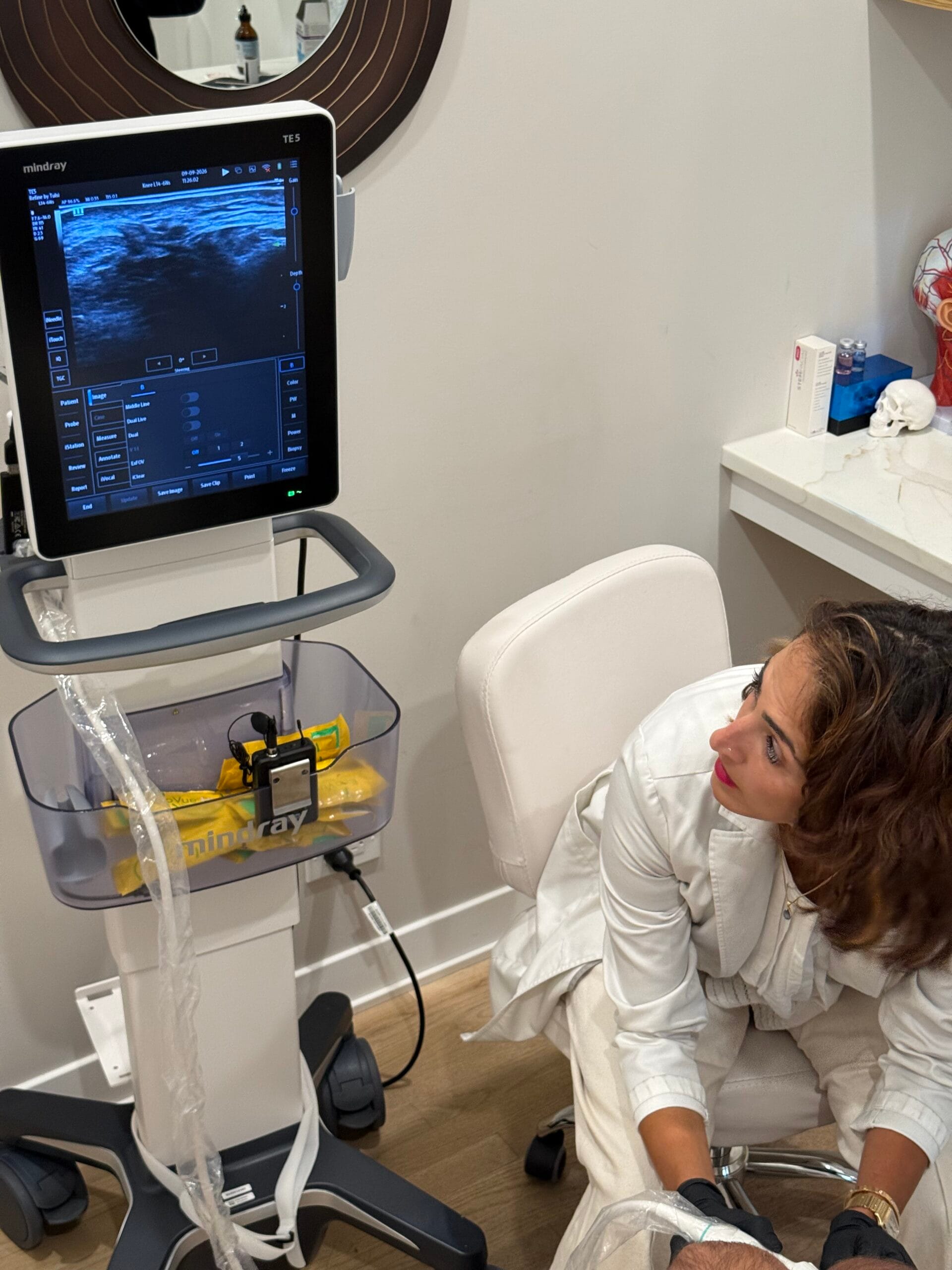
Guided by ultrasound, not guesswork
An injection only helps if it reaches the right target. We use real-time ultrasound to guide the needle into the joint or tissue precisely — improving accuracy, comfort and consistency compared with landmark-only technique.
It's the same imaging discipline behind our ultrasound-guided injectables — applied here to make sure your own biology is delivered exactly where it's meant to go.
An honest look at candidacy
You may be a good candidate if you…
- Have mild-to-moderate joint arthritis or a chronic tendon issue
- Have pain that limits you despite rest, therapy or anti-inflammatories
- Want to explore options before, or instead of, repeated cortisone
- Aren't ready for surgery, or want to consider a step before it
- Have realistic expectations about what the evidence supports
It may not be right if you…
- Have advanced, bone-on-bone arthritis that likely needs surgical care
- Have an active joint infection or certain bleeding conditions
- Have an active or recent cancer without specialist clearance
- Are pregnant, or on blood thinners your physician can't safely manage
- Expect a guaranteed cure or a certain way to avoid surgery
A consultation, exam and a look at your imaging are the only way to know. Your physician will give you an honest read — including when PRP is not the right call.
A same-day, in-office procedure
Evaluation
A physician examines the joint, reviews your imaging and history, and confirms whether you're a candidate.
Blood draw
We draw a small sample of your blood — a quick, routine step, much like any lab draw.
Concentration
Your blood is spun to concentrate the platelets on-site, the same day — minimally processed, never cultured or sent out.
Guided injection
The PRP is placed into the joint under ultrasound guidance for precise delivery, then you're on your way; benefits, if they come, build over weeks.
Physician-led PRP care

Dr. Tulsi Kotecha, MD
Board-certified in Internal Medicine and Aesthetic Medicine and trained at University College London and the University of Bristol, Dr. Kotecha built Refine around regenerative and longevity medicine — practiced honestly. With PRP joint injections, that means your own blood only, ultrasound-guided placement, evidence-based candidacy, and a straight answer about what PRP can and can't do for your joint.
More about Dr. KotechaYour questions, answered honestly
What are PRP joint injections?
PRP (platelet-rich plasma) joint injections use a small sample of your own blood, spun to concentrate the platelets, which is then injected into a painful joint. Those platelets release your own growth factors to calm inflammation and support the joint's natural environment. A related form, PRF (platelet-rich fibrin), releases them more slowly. Both are prepared the same day, placed under ultrasound guidance, and used most often for mild-to-moderate osteoarthritis.
What's the difference between PRP and PRF?
Both are concentrated from your own blood. PRP is spun to deliver a burst of platelets and growth factors. PRF is a newer version spun more gently and without additives, so it forms a natural fibrin scaffold that releases those growth factors more slowly and steadily over days. Your physician recommends one or the other based on your joint and your goals — the biology is the same, the release profile differs.
How is this different from a cortisone shot?
Cortisone is a synthetic anti-inflammatory that can quiet a flare quickly but tends to wear off, and repeated use may be hard on cartilage over time. PRP instead uses your own platelets and growth factors to support the joint environment. Relief tends to build over weeks rather than days, and the aim is a more durable improvement in the right candidate, though results vary and aren't guaranteed.
Are PRP injections FDA-approved?
No. No PRP or PRF product is FDA-approved for joint or orthopedic conditions. Because the material is your own blood, prepared the same day and minimally processed, these are performed as autologous procedures within the FDA's minimal-manipulation and homologous-use framework — but that is not the same as FDA approval. We're upfront about that distinction.
Will PRP regrow cartilage or cure my arthritis?
No, and anyone who promises that isn't being straight with you. PRP doesn't regrow a worn-out joint, reverse advanced arthritis, or guarantee you'll avoid surgery. What the evidence supports is reduced pain and improved function for many people with earlier-stage joint problems, especially in the knee. We set honest expectations before we ever treat.
What does the evidence actually show?
The strongest evidence is for PRP in mild-to-moderate knee osteoarthritis, where recent high-quality analyses show better pain and function than hyaluronic acid or cortisone over 6 to 12 months, particularly with higher-concentration preparations. Other joints and chronic tendon problems may also respond, with thinner data. It's a well-supported option for the right patient — not a cure.
Is it safe, and what are the risks?
Because PRP uses your own blood, the risk of rejection or reaction is very low, and it has a strong safety record. Still, no injection is risk-free: possible effects include a temporary pain flare, swelling or bruising, and — uncommonly — infection or nerve irritation. A physician reviews your history, and ultrasound guidance is used to place the injection precisely.
What is recovery like, and how many treatments will I need?
It's a quick in-office procedure, and most people return to light activity soon after, sometimes with a day or two of soreness or a mild flare. Any benefit typically builds over several weeks. Evidence suggests a short series of injections often works better than a single one, so your physician recommends a plan based on your joint, your goals and how you respond.
Who is not a good candidate?
PRP is generally not the answer for advanced, bone-on-bone arthritis, which usually needs surgical evaluation. It may also be inappropriate if you have an active joint infection, certain bleeding conditions, an active or recent cancer without specialist clearance, or if you're pregnant. If it isn't right for you, we'll say so and help you find the care that is.
Aching joints? Start with an honest evaluation.
Book a consultation in Chicago to find out whether PRP joint injections make sense for you — with a physician who'll examine your joint, review your imaging, and give you a straight answer either way.
(618) 298-8574Chicago, IL 60614
Chicago, IL 60647
Medical disclaimer: This page is general educational information, not medical advice or a guarantee of outcome. PRP and PRF (platelet-rich plasma and platelet-rich fibrin) joint injections are not FDA-approved to treat, cure or prevent osteoarthritis or any orthopedic condition; no PRP or PRF product is FDA-approved for these uses. At Refine by Tulsi these are performed only as autologous, same-day, minimally manipulated procedures — prepared from your own blood — consistent with the FDA's framework for human cells and tissues. PRP does not regrow cartilage, reverse advanced arthritis, or guarantee avoidance of surgery; benefits are not guaranteed and results vary. All treatments require a medical evaluation and are provided only where clinically appropriate, and they are not a substitute for orthopedic or emergency care. Please consult a qualified physician about your individual condition.