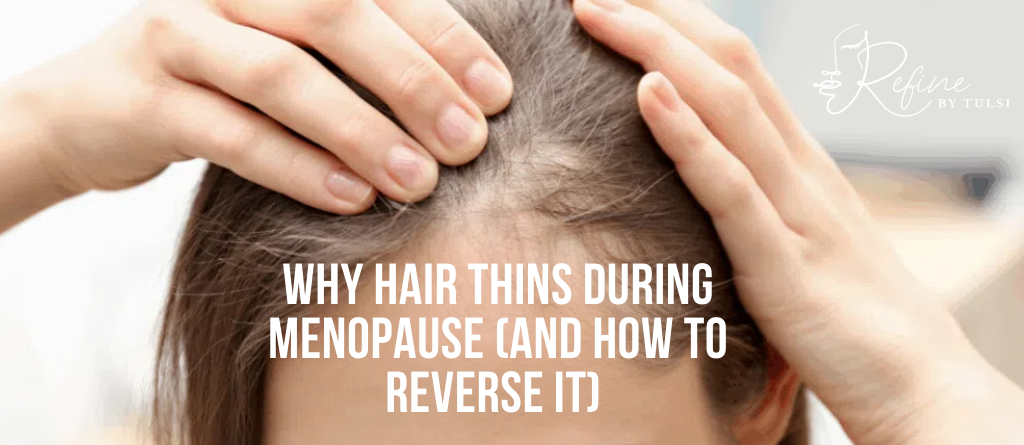
For many women, hair loss is one of the most distressing and unexpected symptoms of menopause. You may notice your ponytail feels thinner, your part looks wider, or you’re shedding more than usual in the shower – all while being told your labs are “normal” or that it’s just aging.
At Refine by Tulsi, we know better. Menopausal hair loss is real, common, and treatable when you address the root causes instead of masking the problem.
Why Hair Loss Happens During Menopause
Hair growth is deeply connected to hormones, metabolism, inflammation, and cellular energy. During menopause, several of these systems shift at once.
1. Estrogen Decline Shortens the Hair Growth Cycle
Estrogen plays a protective role in hair health by:
- Prolonging the anagen (growth) phase
- Supporting scalp blood flow
- Maintaining follicle size and strength
As estrogen declines:
- The growth phase shortens
- More hairs enter the telogen (shedding) phase
- Hair becomes finer, drier, and more fragile
This leads to diffuse thinning rather than patchy bald spots.
2. Relative Androgen Dominance
Even if testosterone levels don’t rise, lower estrogen can make androgens more dominant at the hair follicle level.
This can cause:
- Miniaturization of hair follicles
- Thinner, shorter hairs
- Widening of the part
- Recession at the temples in some women
This process is often referred to as female pattern hair loss, and menopause is a major trigger.
3. Increased Inflammation and Stress Hormones
Menopause is frequently accompanied by:
- Higher cortisol (stress hormone)
- Poor sleep
- Increased systemic inflammation
Inflammation disrupts the hair follicle environment, while cortisol pushes hairs prematurely into the shedding phase.
Hair loss often worsens during periods of emotional stress, burnout, or illness.
4. Thyroid and Metabolic Changes
Thyroid dysfunction becomes more common with age and hormonal transitions. Even subclinical changes can impact hair growth.
Additionally, insulin resistance and nutrient absorption issues may develop during menopause — both of which affect follicle health.
5. Nutrient Depletion and Mitochondrial Decline
Hair follicles are highly metabolically active. When cellular energy production declines, hair growth suffers.
Low levels of:
- Iron
- B vitamins
- Protein
- Cellular energy (ATP)
…can all contribute to thinning hair, even when labs are technically “within range.”
How We Treat Menopausal Hair Loss at Refine by Tulsi
Hair restoration works best when it’s multimodal and personalized. There is no single magic treatment – but the right combination can be transformative.
1. Hormone Optimization: Addressing the Root Cause
Balanced hormones are foundational for hair regrowth.
Our physician-led hormone optimization focuses on:
- Estrogen balance (not excess)
- Progesterone support
- Testosterone optimization (when appropriate)
- Thyroid and cortisol regulation
When hormonal signaling improves, hair follicles are more likely to re-enter the growth phase.
2. Regenerative Therapies: PRP, PRF & Exosomes
Regenerative treatments work directly at the scalp level to stimulate dormant follicles and improve blood supply.
These treatments act directly at the follicle to wake dormant hairs and improve blood flow.
- PRP / PRF: Uses your body’s growth factors to stimulate follicles and extend anagen
- PRF: Slower, sustained release—often preferred for hair
- Exosomes: Potent regenerative signals that can improve thickness and density, especially when layered with PRP/PRF
3) RF Microneedling for the Scalp: Collagen + Circulation
Hair follicles sit in a collagen-rich environment. When scalp collagen degrades, follicles lose support.
RF microneedling on the scalp:
- Stimulates collagen remodeling around follicles
- Improves scalp circulation
- Enhances absorption and response to PRP/PRF, peptides, and topicals
This is especially helpful when thinning is accompanied by a tight, fibrotic, or low-quality scalp.
4) Peptide Therapy: Restoring Follicle Communication
Peptides act like biological text messages, restoring signaling pathways needed for growth and repair. Physician guidance matters—selection and dosing are individualized.
GHK-Cu (Copper Peptide): The Hair + Scalp Quality Peptide
GHK-Cu is one of the most studied peptides for skin and hair health. In hair restoration, it may:
- Support collagen production in the scalp
- Improve follicle environment and vascular support
- Reduce inflammatory signaling around follicles
It’s particularly valuable when scalp quality is compromised or when pairing with RF microneedling and PRP/PRF.
5) Evidence-Based Topicals: Minoxidil (When Appropriate)
Minoxidil remains one of the most evidence-backed treatments for female pattern hair loss.
- Increases blood flow to follicles
- Prolongs the growth phase
- Helps stabilize shedding and support regrowth
At Refine by Tulsi, we guide formulation, strength, and timing, and often use minoxidil as a supportive layer—not the only solution—alongside regenerative and hormonal care.
How These Treatments Work Together
| Hair Loss Driver | Targeted Support |
|---|---|
| Estrogen decline | Hormone optimization |
| Androgen sensitivity | Hormone balance + scalp therapies |
| Inflammation | GHK-Cu, BPC-157, PRP/PRF |
| Poor scalp quality | RF microneedling + GHK-Cu |
| Follicle dormancy | PRP / PRF / Exosomes |
| Low cellular energy | SS-31, NAD support |
| Pattern thinning | Minoxidil (guided use) |
Who Is a Good Candidate?
You may benefit if you:
- Notice diffuse thinning or increased shedding during perimenopause/menopause
- Have a widening part or reduced ponytail volume
- Experience stress-related or inflammatory flares of hair loss
- Want a medical, non-surgical, root-cause approach
Earlier intervention = better outcomes.
The Refine by Tulsi Difference
Hair restoration isn’t overnight – most patients need a series for best results, with visible improvement commonly developing over months. Our treatment planning reflects that reality, so you’re never left guessing. We offer a structured program that intentionally layers regenerative treatments over time—beginning with Sylfirm X RF Microneedling paired with Exosomes to stimulate the scalp, boost circulation, and support follicle regeneration, then alternating with PRF and repeat RF microneedling + exosomes sessions to build momentum.
Noticing Hair Thinning in Perimenopause or Menopause?
Menopausal hair loss is often driven by hormone shifts, inflammation, and reduced follicle support. At Refine by Tulsi, we build physician-led hair restoration plans using hormone optimization, PRP/PRF and exosomes, RF microneedling for scalp collagen, peptides like GHK-Cu, and guided minoxidil to help restore density and confidence.
Book Your Hair Restoration ConsultationPhysician-led • Regenerative scalp treatments • Personalized plans