If you’re asking this question, you’re probably not imagining things.
Perimenopause is not a single moment. It’s a transition – often subtle at first, often dismissed, and for many women, it begins far earlier than expected. I see patients in their mid-30s, early 40s, sometimes younger, who feel off in ways they can’t quite explain. They’re told it’s stress. Or aging. Or anxiety. Or “just life.”
It’s often none of those things.
Perimenopause is real. And it deserves a clearer conversation.
What Is Perimenopause, Really?
Perimenopause is the hormonal transition that leads up to menopause. It can last several years, during which ovarian hormone production becomes unpredictable—not absent, just erratic.
That unpredictability is what makes symptoms confusing.
You may still have regular periods.
Your labs may look “normal.”
And yet, your body no longer feels like your own.
That is perimenopause.
When Does Perimenopause Start?
For many women, perimenopause begins in the late 30s to early 40s, though symptoms can appear earlier.
This surprises people because we’re taught that menopause happens around 50—so anything before that must be unrelated. In reality, hormone shifts start long before periods stop.
Menopause is an event.
Perimenopause is a process.
Common Signs of Perimenopause (That Often Go Unrecognized)
Not every woman experiences hot flashes early. In fact, many don’t. The earliest symptoms are often quieter—and easier to dismiss.
You might notice:
- Shorter or longer menstrual cycles
- Heavier or lighter periods
- Worsening PMS or new mood changes
- Anxiety you never had before
- Sleep disruption (especially early morning waking)
- Brain fog or difficulty concentrating
- Fatigue despite adequate rest
- Weight gain that feels resistant to diet and exercise
- Changes in skin texture, elasticity, or breakouts
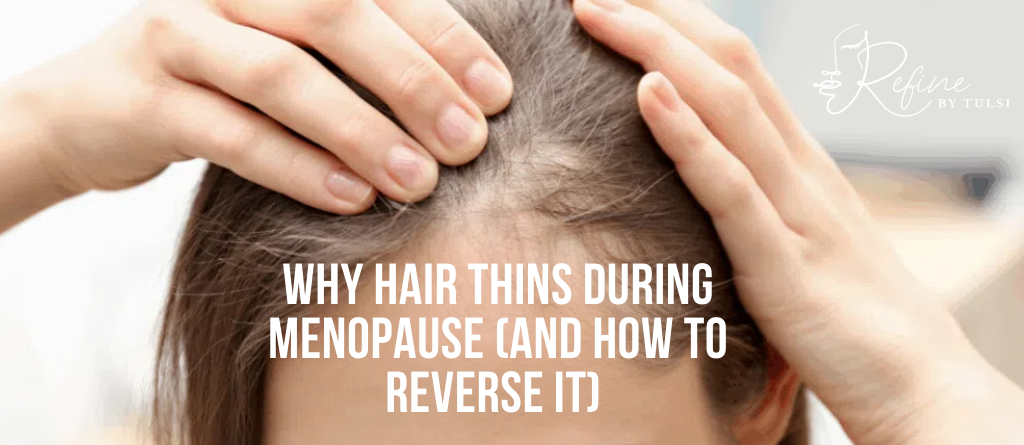
- Hair shedding or thinning
- Lower libido or changes in sexual response
Many women tell me: “I don’t feel like myself anymore.”
That sentence matters.
Why Blood Tests Alone Often Miss Perimenopause
One of the most frustrating parts of perimenopause is being told, “Your labs are normal.”
Hormones fluctuate day to day—sometimes hour to hour—during this transition. A single blood test may capture a moment that looks perfectly fine, even when symptoms are very real.
Perimenopause is a clinical diagnosis, not just a lab result.
Listening to symptoms, tracking cycles, understanding patterns, and evaluating the whole picture matters far more than any one number.
The Skin–Hormone Connection (Why Your Face Changes First)
Estrogen plays a major role in:
- Collagen production
- Skin thickness
- Hydration
- Elasticity
As estrogen becomes erratic, many women notice:
- Thinner skin
- Increased fine lines
- Loss of firmness
- Changes in facial volume distribution
This isn’t vanity—it’s biology.
That’s why aesthetic changes often show up before menopause is even discussed.
Weight Gain, Metabolism, and Perimenopause
Perimenopausal weight gain is not a willpower issue.
Hormonal shifts affect:
- Insulin sensitivity
- Fat storage patterns
- Muscle mass
- Energy expenditure
This is why “doing everything right” can suddenly stop working—and why extreme dieting often backfires, accelerating muscle loss and skin laxity.
A smarter approach focuses on metabolic health, muscle preservation, and hormonal support, not punishment.
A Thoughtful Approach to Treatment (Not One-Size-Fits-All)
There is no single solution for perimenopause—and there shouldn’t be.
Depending on your symptoms and goals, care may include:
- Hormonal evaluation and support
- Lifestyle and sleep optimization
- Stress modulation
- Targeted supplementation
- Growth Factor Based Hair Restoration
- Peptides to support skin, recovery, or metabolic health
- Aesthetic treatments that focus on collagen and skin quality rather than overcorrection
The goal is not to “reverse aging.”
It’s to restore balance.
Refine Her: Our Women’s Wellness Program
Refine Her is our physician-led women’s health and longevity program designed for women navigating perimenopause and midlife transitions. Rather than treating symptoms in isolation, Refine Her takes a whole-body approach—looking at hormones, metabolism, sleep, stress, skin quality, and long-term health together.
Every plan begins with a thoughtful consultation focused on how you feel, not just what your labs show. From there, care may include hormone optimization when appropriate, lifestyle and metabolic support, targeted supplementation, peptide therapy, and aesthetic strategies that prioritize collagen and skin quality over overcorrection.
Refine Her is not about chasing youth or trends. It’s about restoring balance, supporting your body through change, and helping you feel like yourself again—calm, clear, and resilient.
Think You Might Be in Perimenopause?
Refine Her is our physician-led women’s hormone and longevity program designed to support sleep, mood, metabolism, energy, and skin quality—without guesswork. Book a consult to review your symptoms, goals, and a personalized plan.
A Note on Aesthetics During Perimenopause
This stage of life often requires a shift in aesthetic strategy.
Treatments that worked in your 20s may no longer be appropriate. Instead of chasing volume or aggressive correction, we focus on:
- Collagen stimulation
- Skin quality
- Subtle facial support
- Preserving natural expression
Less is often more—when done intentionally.
If You’re Wondering, You’re Probably Not Wrong
Perimenopause is under-discussed, under-diagnosed, and frequently minimized. But your experience is valid.
If your body feels different, if your skin and energy have changed, if your mood or sleep is no longer predictable—it’s worth exploring why, not just pushing through.
This phase of life isn’t something to endure quietly. With the right guidance, it can be navigated thoughtfully, proactively, and with compassion.