
Subcision for
Acne Scars in Chicago
The only treatment that cuts the anchor.
Rolling scars are pulled down from beneath by fibrous bands. No laser reaches them. Subcision releases those bands from under the skin — and Dr. Tulsi Kotecha, MD performs every one personally.

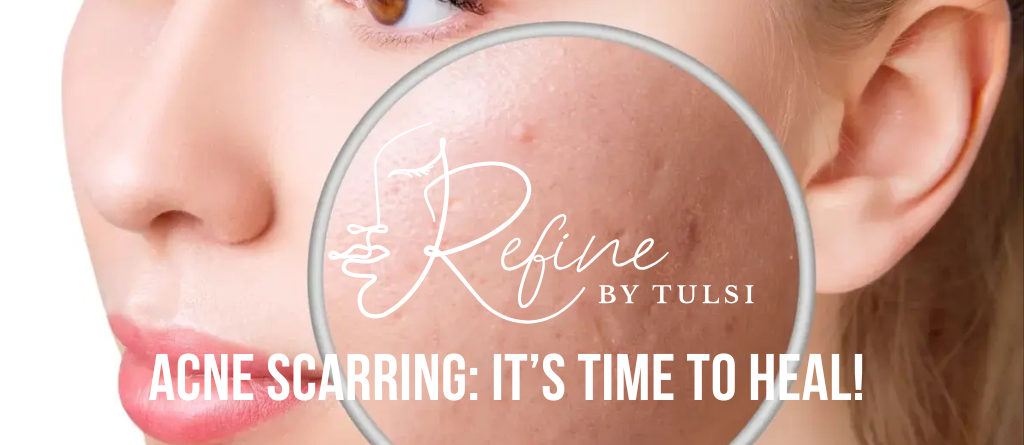
What is subcision?
During acne healing, bands of fibrous collagen form between the skin's surface and the tissue underneath. They act like guy-ropes on a tent, anchoring the skin downward. The result is a rolling scar — a wide, shallow, wave-like depression.
You can resurface a rolling scar flawlessly and it will still look depressed — because the surface was never the problem.
This is why patients arrive frustrated after several rounds of microneedling or laser. Those treatments do exactly what they claim. They simply cannot reach an anchor.
Subcision is a minor in-office procedure that goes beneath the scar and severs those bands, letting the depressed skin lift and float back to level. It is the only treatment on our acne scar menu that addresses the tether itself.
See what subcision actually does
Toggle between the two states. This is the entire argument for the procedure, in one control.
Illustrative cross-section, not to clinical scale. Band depth, number, and distribution vary considerably between patients.
Is subcision right for your scars?
Subcision treats one thing extremely well and several things not at all. Here is the honest sorting.
Rolling scars
Wide, shallow, wave-like depressions that shift when you stretch the skin. Tethered from beneath. This is precisely what subcision was designed for.
Tethered depressed scars
Any atrophic scar bound down by fibrous adhesion — including some broad boxcar scars — may lift once the anchor is released, then be resurfaced later.
Ice-pick scars
Narrow, deep punctures with no tether to cut. These need CO₂ resurfacing or punch excision, not subcision.
Pigmentation & redness
Post-inflammatory hyperpigmentation and erythema are colour, not texture. The skin surface is intact. These respond to Aerolase and peels.
Raised & keloid scars
Hypertrophic and keloid scars come from collagen overproduction. The controlled injury of subcision can worsen them. Assessment first, always.
Active acne
Breakouts must be well controlled before scar revision. Treating scars during active acne creates new scarring and complicates healing.
Needle or cannula?
Two instruments, two different jobs. Dr. Kotecha selects based on how your scars are distributed and how deep the tethering runs — not on preference.
Needle subcision
A hypodermic needle inserted beneath the scar and moved in a controlled fanning motion to sever individual bands.
- Precise; well suited to isolated, discrete scars
- Excellent control at a specific depth
- Somewhat more bruising than a cannula
Cannula subcision
A blunt-tipped instrument that separates tissue planes rather than cutting through them, sweeping across a wider field.
- Treats broader areas in a single entry point
- Blunt tip reduces risk to blood vessels
- Generally less bruising than needle technique
Released bands can re-adhere
This is the central challenge of subcision, and where most of the outcome is won or lost. Having cut the tethers, the tissue can simply reattach as it heals — and the scar returns. Something must occupy the space while new collagen forms.
PRF — Platelet-Rich Fibrin
Drawn from your own blood and injected into the released pocket immediately after subcision. Acts as a spacer and delivers growth factors into the healing environment.
- No foreign material — it comes from you
- Adds growth factors to support collagen formation
- Resorbs over time; may need repeating
- Requires a blood draw and spin at the visit
Collagen Biostimulators
The FDA-approved collagen biostimulators (Sculptra or Radiesse) are placed into the released space to hold the lift and stimulate collagen around the microspheres.
- Supports collagen remodeling after subcision
- Helps prevent scar re-tethering
- Improves skin texture and acne scar depth
- Priced per syringe/vial, separate from subcision
Which is placed — or whether either is — is a clinical decision made at your consultation, based on scar depth, skin thickness and budget
Your subcision recovery, day by day
Bruising is the single reason patients hesitate — so we're not going to bury it. Click through the stages and plan around them.
Subcision quick facts
Cost depends on the number of scars treated and the area covered. PRF and Bellafill® are priced separately. Membership plans and financing are available.
Book Now FinancingSubcision risks & side effects
Subcision is a minor surgical procedure, not a facial. Performed by a physician on the right candidate it is safe and well tolerated — but every patient should understand the following before consenting.
- Bruising and swelling — expected, not a complication. This is the most visible downtime of any acne scar treatment we offer
- Temporary lumpiness or firmness as the tissue heals
- Post-inflammatory hyperpigmentation, particularly in deeper skin tones
- Under-correction — some scars need more than one session
- Re-adhesion of released bands, which is why PRF or filler is placed
- Uncommon: infection, bleeding, or nodule formation
- Not appropriate with active acne, active infection, keloid tendency, certain bleeding disorders, or anticoagulant therapy
Scarring is improved, not erased. Substantial smoothing is realistic. Perfection is not — and anyone promising it is selling something.
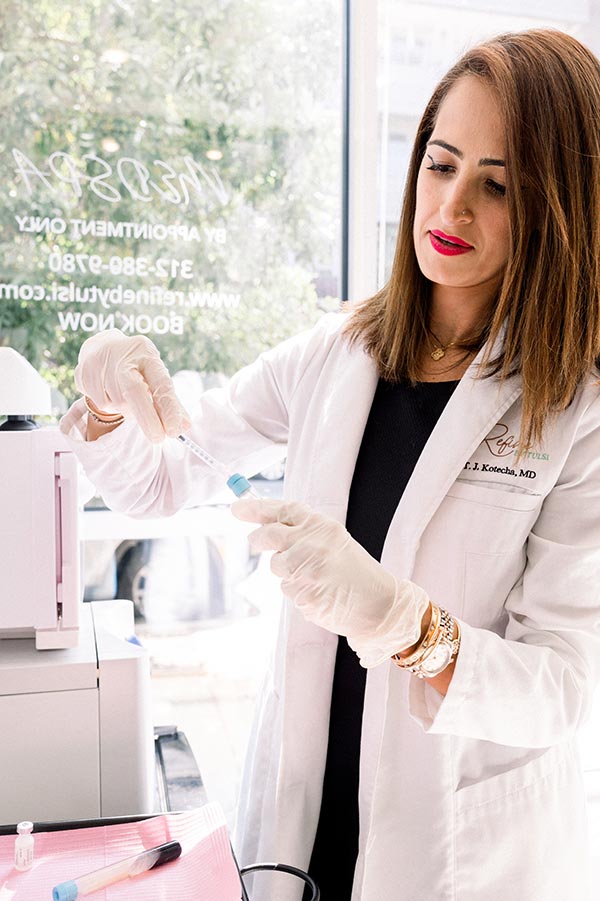
Subcision performed by Dr. Kotecha
Subcision is a procedure performed beneath the skin with an instrument you cannot see. Technique, depth, and instrument selection determine both the result and the risk — which is why it is not delegated at Refine.
Dr. Kotecha is board-certified in Internal Medicine and Aesthetic Medicine, trained at University College London and the University of Bristol. She has invested specifically in approaches that are safe across all skin types, including deeper skin tones — a population too often underserved in scar treatment.
More about Dr. KotechaWhat patients say
She explained exactly what to expect.
I knew about the bruising going in, so it wasn't a shock. Two weeks later it had settled and I could already see the difference in how the light hit my cheeks.
The fact that Dr. Kotecha is an MD gave me full confidence.
She combines medical expertise with a compassionate approach to care. My results are exactly what I wanted — subtle and natural.
My recovery has been smooth.
Dr. Tulsi is friendly, knowledgeable, and skilled. She told me honestly what one session could and couldn't do.
Subcision FAQ
The area is numbed with topical and/or local anesthesia beforehand, so most patients report a sensation of pressure and movement rather than sharp pain. You'll feel the instrument working beneath the skin, which is an unusual sensation but not a painful one. Afterward the treated area feels tender and tight for several days, comparable to a bruise, and is managed with cold compresses and paracetamol.
Typically seven to fourteen days. This is the most visible downtime of any acne scar treatment we offer, and we would rather you plan around it than be surprised by it. Most patients schedule subcision with two clear weeks before any significant event. Bruising is expected — it is a sign the bands were released, not a sign something went wrong.
Because released fibrous bands can re-adhere as the tissue heals, which brings the scar back. Placing PRF or Bellafill® into the released space acts as both a spacer and a healing stimulus, keeping the tissue planes separated while new collagen forms. It substantially improves how durable the result is, and it is the step that most distinguishes a good subcision from a disappointing one.
Typically one to three, spaced four to six weeks apart, depending on scar severity and how your skin responds. Results build progressively over eight to twelve weeks as new collagen forms in the released space. We reassess between sessions rather than committing you to a package up front.
Ice-pick scars, no — they are narrow, deep punctures with no tether to cut, and need CO₂ resurfacing or punch excision. Some broad boxcar scars are partially tethered and may lift, but their sharp edges still require resurfacing afterward. Subcision is precisely, specifically for rolling and tethered scars. Using it on the wrong scar type is a waste of your money and your downtime.
Yes, and it usually should be. Subcision releases tethered scars from beneath; laser resurfaces texture from above. They solve different problems and neither substitutes for the other. Resurfacing typically follows subcision by around six weeks, once the initial healing has settled and the released tissue has begun to stabilise.
Yes, and it has an advantage over ablative lasers here: subcision does not rely on heat or light, so it avoids the primary mechanism by which lasers cause pigmentation problems in deeper skin. Post-inflammatory hyperpigmentation is still possible from the inflammation of healing, so conservative technique, careful aftercare, and strict sun protection matter. Dr. Kotecha treats all Fitzpatrick skin types.
Patients with active acne, active skin infection, a keloid tendency, certain bleeding disorders, or those taking anticoagulant therapy. Active acne in particular should be well controlled before any scar revision begins. Hypertrophic and keloid scars can be worsened by the controlled injury of subcision, so raised scars require assessment before anything is planned.
Pricing starts from $650 per session and depends on how many scars are treated and how large an area is covered. PRF and Bellafill® are priced separately, since not every patient has one placed. Full pricing is reviewed transparently at your consultation before you commit to anything, and financing is available.
Let's find out if you're tethered.
Book a consultation with Dr. Kotecha. She'll examine your skin under angled light, tell you honestly whether subcision is the right tool, and what a realistic result looks like.
(618) 298-8574Medical disclaimer: This page is for general educational purposes and is not medical advice, diagnosis, or treatment. Subcision is a minor surgical procedure performed only after an in-person medical evaluation, and is not appropriate for everyone. Downtime, session counts, and pricing shown are typical ranges and vary by individual. Acne scarring is improved rather than eliminated. Before and after images depict individual patients who provided written consent; individual results vary. Please consult a qualified physician before beginning any treatment.